How to Write a Wedding Band Contract
What a musician's contract should include, how to structure it, and how to get it signed digitally. A practical guide to protecting both you and your client.
March 21, 2026 · BandCalendar

Why a contract is non-negotiable
Playing a wedding without a contract is a risk many musicians still take. Without a signed document, every verbal agreement becomes a he said, she said situation: the agreed fee, the performance times, the included services.
A professional contract protects you on multiple fronts:
- Secures the fee and payment terms (deposit + balance)
- Defines the start time, total duration, and number of sets
- Establishes cancellation penalties for last-minute cancellations
- Protects both parties in the event of a dispute
The mistakes that cost you money
Before looking at what to put in the contract, it's worth understanding what goes wrong when there isn't one — or when it's poorly written.
No written contract. The most common case. A verbal agreement is nearly impossible to enforce: without written proof, every dispute ends in a compromise, or a lawsuit that isn't worth pursuing.
No deposit. The band blocks the date for months. The client cancels two weeks out. Without a non-refundable deposit clause, the band earns nothing — and has probably already turned down other bookings for that evening.
Missing or vague cancellation clause. Phrases like "we'll figure it out together if anything comes up" are worthless. Penalties must be specific percentages tied to clearly defined time windows.
Logistics not in writing. Who brings the PA? Do the musicians eat at the dinner? Is there parking? Seemingly trivial details that turn into arguments on the night if they're not written down.
Vague performance time. The client who asks for "just one more set, another half hour," convinced it's included in the price. If the contract doesn't specify exact duration and structure, that position is hard to defend.
Just an invoice, no contract. Many bands send a quote or a simple payment request: they state the price, the date, the bank account for the deposit. But an invoice is not a contract. It contains no cancellation clauses, no penalties, and no binding obligations for either party. A client who changes their mind can simply not pay the deposit — with no written recourse for either party.
Deposit requested before a signed contract. Sending a payment link before the contract is signed is a mistake that cuts both ways: the musician has no written protection if the client disappears after paying only part of the deposit, and the client has no protection if the band doesn't show up. There's only one correct order: sign the contract first, then pay the deposit. Never the other way around.
The date isn't booked until there's a signature
This is a point few people grasp until they're caught in the middle of it.
A band that verbally accepts a wedding is effectively giving up every other possible booking on that date: another evening gig, a corporate event, another wedding. Blocking a date is a real financial commitment for musicians — one that, without a signed contract, is binding on no one.
These situations are common: bands confirming for months by email, answering questions, discussing the setlist — and then, a few weeks before the ceremony, letting the client know that the date is "no longer available." The client is left scrambling to find a band at the last minute. All of this, simply because nothing was ever signed.
The practical rule is simple: until the contract is signed, the date doesn't exist. Any other assurance — confirmation email, WhatsApp message, phone agreement — carries no legal weight.
What a musician's contract must include
A well-structured contract for a wedding event should include, at a minimum:
1. Party details
Full name (or company name) of the band or musician, and of the client. Address, tax identification number, or VAT number where applicable.
2. Service description
- Date and time of the event
- Venue (name and full address)
- Type of service (ceremony, cocktail hour, dinner, dancing)
- Total duration and set structure
- Band lineup: number of musicians and instruments
- Substitution clause: if a member is unable to perform, the band commits to providing a substitute of equivalent technical level who knows the repertoire, with timely notice to the client
3. Fee and payment terms
State the total fee, the deposit due at signing (typically 30–50%), and the balance deadline (usually 7–15 days before the event).
4. Cancellation clause
Define the penalties for late cancellation. A common example:
- More than 90 days out: deposit non-refundable
- 90 to 30 days out: 50% of the total fee
- Less than 30 days out: 100% of the total fee
Our guide to protecting your date with deposits and cancellation clauses explains how to structure these clauses to protect your income.
5. Logistics
Dressing room, meal for the musicians, PA system (whether provided by the band or required from the venue), parking.
6. Signatures
Date, location, and a legible signature from both parties.
Is a digital contract legally valid?
Yes — in most jurisdictions, a simple electronic signature (SES) carries the same legal weight as a handwritten one for private service contracts. The specifics vary by region:
European Union: The eIDAS Regulation (EU 910/2014) explicitly recognises electronic signatures for service contracts. A simple electronic signature — a digital confirmation of identity and consent — is sufficient for this type of agreement.
United States: The E-SIGN Act (2000, federal) and the UETA (Uniform Electronic Transactions Act, adopted by 49 states) give electronic signatures the same legal standing as handwritten ones. Both laws apply to service contracts like a wedding band agreement.
Other countries: The UK (Electronic Communications Act 2000), Canada (PIPEDA and provincial laws), and Australia (Electronic Transactions Act 1999) all recognise electronic signatures for private contracts. In most of the world, if both parties consent and the record is preserved, a digital signature is valid.
It's the same system used every time you sign a contract with a utility provider, an internet service provider, or an insurance company: there's nothing experimental about it. It's been solid infrastructure for years.
No printing, signing by hand, or scanning required: the contract is created, sent, and signed in minutes — on both the musician's side and the client's.
With BandCalendar the workflow is immediate on both ends:
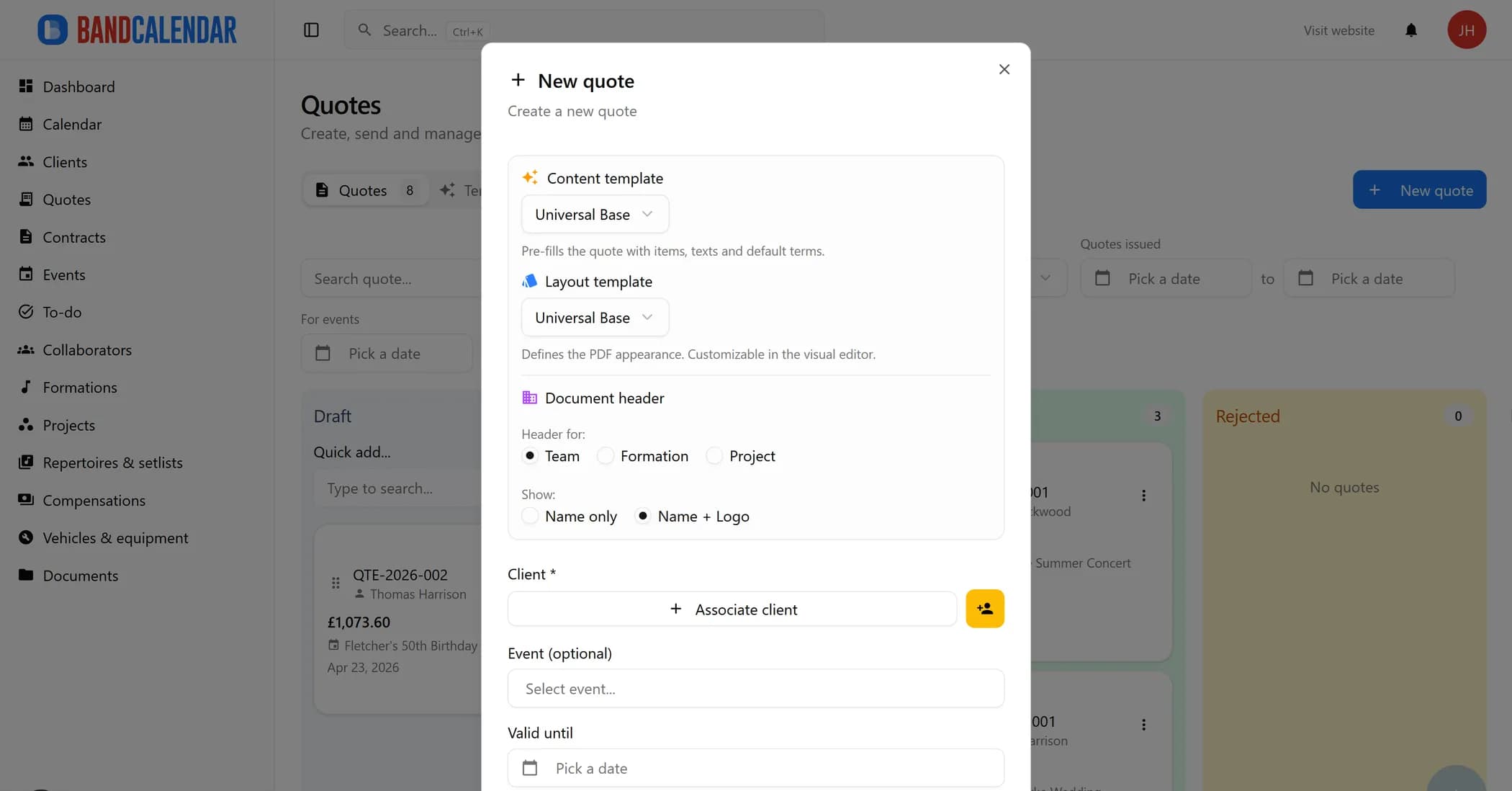
- You generate the contract from the event — client details, date, and venue are already filled in
- You send the link with one click — the client receives the email within seconds
- The client opens the document on any device, without installing anything, and signs with one click
- You receive an instant notification: the contract moves to "Signed" status and you can export it as a PDF at any time
No more "I'll send you the contract by the end of the week." No more waiting on a paper document by post. The date gets booked the only way that makes sense: with a signature, right now.
You can track status in real time — sent, viewed, signed — eliminating all "I never got the email" ambiguity.
How long does it take?
With a well-structured template, creating and sending a contract takes under 3 minutes. The client can sign from their smartphone at any time.
BandCalendar approaches this differently from most generic tools.
Separate templates for content and layout
BandCalendar has two independent levels of templates:
- Content templates — the contract text: clauses, general conditions, penalty structure. Edit it once, reuse it for years.
- Graphic layout templates — the visual appearance of the PDF: logo, colors, fonts, header, footer. You can have a different visual style for each project or client.
Content and design combine freely. Same text, two different layouts for two different bands. Same layout, different clauses for weddings and corporate shows.
Multiple templates for every situation
There is no one-size-fits-all contract. Each type of event has its own specifics:
- Weddings: ceremony + cocktail hour + dinner + dancing, with three payment milestones
- Public concerts: fee, expense reimbursement, hospitality, music licensing coverage
- Corporate events: potential NDA, B2B invoicing, withholding tax
- Private parties: simplified contract, single deposit
With BandCalendar you can create a dedicated template for each case and select it in seconds when creating a new contract.
Auto-fill with client data
When you create a contract from an event, BandCalendar automatically fills in the client name, address, event date, and venue. Zero copy-pasting, zero transcription errors. Review, customize if needed, and send.
After the signature: track everything in one place
The signed contract is just the beginning. BandCalendar keeps track of:
- Payments received and expected — deposit, balance, any partial payments
- Deadlines — automatic reminders as the balance due date approaches
- History — all contract versions and communications with the client
No more spreadsheets to figure out who has paid and who hasn't. Everything is linked to the event, the client, and the lineup.
The bottom line
A professional contract isn't bureaucracy: it's the document that lets you work with peace of mind, get paid on the agreed terms, and handle exceptions without conflict. Getting it right takes less time than you think — and with the right tools, it becomes a natural part of your workflow.
If you're ready to stop wasting time with Word documents, PDFs, and paper signatures, BandCalendar is built exactly for that.
Related BandCalendar workflows
Explore the connected features
Quotes and contracts
Create professional quotes and contracts for music services from separate content and layout templates, with rich text editing, preview-consistent PDFs, services and expense reimbursements, online quote acceptance, public links and click-to-accept simple electronic signature without a client account.
Open pageWedding bands
BandCalendar helps wedding bands and live musicians turn inquiries, quotes, contracts, repertoires, setlists, logistics and payments into one workflow that the whole team can use before, during and after the event.
Open pageDocuments and media
Organize PDFs, riders, contracts, quotes, images, audio, video, versions and public links in a cloud archive connected to clients, events, collaborators, lineups and projects, with contextual upload dialogs, PWA offline and controlled collaborator visibility on the event.
Open pageStop wasting time with Word, PDFs and spreadsheets.
- Separate templates for content and visual layout
- Auto-fill with client data
- Click-to-accept simple electronic signature from a smartphone
Get one useful guide a month