How to Write a Wedding Band Quote That Converts
What to include in a wedding band quote, how to structure it so it doesn't get ignored, and why presentation matters almost as much as the price — with real market data for 2026.
June 4, 2026 · BandCalendar
The quote is your first impression
When a couple contacts you about their wedding, the quote they receive is almost always the first official document they see from you. It arrives before the contract, before the handshake, before they hear you play live.
In that moment they decide two things: whether the price is acceptable, and whether you're the right band. The second decision depends almost entirely on how you built that document.
A poorly written quote — vague, bare, unstructured — communicates disorganisation. Even if the price is competitive, the client already has an impression that will be hard to reverse. A well-crafted quote, on the other hand, sells the service before the client has even read the total.
What the market actually looks like in 2026
Before discussing how to write a quote, it helps to know what couples are actually paying.
The wedding entertainment market varies enormously by region. Here's what the numbers look like across the major English-speaking markets:
United Kingdom
According to Bridebook's 2026 UK Wedding Report, couples spend an average of just under £2,000 on wedding music. The typical booking for a live wedding band sits at £1,880, with most couples spending between £1,200 and £2,500.
| Lineup | Typical 2026 Price Range |
|---|---|
| Soloist (ceremony/drinks) | £350 – £650 |
| Acoustic duo | £600 – £1,000 |
| 3-piece band | £850 – £1,500 |
| 4-piece band | £1,100 – £2,500 |
| 5-piece band | £1,300 – £3,000 |
| 6–10 piece (soul/Motown, horns) | £2,000 – £6,000 |
| 11–20 piece show band | £5,000 – £25,000 |
Most couples book a four- or five-piece band. Regional variation within the UK is modest — booking data shows roughly a £300 difference between the highest and lowest average regions.
Ireland
Professional 4–5 piece wedding bands in Ireland typically cost €2,400–€3,200 in 2026. The most common booking is a band + DJ package at €2,600–€3,500, covering the full evening from first dance through to late-night DJ sets. Dublin and nearby counties sit closest to the base rate; Galway, Kerry, Cork and other long-distance venues often add travel or accommodation costs.
United States
The US market is the most varied. The Knot's 2025 Real Weddings Study puts the national average for a live wedding band at approximately $4,000–$4,500, but the range is enormous:
| Region | Average Cost Range |
|---|---|
| Northeast | $4,500 – $12,000 |
| Southeast | $3,000 – $8,000 |
| Midwest | $2,500 – $7,500 |
| Southwest | $3,000 – $9,000 |
| West Coast | $4,000 – $15,000+ |
Band size is the primary cost driver: a trio starts at $1,800–$3,500, while a 7–9 piece band with horns runs $7,500–$17,000. Industry guidance suggests allocating 5–8% of the total wedding budget to live music.
Canada
In major markets like Toronto, professional wedding bands fall into three tiers: small ensembles at CAD $1,800–$3,500, established bands at $4,500–$8,000+, and luxury/show bands at $10,000–$15,000+. A 6–8 piece party band for a full reception typically starts around $5,000.
Australia
Australian couples spend an average of $2,000 AUD on wedding music overall, but live bands sit well above that average. A 4–5 piece band costs AUD $3,500–$6,000, a 6–8 piece with horns runs $5,000–$8,000, and full show bands (9–12 piece) command $8,000–$12,000+. Sydney and Melbourne are the premium markets; regional areas can be 10–20% less.
What this means for your quotes
Across all these markets, one pattern is consistent: couples compare quotes carefully, and they compare them against each other. A quote that breaks down costs transparently stands out immediately against competitors who send a single number in an email.
The mistakes that cost you clients
Before deciding what to put in a quote, it's worth understanding what goes wrong with the ones that don't convert.
A bare price with no context. The most common response to an enquiry is an email with a number: "for your wedding the fee is £2,800." Full stop. The client doesn't know what that figure includes, how many musicians, whether the sound system is included, or when to pay the deposit. They end up comparing numbers on a spreadsheet and choosing the lowest.
No itemised costs. Hidden costs are the main reason clients distrust quotes in the wedding industry. If the client discovers later — during negotiations or, worse, after signing — that transport, soundcheck or equipment weren't included, trust collapses. Anything not explicitly stated in a professional quote is perceived as a potential extra to be added.
A quote sent as plain text. Sending the quote in the body of an email is a subtle but costly mistake. It has no logo, no header, no expiry date. It doesn't look like any professional document. The client compares it to the designed PDF they received from the photographer or catering company, and the difference shows.
Late response. In the wedding industry, the first vendor to respond professionally has a significant advantage. It's not just a feeling: industry data shows that couples tend to gravitate towards whoever responded first with a clear proposal. If you arrive third or fourth, and only after days, you're already playing catch-up.
A quote without an expiry date. A quote without a validity date is a quote the client can ignore for weeks, compare endlessly, and use as leverage with another band. An explicit deadline — "valid until [date]" — creates genuine urgency and protects your availability.
A single option. Offering one solution at price X puts the client in front of a binary choice: take it or leave it. Offering two or three packages (ceremony, ceremony + cocktail, full day) shifts the question from "do I hire them?" to "which package do I choose?" — a psychological difference that's not trivial.
What a professional quote must contain
A wedding quote is not a shopping list. It's a document that presents your offer in an orderly, transparent and persuasive way.
1. Header and identifying information
The band's name or legal entity, contact details, and the client's information. The issue date and, always, the expiry date.
2. Event and service description
- Date, time and venue of the event
- Type of service: ceremony, cocktail hour, dinner, evening dancing (or combination)
- Total duration and set structure: how many sets, how long each one, how many breaks
- Lineup composition: number of musicians, instruments
- Included services: sound system, lighting, PA, DJ music between sets
Every item must be described clearly enough that the client understands what they're buying without having to call you. Ambiguity is the enemy of a converting quote.
3. Itemised cost breakdown
This is the most important section, and the most often neglected.
A transparent quote lists costs separately:
- Artist fee — the performance fee. For a 4–5 piece band in the UK, this typically covers £1,100–£2,500 of the total; in the US, $2,500–$5,500
- Audio/lighting equipment — if included, specify what's covered; if not included, state it explicitly. A professional PA and lighting rig for 100–150 guests represents significant value (the average UK wedding band carries over £15,000 worth of equipment)
- Travel and logistics — fuel, tolls, overnight accommodation if needed. For bookings more than 50 miles from base, a travel supplement is standard
- Performing rights (PRS/PPL, ASCAP/BMI, APRA, SOCAN) — clarify who handles this and how. In most cases the venue holds the licence, but it should be stated
- Rehearsal and preparation — for custom songs or on-request repertoire, many bands charge a supplement; if you don't, use it as an included value point
- Optional extras — additional sets, overtime, extra musicians
It's not necessary to price every item separately if that's not your pricing model. But if you have a single total, still list what's included and what isn't. Transparency builds trust before the client even signs.
4. Payment plan
Define the deadlines upfront. A typical structure for weddings:
- Deposit at signing — 30–50% of the total, non-refundable
- Balance — due 7–15 days before the event
- Accepted methods — bank transfer, electronic payment, or other
The payment plan shouldn't be buried at the bottom as a footnote. It should be prominently displayed. A client who knows exactly when and how much they'll pay has fewer objections to signing.
5. General terms
In brief form — not a legal treatise — include:
- Cancellation policy (refer to the contract for details, or summarise the main penalties)
- Quote validity period
- Any technical requirements (stage access, minimum space, dedicated power outlet)
6. Signature and acceptance
If the quote is a digital document, add a field or link for formal acceptance. This creates an explicit moment of commitment — useful for both sides — even before moving to the actual contract.
Presentation matters as much as content
A professional quote isn't just about what's written — it's about how it looks.
Logo and visual identity. The quote should look like a document from your band, not an anonymous template. Logo, consistent colours, fonts that match your website. If you have a polished image, the quote should reflect it.
Readable visual structure. Use clear headings, tables for cost items, visual separations between sections. A dense block of text doesn't get read — it gets scanned. If the important information (total price, dates, what's included) doesn't stand out at a glance, the document has already failed.
PDF, not Word. The file should be delivered as a PDF. Not an editable document, not a screenshot, not a formatted email. A PDF looks professional on any device, can't be accidentally modified, and gives the impression of a definitive document — which is exactly what it is.
Length and spacing. A quote shouldn't be a wall of text or a thirty-page book. Two to three pages is the ideal format for most wedding quotes: complete enough to cover everything, short enough to actually be read.
Photos or images (sparingly). Some bands include a photo of the lineup or the band in action. It can work if used in moderation: it reinforces the identity and helps the client visualise the service. The important thing is that it doesn't turn the quote into a marketing brochure.
How to structure a quote that converts
Beyond content, there are structural choices that make the difference between a quote that gets read and one that gets ignored.
Lead with value, not price. Before getting to the numbers, spend a few lines reminding the client why they contacted you: the type of event, their specific request, what you can offer that others can't. It shouldn't be empty marketing copy — it should reflect the real conversation you've already had with them.
Offer multiple options. A client who can choose between three packages feels in control. The package logic works like this: the basic package sets the entry price; the mid-tier package (the one you want to sell) is your main product; the premium package exists to give context to the price and, often, to make the middle option feel like a reasonable choice.
Highlight what's included. Especially things others don't include. Sound system, lighting, a custom song, an extra musician for the ceremony: if you're already doing it, say so. The client won't know unless you tell them.
Clear expiry date. "This quote is valid until [date]" is not pressure — it's respect for your time and your schedule. Dates fill up. A professional band can't hold an option open indefinitely.
Explicit next step. Don't leave the quote hanging. Close with a concrete action: "To accept this proposal, reply to this email" or "To proceed with the booking, click here to sign the contract." The client needs to know exactly what to do to move forward.
Multiple quotes for every event format
There's no universal wedding quote. A string quartet for the ceremony alone has completely different needs from a full band for the entire day.
Having pre-set templates for each format avoids starting from scratch every time — and dramatically reduces the risk of forgetting important items:
- Ceremony only — music at the entrance, during the ceremony and for the couple's exit. Typical pricing: £350–£650 / $500–$1,200
- Ceremony + cocktail hour — often requested together, with a set change in between. Typical pricing: £600–£1,200 / $800–$2,000
- Evening reception — dance sets, break management, optional DJ set. Typical pricing: £1,100–£2,500 / $2,500–$5,500
- Full day — from ceremony to dancing, covering all the moments in between. Typical pricing: £1,800–£3,500 / $4,000–$8,000
- Acoustic set — smaller lineup for intimate spaces or tighter budgets. Typical pricing: £400–£900 / $600–$1,500
Each format has its own variables (duration, number of musicians, equipment), and each quote must reflect them precisely.
After the quote: the step that closes the deal
The quote convinces. The contract protects. The two documents serve different purposes, and should be used in sequence.
A common mistake is sending the quote and waiting for the client to respond on their own. Follow-ups are part of the process: a reminder a few days before the expiry, a question about the decision timeline, an offer to clarify any doubts. It's not pestering — it's professional follow-through.
The other mistake is requesting the deposit before the contract is signed. The correct order is fixed: sign the contract first, then collect the deposit. The quote opens the conversation; the contract closes the deal.
How long does it take?
With a well-built template, creating and sending a quote takes under 5 minutes. Without one, every quote is work from scratch: copying from a previous document, updating the client's details, adjusting line items, changing totals, exporting to PDF.
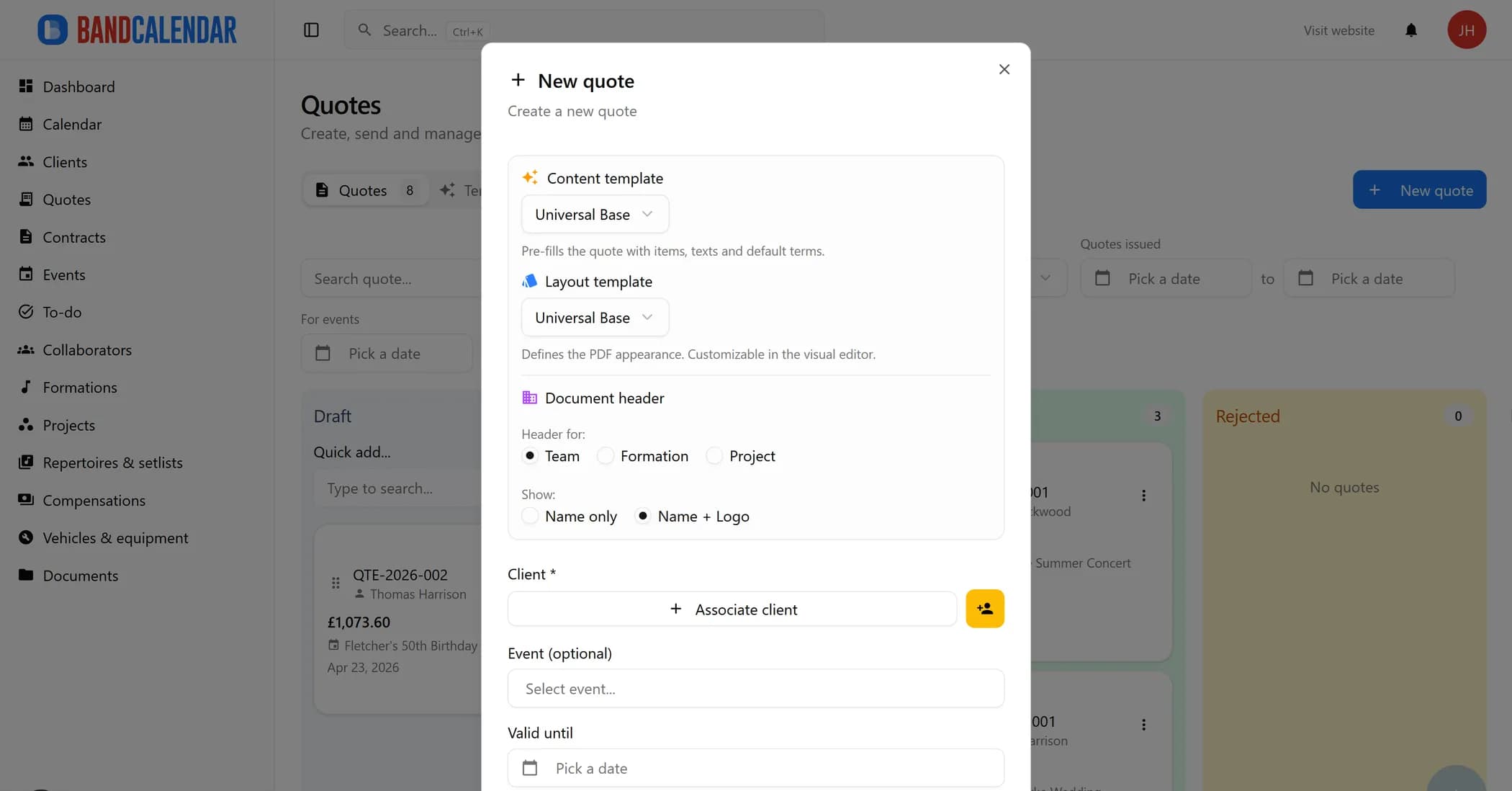
BandCalendar addresses this with a two-level template system:
- Content templates — the line items, packages, and general terms. Set them up once, reuse them for every enquiry.
- Graphic layout templates — the visual appearance of the PDF: logo, colours, fonts, header. You can have a different layout for each project or lineup.
When you create a quote from an event, BandCalendar automatically fills in the client details, date and location. You select the template, review, and send.
The client receives a link, reads the quote on any device, and can accept it. Everything is tracked: quote sent, viewed, accepted, and then converted into a contract with one click — without rewriting anything from scratch.
No more scattered Word files, no more PDFs renamed "quote-FINAL-2-ok.pdf." The quote lives in the system, linked to the client and the event, accessible at any time.
The bottom line
A professional quote isn't extra bureaucracy — it's the tool you use to convert an enquiry into a booking. Done well — transparent, detailed, visually polished, with a clear action at the end — it reduces objections, accelerates the decision, and positions your band as a vendor clients can rely on.
Content matters. Presentation matters just as much. And the speed at which you send it matters almost as much as both.
Related BandCalendar workflows
Explore the connected features
Quotes and contracts
Create professional quotes and contracts for music services from separate content and layout templates, with rich text editing, preview-consistent PDFs, services and expense reimbursements, online quote acceptance, public links and click-to-accept simple electronic signature without a client account.
Open pageWedding bands
BandCalendar helps wedding bands and live musicians turn inquiries, quotes, contracts, repertoires, setlists, logistics and payments into one workflow that the whole team can use before, during and after the event.
Open pagePrivate events
BandCalendar helps musicians, bands and small ensembles manage private parties, corporate events, receptions and custom bookings with clients, quotes, contracts, timings, venues, documents and payments always connected.
Open pageBandCalendar vs Excel
Excel works for simple lists, but it does not connect clients, gigs, click-to-accept contracts, setlists, Finances and fees. See when BandCalendar fits better.
Open pageStop wasting time with Word, PDFs and spreadsheets.
- Separate templates for content and visual layout
- Auto-fill with client data
- Click-to-accept simple electronic signature from a smartphone
Get one useful guide a month