Wedding Band Contracts: 7 Points to Agree
What to discuss in a wedding band agreement: services, payment, weather, cancellation and substitutions.
Published · Updated · BandCalendar

The short answer
A wedding band agreement should identify the parties, services, date, venue, schedule and payment terms. It should also address technical requirements, bad weather, cancellation and substitutions. Rules differ by jurisdiction and client, so ask a qualified local professional to review the agreement before using it.
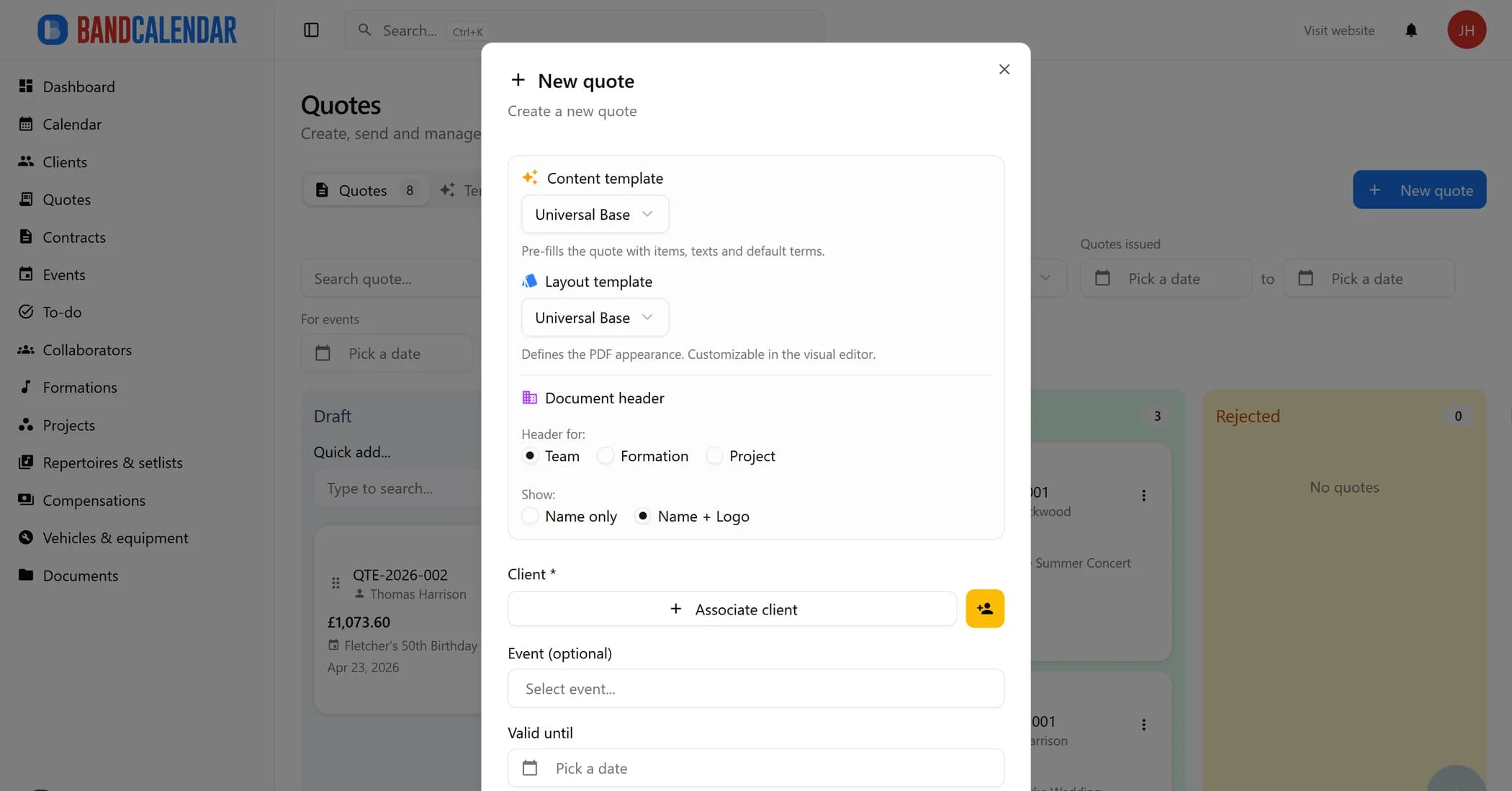
BandCalendar can help you prepare and send quotes and contracts and keep related event information together. The parties remain responsible for the content and legal suitability of their agreement.
What should the agreement cover?
| Topic | Points to discuss |
|---|---|
| Parties and services | Who contracts, date, venue, lineup and included services |
| Schedule | Arrival, setup, performance, breaks, finish and possible extensions |
| Payment | Total fee, expenses, deposit terms and due dates |
| Weather and safety | Technical requirements, a safe alternative and responsible contacts |
| Cancellation or postponement | Notice, treatment of payments and each party’s responsibilities |
| Substitutions | Guaranteed performers or features and how changes are communicated |
| Logistics | Access, meals, facilities, equipment and power responsibilities |
Use this as a discussion checklist, not a ready-made legal template.
1. Identify the parties and services
State who is providing and purchasing the service, where and when it takes place, the number and type of performers, covered moments and included equipment. Explain any optional services. If a particular singer or player matters to the client, agree whether that person is guaranteed.
2. Agree the schedule and extensions
Separate arrival, setup and soundcheck from performance sets, breaks and the finishing time. Discuss delays, who may approve an extension and the agreed fee. Any extension also needs to fit the venue’s applicable restrictions.
3. Clarify fees and deposits
Set out the total price, expenses, due dates and payment methods. Explain the purpose and treatment of any deposit or retainer, including how it relates to the final balance. Do not assume that calling an amount non-refundable makes that term enforceable everywhere; local consumer and contract rules may apply.
4. Plan for bad weather and safety
For outdoor events, agree who arranges a suitable alternative, where it will be, when the decision is made and who contacts the venue. Set out what happens if the performance must move, be postponed or cannot take place. The financial outcome depends on the agreement, circumstances and applicable law; it is not automatically the full fee.
5. Discuss cancellation and postponement
Agree how to give notice and what happens to payments if either party cancels, a date changes or an event outside the parties’ control prevents performance. Have cancellation charges and their relationship with deposits reviewed locally; there is no universal percentage.
6. Agree how substitutions work
Explain whether the lineup can change, which performers or characteristics are essential and how a replacement will be selected and communicated. A substitute may solve a practical problem, but does not automatically satisfy every agreement. BandCalendar can record event-specific changes to collaborators and lineups.
7. Set technical and practical requirements
Agree who provides audio, lighting and power, who checks the setup and who acts as technical contact. Required circuits, protection, distances and equipment depend on the venue and setup; consult a qualified person rather than relying on a generic specification. Discuss access, loading, parking, meals and changing space where relevant.
What about electronic acceptance?
BandCalendar allows a client to review a contract through a link and accept it with an explicit action; it retains the document version and acceptance information. A graphic signature image is decorative. The legal effect of any particular agreement depends on the process and applicable law, and an electronic signature does not eliminate disputes.
For example, the UK Electronic Communications Act, section 7 addresses admissibility of electronic signatures as evidence. In the US, the FTC’s discussion of the ESIGN Act explains that electronic form alone does not make an agreement invalid in the circumstances covered by that law. Neither source guarantees enforceability of a particular booking: obtain advice for your jurisdiction.
Frequently asked questions
What should a wedding band contract cover?
Identify the parties, date, venue, services, lineup, schedule and payment. Address technical requirements, bad weather, cancellation and substitutions, and obtain advice suited to your jurisdiction.
Is a booking deposit always non-refundable?
No. Its treatment depends on the agreement, applicable law and circumstances. Have a qualified local professional review deposit and cancellation terms, particularly for consumer bookings.
What happens if it rains and there is no indoor option?
The outcome depends on the facts, agreement and applicable law. Discuss who provides a safe alternative and how postponement, cancellation and payment will be handled; do not assume the full fee is automatically due.
Is an electronically accepted contract legally binding?
Electronic form alone does not necessarily prevent legal effect, but validity, evidence and any formal requirements depend on the process, agreement and applicable law. A click does not automatically settle every legal question.
Can a band substitute a musician at short notice?
That depends on the agreement and circumstances. Identify any guaranteed performers or lineup features and agree how and when substitutions will be communicated.