Sound Limiters, Decibels and Curfews for Wedding Bands: Rules and Contract Clauses in 2026
Decibel caps, venue sound limiters with power cutoffs, council curfews and contracts: what live wedding bands must know to protect their gear and fee.
November 2, 2026 · BandCalendar
The short answer
Noise limits, sound limiters, and curfew hours at wedding venues depend on local council premises licences and exemptions granted to the venue or couple, not the band. If a venue cuts power via a sound limiter or enforces an early stop, musicians are not liable for council fines. Using contracts created in Quotes & Contracts, your agreed fee remains fully payable. In the product, this connects seamlessly with Wedding band.
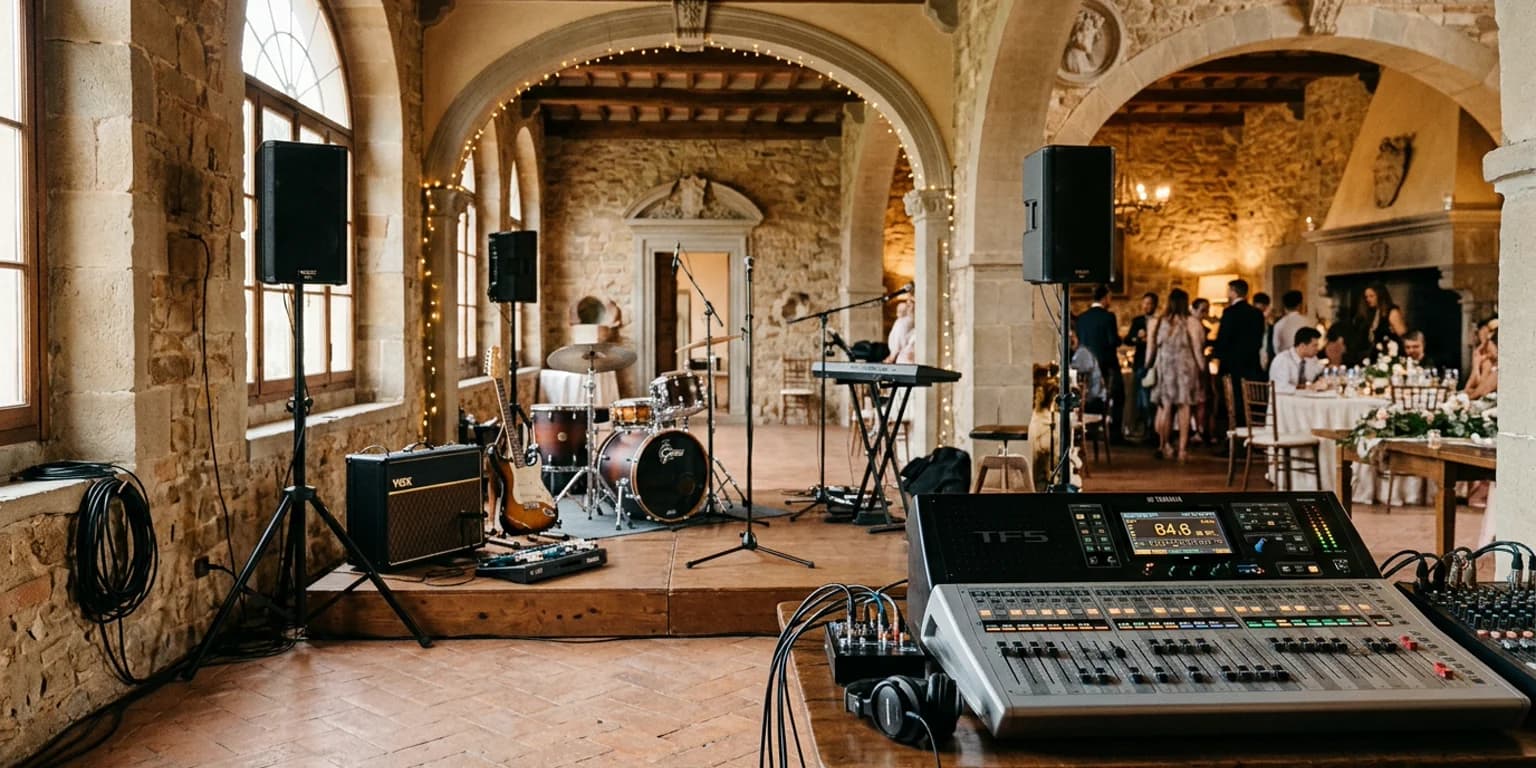
It is 11:15 PM. The dancefloor is packed, the couple is in the middle of your biggest party anthem, and the energy in the room is electric. Suddenly, a deafening click echoes through the hall: the PA falls silent, the guitar amplifiers die, the stage lights drop, and the entire room plunges into an awkward, stunned quiet, punctuated only by the acoustic rattle of drum cymbals.
The venue's sound limiter has tripped.
Moments later, an anxious duty manager rushes across the room pointing at a red flashing beacon on the wall: "I warned you about the volume! The breaker is locked for fifteen minutes, and local council regulations require all amplified music to end at midnight anyway". The newlyweds turn around with disappointed faces, looking at the band as if the disaster were your fault.
Sound limiters, decibel caps, and strict council noise curfews are among the most stressful operational hazards facing working wedding bands today. Here is what every professional musician needs to understand about the law, real-world acoustics, and the contract clauses that keep your gear safe and your fee protected.
The legal reality: Environmental Health and Premises Licences
In the UK, noise from entertainment venues is governed primarily by the Environmental Protection Act 1990 (which covers statutory noise nuisance) and the Licensing Act 2003. Across Europe, similar national frameworks regulate environmental acoustics and residential zoning.
Every commercial wedding venue operates under a Premises Licence granted by the local authority. This licence sets mandatory conditions, including:
- Strict curfew times: typically 11:00 PM for outdoor marquees and courtyards, and midnight for indoor function rooms.
- Sound limits at site boundaries: music must not exceed ambient background noise levels by more than a specified margin (often 3 to 5 dB) at the nearest residential perimeter.
- Mandatory installation of noise limiting devices: local councils frequently require historic barns, country manors, and marquee sites to install hardwired sound limiters to prevent neighbour complaints.
Real band decibels vs. venue limiter thresholds
The core dilemma is rooted in physics: a live party band naturally produces sound levels that easily exceed residential acoustic limits.
| Instrument / Setup | Typical Sound Level at 2 Metres | Typical Venue Limiter Cap |
|---|---|---|
| Acoustic snare drum (solid backbeat) | 100 – 108 dB(A) | 85 – 92 dB(A) |
| Tenor saxophone solo | 92 – 98 dB(A) | 85 – 92 dB(A) |
| Electric guitar combo (30W tube amp at stage level) | 90 – 96 dB(A) | 85 – 92 dB(A) |
| Acoustic trio (vocals, acoustic guitar, cajon) | 78 – 85 dB(A) | 85 – 92 dB(A) |
| Live party band with acoustic drum kit & brass | 98 – 105 dB(A) | 85 – 92 dB(A) |
As shown above, an unamplified acoustic snare drum stroke or the cheer of a hundred guests singing along can instantly register above 95 dB(A). When a venue assures a couple that a 5-piece rock and pop band is welcome while concealing an 85 dB(A) cutoff limiter, they are promising an acoustic impossibility.
How sound limiters work (and why they damage equipment)
A commercial venue sound limiter typically consists of:
- A calibrated measuring microphone, usually mounted on the ceiling directly above the band area or dancefloor.
- A monitoring processor, which continuously averages sound pressure levels ($L_{Aeq}$) over short intervals (typically 5 to 60 seconds).
- A traffic-light warning display, flashing green under safe levels, amber when approaching the threshold, and red when exceeded.
- A heavy-duty contactor relay, wired directly into the stage power sockets. If the red threshold is breached for more than a few seconds, the relay cuts power to the entire stage.
Sudden power cuts under heavy load are dangerous for digital audio equipment. Abrupt shutdowns can corrupt digital mixing console firmware, blow power amplifier output stages, and damage speaker drivers through transient voltage spikes.
Who is liable for council fines and licence breaches?
When neighbours complain to the local council and Environmental Health Officers (EHO) arrive on site:
- The venue licence holder is responsible: the council serves statutory noise abatement notices and administrative fines directly on the premises licence holder or venue operator, not on the musicians hired for the night.
- The couple's responsibility: couples hiring private venues are responsible for checking whether their chosen musical entertainment complies with venue rules, or whether Temporary Event Notices (TENs) are required for late-night finishes.
- The band's legal status: performing musicians act as independent contractors delivering agreed artistic services. Unless musicians deliberately bypass sealed safety devices or trespass on private property, they have no legal standing in the venue's council licence.
In BandCalendar, you can document venue power specifications, sound caps, and contact persons directly within Event Management.
The essential contract clause to protect your band fee
To prevent clients or venues from withholding payment following a limiter trip or early shutdown, your booking agreement must clearly allocate acoustic liability.
Here is a tested clause to include in your booking terms:
Sound Limiters, Venue Noise Restrictions and Curfews
1. The Client confirms that they have consulted with the management of the venue
   regarding the suitability of the agreed musical lineup and instrumentation.
2. The Band accepts no liability for interruptions, power cutoffs, or volume
   reductions caused by venue sound limiting devices, sound ceilings, or local authority curfews.
3. If performance is halted, shortened, or volume forced down by the venue management,
   sound limiter equipment, or environmental health authorities, such event shall not
   constitute a breach of contract by the Band, and the full agreed fee shall remain payable.
Generating contracts via BandCalendar's digital workflow allows clients to accept these protective terms online with clear audit logs before the date. For a complete guide to contract structure, read our guide on how to write a wedding band contract.
4 practical steps for managing sound-sensitive venues
When booking dates at venues with strict sound limiters, adopt these proactive strategies:
- Deploy an electronic kit or hybrid snare: kick drums and acoustic snares trigger 90% of limiter cutoffs. Using a professional electronic drum kit or mesh heads with triggers allows full dynamic playing while keeping overall decibels well below the limit.
- Eliminate stage wedges in favour of In-Ear Monitors (IEMs): floor wedge monitors blast sound backwards into walls and ceilings, inflating the decibel reading. Running a quiet stage with IEMs frees up valuable acoustic headroom for the main speakers.
- Keep subwoofers grouped centrally: placing subwoofers in room corners creates boundary reinforcement and room modes that artificially spike ceiling measurement microphones. Keep subwoofers together on the floor in front of the stage.
- Inspect the microphone sensor on arrival: locate the limiter microphone before soundcheck. Direct your front-of-house PA speakers downward into the crowd, avoiding reflective stone walls and the sensor's line of sight.
Frequently Asked Questions
What decibel level is typically allowed for wedding bands?
Most UK and European venues with sound limiters enforce ceilings between 85 dB(A) and 95 dB(A) LAeq at the sound desk or dancefloor. Venues without limiters generally adhere to residential Environmental Health guidance, which requires music to be inaudible inside neighbouring homes after 11:00 PM.
What happens if a sound limiter trips and cuts power during the set?
When a sound limiter trips, it abruptly cuts power to the band's stage outlets for several seconds or minutes. Under a professional contract, the band is not liable for interruptions caused by venue limiters, and the full agreed fee remains payable without deductions.
Who is legally responsible for venue noise licences and council fines?
The venue licence holder and event organisers (the couple) are legally responsible for compliance with council premises licences and Environmental Protection Act statutory nuisance notices. Performing musicians are independent contractors and cannot be fined for venue licensing breaches.
Can a venue sue or fine a wedding band for being too loud?
No. Local authority Environmental Health Officers issue abatement notices and fines to the premises licence holder, not the performers. However, venues may attempt to withhold money or demand early finishes if the performance contract does not clearly define noise liability.
How do you protect your band fee against venue sound limits in the contract?
Include a dedicated sound limiter and curfew clause in your contract stating that the client is responsible for verifying band suitability with the venue, and that any forced volume reduction or early cutoff does not alter the agreed balance.