Cancellations and Deposits: Protecting Your Date (and Your Income)
Last-minute cancellations, unpaid deposits, contracts without penalty clauses: how to protect your work and your time with the right tools.
March 20, 2026 · BandCalendar

The problem nobody warns you about
A couple books your band for their wedding. You trust them, hold the date, turn down other enquiries. Then, three weeks before the event, you get a message: "We're so sorry, we have to cancel." Or worse: no message at all, and you find out by calling them.
Without a signed contract and a paid deposit, you've lost that evening. With no way to recover it.
This scenario is more common than you think. On wedding forums, threads about non-refunded deposits and withheld penalties are among the most frequent. Couples ask for advice on how to recover money they've paid; vendors — musicians included — find themselves having to retain deposits or chase balances that never arrive.
The point isn't to be inflexible. It's that holding a date has a real financial cost: every booked Saturday is a Saturday you can't sell to anyone else. If the client cancels with no penalty, that lost time is gone forever.
Deposit vs. advance payment: the difference that matters
Many people use the terms interchangeably. They aren't. And the distinction has real legal consequences.
An advance payment is simply a prepayment against the total. If the wedding is cancelled, the advance must be returned (unless otherwise agreed). It's a simple prepayment, with no guarantee function.
A confirmatory deposit — which is what you should always use — is a guarantee against withdrawal. If the client cancels without a valid contractual reason, you keep the deposit. If you cancel, you are liable for damages as defined in the contract — which may include returning the deposit and paying additional compensation, depending on your jurisdiction and the terms agreed.
The difference isn't merely formal. It's substantial. Writing "advance payment" instead of "confirmatory deposit" in the contract can cost you thousands if a cancellation occurs.
What the real data shows
Based on discussions on major wedding forums, the most frequent situations are:
- Cancellations 6–12 months in advance: most vendors retain the deposit in full, but offer the option to move the date without additional penalties
- Cancellations within 60 days: almost all contracts provide for the deposit being retained plus an additional percentage (often 20–30% of the remaining balance)
- Cancellations due to health reasons: depends on the specific clauses. Some contracts provide partial refund or credit towards a future date; others don't
One point emerges clearly: whoever didn't write the rules beforehand is stuck with someone else's. Couples asking for advice on forums almost always admit they didn't read the contract before signing. Vendors in difficulty are those who handled everything verbally or used generic contracts downloaded from the internet without adapting them.
The clauses you can't leave out
A contract for a wedding band must explicitly cover these points:
1. Deposit amount and timing
The deposit is paid at the time of signing, not after. Never hold a date without a paid deposit — even if the client is "a friend of a friend."
The typical amount is 30–40% of the total fee. Too low (e.g. 10%) doesn't act as a deterrent; too high (e.g. 60%) can put clients off.
2. Tiered cancellation penalty
The penalty should be proportional to how much notice is given. A typical structure:
- More than 6 months: deposit retained
- 3–6 months: deposit + 20% of the remaining balance
- 1–3 months: deposit + 50% of the remaining balance
- Less than 30 days: 100% of the total fee
These percentages are indicative. The important thing is that they're written down in black and white before signing.
3. Force majeure and exceptional circumstances
The pandemic taught everyone that unexpected events happen. A well-drafted force majeure clause protects both parties:
- Serious illness or death of one of the spouses or an immediate family member: usually provides for partial refund or credit towards a future date
- Objective impossibility of the venue (e.g. structural damage, forced closure): the contract is dissolved without penalties
- Government restrictions preventing the event from taking place: to be defined case by case
Note: "changing their minds" or "the couple breaking up" are not force majeure. They must be treated as voluntary withdrawal.
4. Balance: when and how
The balance should be paid 7–14 days before the event, not on the evening itself. Asking for money at midnight while the couple are celebrating is awkward for everyone.
If the client insists on paying on the night, ask them to delegate a witness or family member: they'll hand the envelope to the bandleader at the start of the evening, when the atmosphere is still calm.
5. Date change vs. cancellation
Some contracts provide that, if the date is moved (at the client's request), the deposit is automatically transferred to the new date. It's a fair solution that avoids disputes.
If the new date isn't available or isn't acceptable to you, the deposit stays retained as per the cancellation clause.
Real cases from the forums
We've analysed the most recent discussions on major wedding forums. Here are some typical scenarios:
Case 1 — Cancellation for health reasons
"I signed the contract four months ago for the reception, but for health reasons I'm forced to cancel. Am I entitled to a refund of the deposit?"
Common response from users: depends on the contract. If health reasons are explicitly listed as grounds for a refund, yes. Otherwise, the confirmatory deposit is retained.
Case 2 — Date change due to COVID
"We're just moving the date, not cancelling. Can I get the deposit back?"
In almost all cases, venues transferred the deposit to the new date without problems. Some asked for a small supplement if the new date fell in peak season.
Case 3 — No deposit requested
"The vendor doesn't want a deposit — says their word is enough. Is that normal?"
Unanimous response: no. A professional vendor always requires both a deposit and a contract. Anyone who doesn't is either inexperienced or has no intention of protecting themselves (or you).
How BandCalendar protects you
BandCalendar isn't just a management tool for events and setlists. It's a way to bring order to the administrative side of your work — the part musicians often underestimate, but which makes the difference between a professional band and one that works from gig to gig.
Contracts with built-in cancellation clauses
BandCalendar's contract templates already include the essential clauses:
- Confirmatory deposit with customisable percentage
- Tiered cancellation penalty (based on notice period)
- Force majeure and exceptional circumstances
- Payment schedule (deposit, interim payments, balance)
You can edit every clause, add client-specific notes, and generate a PDF ready for signing.
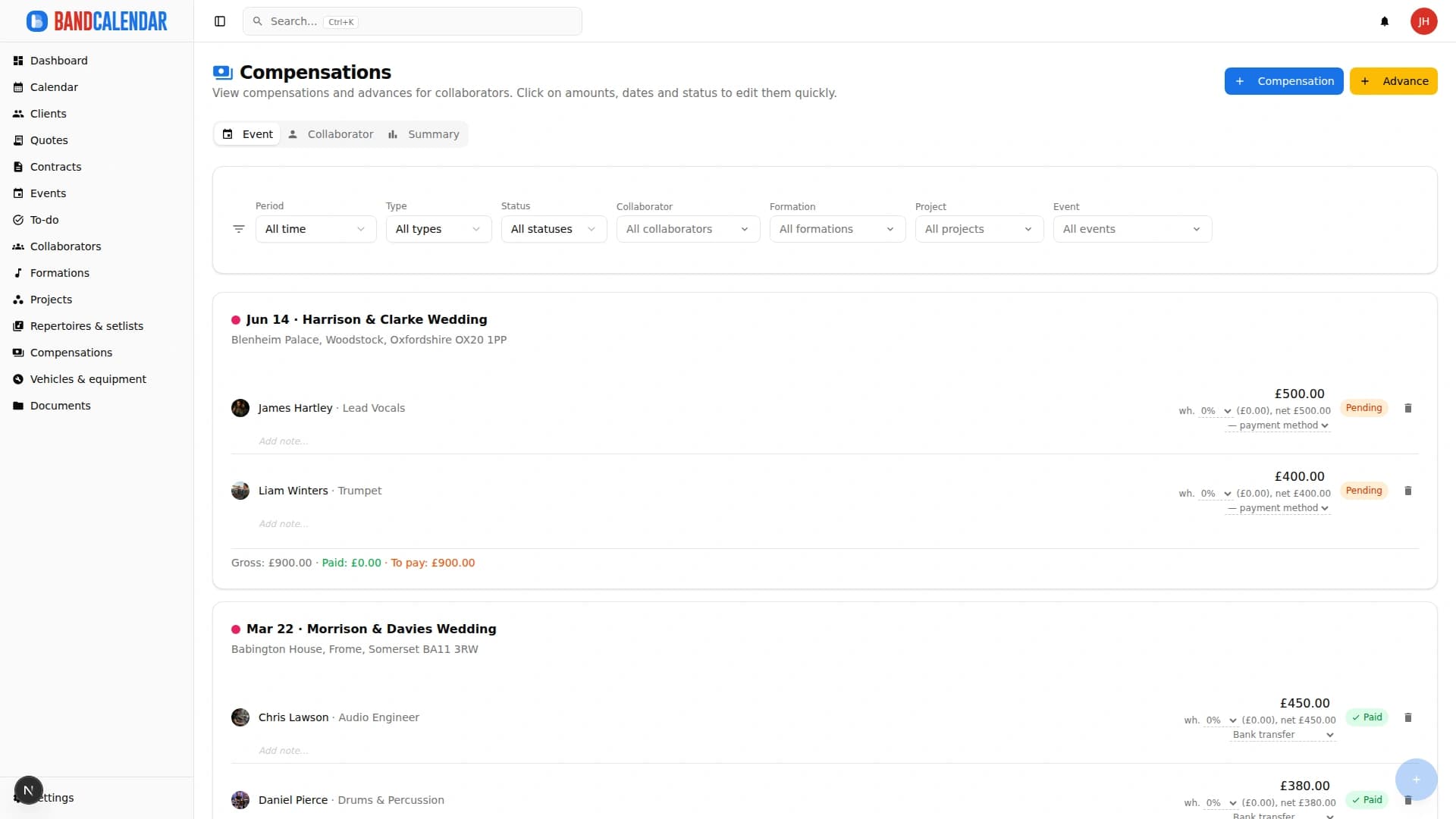
Payment tracking with statuses
Each event has a dedicated payments section, with distinct statuses:
- Deposit: paid at signing (with date and amount)
- Interim payment: paid at an intermediate stage (optional)
- Balance: to be requested by the agreed deadline
The system shows you at a glance which events have a paid deposit, which are awaiting the balance, and which payments are overdue.
Digital signature link
Once the contract is generated, BandCalendar creates a digital signature link to send to the client. The client opens the link, reads the contract, and signs digitally — no printing, handwriting, or scanning required.
The signature has legal validity, and the signed contract is automatically archived in the system, linked to the event and the client.
Automatic reminders
BandCalendar can send automatic reminders for upcoming payment deadlines. You no longer have to remember to chase the balance yourself: the system does it for you, with a professional email or WhatsApp message.
The golden rule: everything in writing, upfront
There's no "correct" contract in absolute terms. There's a contract that both parties have read, understood and accepted before signing.
Forum arguments almost always stem from misaligned expectations: the client thought the deposit was just an advance; the vendor assumed the client knew it was a confirmatory deposit. Nobody read the contract. Everyone paid the price.
Before holding a date:
- Prepare a written contract (use a template or have one drafted by a lawyer)
- Explain to the client what a confirmatory deposit means
- Collect the deposit at the same time as the signature
- Keep a copy of the signed contract and the payment receipt
Follow these four steps and 90% of problems will never arise.
The bottom line
Protecting your date and your income doesn't mean being inflexible or taking advantage of clients. It means treating your work as a professional activity — because it is.
A band that plays well but has unclear contracts will lose bookings and waste time chasing payments. A band that plays well and has solid administrative processes works more, earns more, and has less stress.
With BandCalendar you can manage contracts, deposits, payments and client communications in one place. So you have more time to focus on music — and fewer administrative headaches.
If you want to stop wasting time with Word documents, PDFs and paper signatures, BandCalendar is built exactly for this.
Related BandCalendar workflows
Explore the connected features
Quotes and contracts
Create professional quotes and contracts for music services from separate content and layout templates, with rich text editing, preview-consistent PDFs, services and expense reimbursements, online quote acceptance, public links and click-to-accept simple electronic signature without a client account.
Open pageFees and Finances
Track event money on two clear layers: client collections and customer refunds (commercial documents and the Finances tab), and collaborator fees with advances, line items, withholding and expense reimbursements. Summaries by period, event or musician.
Open pageWedding bands
BandCalendar helps wedding bands and live musicians turn inquiries, quotes, contracts, repertoires, setlists, logistics and payments into one workflow that the whole team can use before, during and after the event.
Open pageStop wasting time with Word, PDFs and spreadsheets.
- Track advances, balances and payments for each musician
- Financial summary by event and by period
- Everything linked to lineups and collaborators
Get one useful guide a month