How to Manage Payments Within a Band
Manual calculations on WhatsApp, splits argued at the end of the night: how to handle musician payments fairly and transparently, without the friction.
March 20, 2026 · BandCalendar
The payment problem inside bands
Fee management is one of the main sources of friction within a band. Payments received late, splits calculated by hand on WhatsApp, forgotten advances, expenses disputed after the fact: without a clear system, every gig risks ending with an argument.
The issue isn't just the maths. It's that unspoken expectations accumulate. Whoever does more work than the others — without that being explicitly acknowledged — ends up feeling exploited. Whoever doesn't understand why their cut is different from a colleague's starts asking questions. Transparency isn't optional: it's the foundation that allows a band to work together over time.
How to calculate net pay
The gross fee for an event never equals the net amount that goes into each musician's pocket. Before splitting, you need to deduct:
- Travel expenses: fuel, tolls, van rental if applicable
- Production costs: consumables, technical materials, tuning
- Extra shares for additional roles or work (see below)
Only after these deductions do you divide the remainder among the musicians.
Extra work that deserves recognition
Equal splits are the simplest system — but often not the fairest, because not all members contribute equally to running the band.
Whoever handles booking and client relations
In almost every band, someone acts as the client-facing point of contact: responding to enquiries, sending quotes, closing contracts, managing deposits, keeping event records. It's usually the bandleader, but not necessarily — it could be a dedicated member or an external manager.
This is real work that takes time: phone calls, emails, meetings, data entry, client follow-ups, coordination with the venue. It's not part of "making music" — it's a business management activity. It's fair that whoever does it gets paid for it — typically as a percentage of the gross event fee (usually 10–20%), deducted before the musicians' split.
Whoever brings the PA system
The sound of a wedding band depends almost entirely on the equipment: speakers, mixer, cables, stands, microphones, amplifiers. Transporting all of this has a real physical and logistical cost — and carries a genuine risk of wear, breakdowns and damage.
Whoever brings the gear loads and unloads mostly alone, arrives early and leaves last, and is personally responsible for equipment worth thousands of euros. This too is an extra contribution that deserves a dedicated fee, separate from the musical share.
Shared equipment: works in theory, less so in practice
Some bands decide to purchase and manage equipment collectively. It's a sensible idea on paper, but often creates problems over time: members change — if someone leaves the band, do they have a right to a share? Who pays for repairs? What happens if one of the co-owners isn't available for a gig?
The most common solution in practice is for a single member to own the equipment and make it available to the band at each event, receiving a fee for this. It's less romantic than collective ownership, but it works better.
Shared marketing and promotion costs
Fees aren't the only financial item a band needs to manage together. There are shared expenses related to promotion and visibility:
- Wedding directory subscriptions — platforms where couples search for bands often charge an annual fee
- Paid advertising — social media campaigns, Google Ads, sponsorships
- Demo video and audio — essential for presenting yourself on YouTube, directories and to clients; production has a significant cost
- Website — domain, hosting, development or maintenance
The basic rule is simple: whoever fronts a cost should have the right to recover it before the fee is split. This applies whether the expense is covered by the bandleader alone or shared among members. What matters is that there's an explicit agreement — who pays what, how they get reimbursed, and over what timeframe.
Equal split or role-based?
Once expenses and extra shares have been deducted, the remainder is divided among the musicians. The most common approaches:
- Equal shares — the simplest system, works well in flat bands where everyone contributes equally
- Role-based shares — whoever has extra responsibilities (soundcheck, artistic direction) receives a larger cut
- Experience-based shares — used when session musicians or occasional players have a pre-agreed rate
Whatever system you choose, the key thing is that everyone knows it in advance and that it's written down somewhere — not just remembered verbally.
The main rule: talk about it first
There's no universally correct system. Every band has its own history, its own dynamics, its own agreements. Some split everything equally because that's the formula that's always worked. Some have a bandleader who handles everything and gets paid accordingly. Some have formalised every detail in an internal document.
The main rule isn't which system to adopt — it's that these things get discussed openly, before they become a problem.
The bandleader who has spent years handling bookings, quotes and contracts without receiving anything more than the others will eventually grow resentful. The musician who bought the PA alone and hauls it to every gig will start wondering if it's worth it. Whoever paid out of pocket for the ad campaign that brought in ten new clients will want that acknowledged.
None of these grievances is unreasonable. All of them are preventable with a conversation had at the right time — meaning before, not after.
Advances and balances: how to track them
Many clients pay a deposit when the contract is signed and the balance shortly before the event. Tracking these payments is essential to:
- Know exactly how much is still outstanding
- Avoid forgetting to request the balance
- Calculate the correct net pay — if the balance hasn't arrived yet, the net can't be split
Fees and taxes
Musicians operating as sole traders or through a company issue invoices. Those working as occasional contractors should remember the annual limits and applicable withholding tax rules in their country. Always consult an accountant for your specific situation.
A tool that does the calculations for you
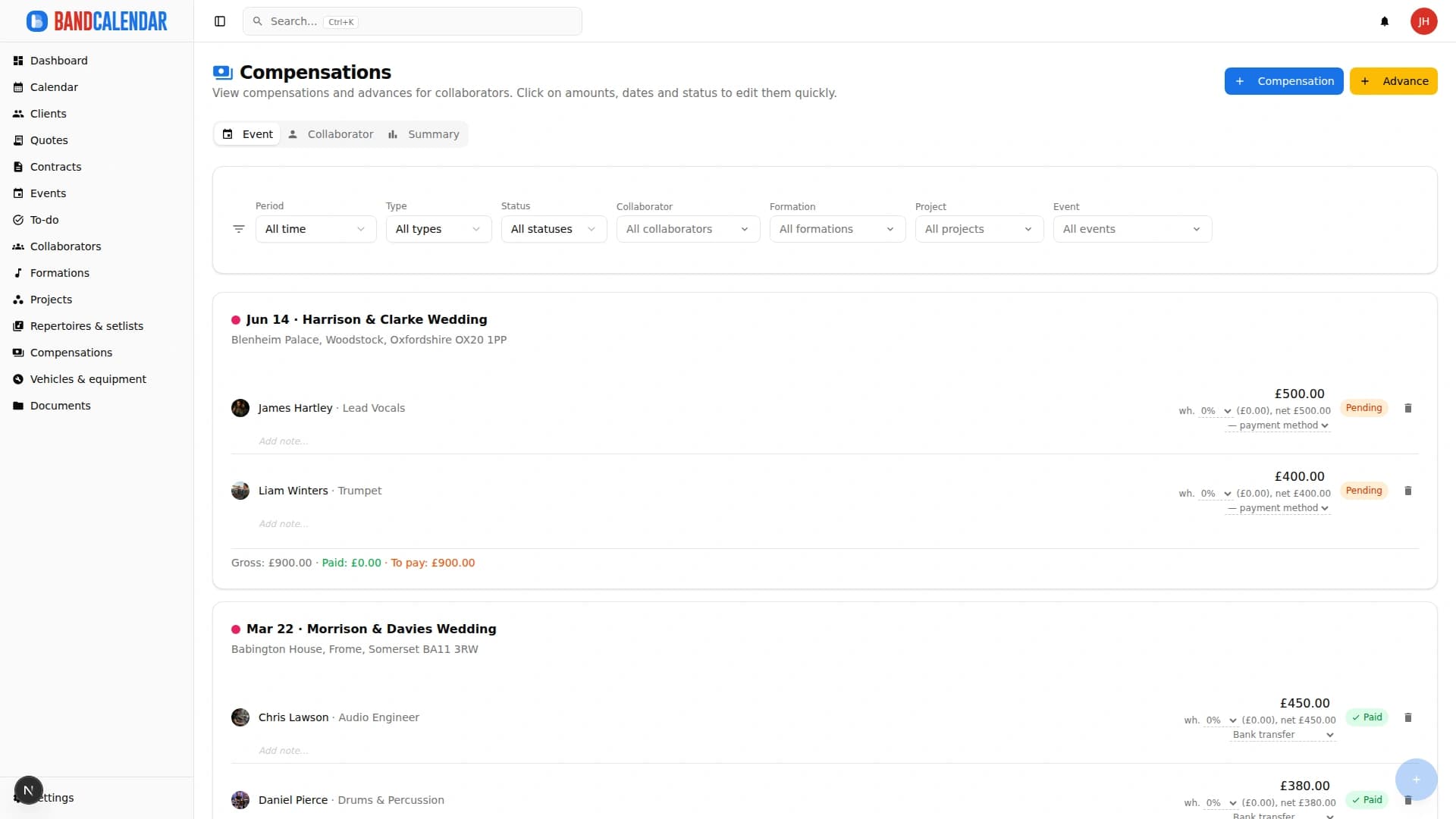
BandCalendar lets you record every fee, link it to the event and the musicians involved, track advances, and automatically calculate the net amount to distribute.
Data visibility is fully configurable: each team member can have different permissions, granular down to a single module. A musician invited by the account owner can view their own fees without seeing their colleagues'. The bandleader can keep the administrative side — including fees — visible only to themselves, giving others access only to the information that directly concerns them. Each band can set the configuration that works for them.
If you want to stop wasting time with spreadsheets and manual calculations, BandCalendar is built exactly for this.
Related BandCalendar workflows
Explore the connected features
Fees and Finances
Track event money on two clear layers: client collections and customer refunds (commercial documents and the Finances tab), and collaborator fees with advances, line items, withholding and expense reimbursements. Summaries by period, event or musician.
Open pageCollaborators and lineups
Manage the band's real lineup: core musicians, substitutes, extra collaborators, roles, instruments, lineups, projects, linked events, payments, documents and different team permissions.
Open pageConcert bands
BandCalendar helps concert bands, tribute bands, entertainment agencies, promoters and live-entertainment companies manage gigs, tours, venues, changing lineups, setlists, technical documents, logistics, fees and reimbursements in one workspace.
Open pageBandCalendar vs Excel
Excel works for simple lists, but it does not connect clients, gigs, click-to-accept contracts, setlists, Finances and fees. See when BandCalendar fits better.
Open pageStop wasting time with Word, PDFs and spreadsheets.
- Track advances, balances and payments for each musician
- Financial summary by event and by period
- Everything linked to lineups and collaborators
Get one useful guide a month