When to Get Paid for a Wedding or Event Gig: Why End-of-Night Payment Terms Fail
Why demanding payment at 1 AM damages your business: the 50/50 payment model, balance deadlines, and polite reminder scripts that get you paid before showtime.
Published · BandCalendar

The short answer
Waiting for payment at the end of the night exposes live bands to delayed transfers, awkward conversations, and cash shortages. The industry standard requires a 30% to 50% booking retainer upon contract execution and the final balance settled via bank transfer 7 to 14 days before the event. On the night of the show, musicians focus entirely on performing, with any last-minute overtime invoiced separately after the gig.
In the product, this workflow lives in Quotes & contracts, tied directly to clients, dates, and payment milestones rather than a disconnected spreadsheet.
It is an all-too-familiar backstage scene for working wedding musicians and bandleaders: it is 1:30 in the morning, the encore is over, your road cases are being wheeled to the trailer, and the bandleader is awkwardly scanning the dance floor searching for the groom.
When you finally track him down, he is six drinks deep and his bowtie is in his pocket. “Incredible night, mate! Let me find my best man to see who has the cash envelope.” The best man left thirty minutes ago in an Uber. The result? Twenty minutes of agonizing discomfort, a damp envelope missing a third of the agreed fee, or the exhausted promise: “I’ll transfer the rest first thing on Monday morning.”
Monday arrives, the couple boards a flight to the Maldives for their two-week honeymoon, and the bandleader spends the next month sending polite text messages trying to recover the funds already owed to the horn section and sound engineer.
This situation is not an unavoidable industry hazard: it is the direct consequence of a broken payment structure.
The three fatal flaws of "Net Zero" end-of-night payment terms
Agreeing to collect your performance balance at the conclusion of an event introduces three systemic vulnerabilities into your music business:
- Severe cognitive vulnerability: Late at night, clients have zero bandwidth for financial accounting. Asking for money while a couple is bidding farewell to their guests shatters the emotional atmosphere created by hours of great music.
- Dispute and renegotiation risk: If catering ran 45 minutes late or the venue manager complained about sound levels during dinner, an unscrupulous client may use late-night leverage to demand an unjustified discount.
- Damaged business cash flow: Freelance musicians and production crew expect prompt payouts. If your client's final balance payment is delayed by a month due to travel, the bandleader ends up financing the gig out of their own pocket.
High-end venues, luxury caterers, marquee hire companies, and photographers never wait until 2:00 AM to get paid. There is zero reason for live musicians to operate with inferior financial terms.
The ideal payment structure: 50/50 or 30/70 milestones
The gold standard among professional live music agencies and function bandleaders divides client billing into two distinct, predictable milestones:
Milestone 1: UPON CONTRACT EXECUTION (3 to 12 months in advance)
             → 30% to 50% Non-Refundable Booking Retainer
             → Permanently secures the date on your band's calendar.
                                   ↓
Milestone 2: 7 TO 14 DAYS PRIOR TO PERFORMANCE
             → Remaining 70% or 50% Balance cleared via Bank Transfer
             → Funds confirmed in your account before loading gear into the van.
                                   ↓
Milestone 3: THE NIGHT OF THE EVENT
             → Zero financial transactions on site. 100% focus on the performance.
             → Last-minute overtime hours recorded and invoiced the following week.
Why is the 7-day pre-show cutoff essential?
- It provides ample time for electronic bank transfers to clear and reconcile.
- It aligns perfectly with the final timeline run-down and headcount verification.
- It completely removes financial stress from the couple's shoulders on their wedding day.
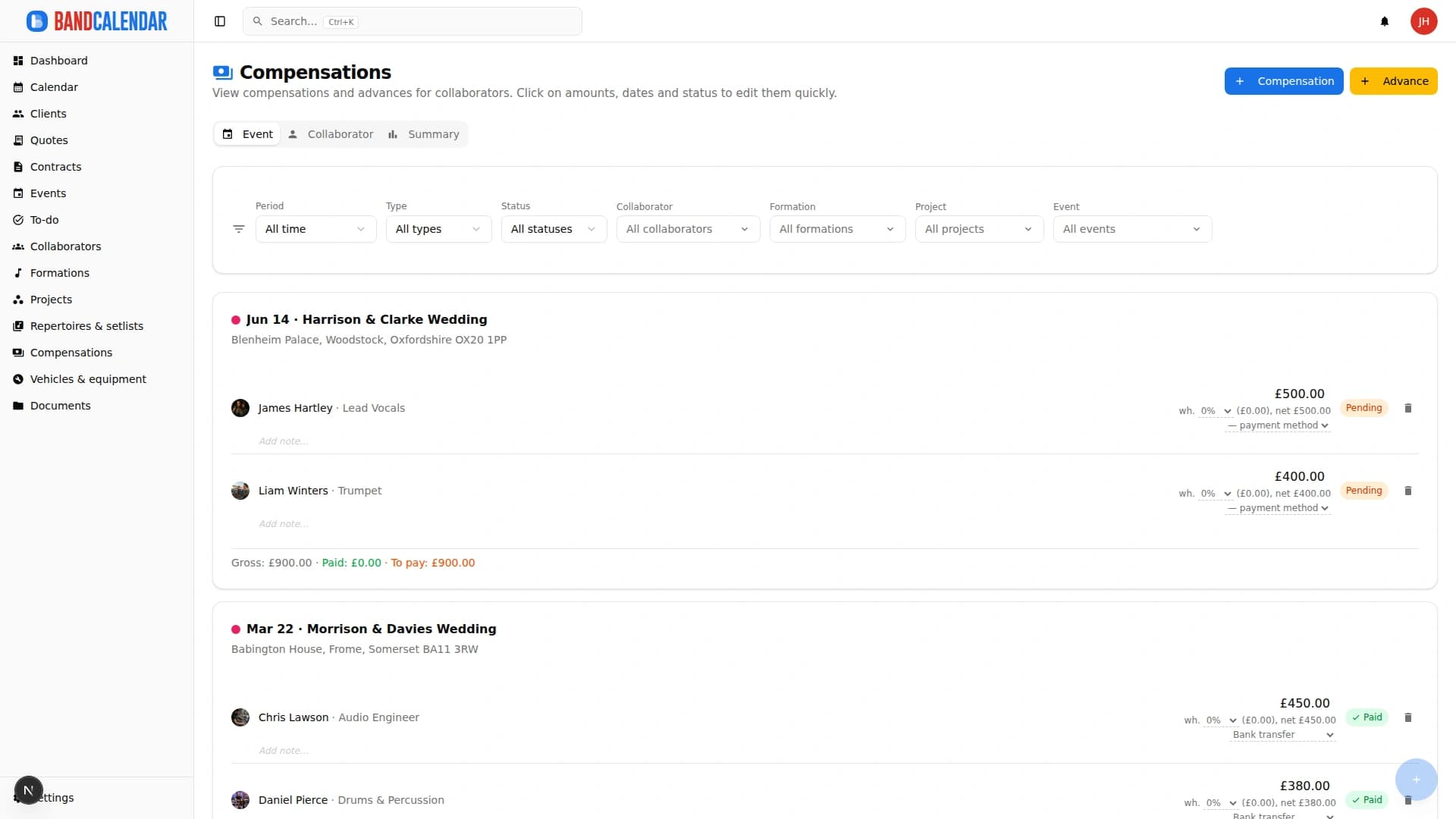
Within your financial dashboard, tracking scheduled billing milestones and tracking outgoing artist distributions is handled cleanly through Musician payments, keeping client revenue separate from performer settlements.
How to ask for the balance without feeling uncomfortable
The primary reason amateur bandleaders fail to implement upfront balances is fear: they worry that asking for full payment before playing will make them sound demanding or untrustworthy.
The secret is coupling the balance reminder with a moment of high operational value: the final musical and logistics check-in.
The 14-day balance & run-sheet review script
"Hi [Names],
We are only two weeks away from your wedding celebration and our team cannot wait to perform for you and your guests!
We are reaching out to lock down our final operational details: 1. We have rehearsed your requested first dance song ([Song Title]) and it sounds fantastic; 2. We have coordinated load-in and soundcheck access for 3:30 PM directly with the venue team at [Venue Name]; 3. As outlined in our performance agreement, here is the invoice reminder for your final balance of £/€/$ [Amount], due via bank transfer by [Due Date, 7 days prior], so all administrative details are settled well before your big day.
Our bank transfer details are attached below. Once submitted, feel free to reply with the transfer confirmation reference so we can update your file.
We will speak in a few days for our final timeline rundown—enjoy the final countdown!"
This email does not read like an aggressive collections notice. It reads like a polished, top-tier vendor taking care of business so the client can relax.
Using automated client messaging in Client emails & mailbox, you can schedule balance reminder templates to dispatch automatically 14 days prior to every gig in your schedule.
Handling last-minute overtime and encore requests
If the balance is fully paid before the event, what happens when the party is electric at 1:00 AM and the couple begs the band to play for another 45 minutes?
Managing on-site extensions requires two non-negotiable rules:
- Explicit contract overtime clause: Your signed agreement must clearly define your hourly extension rate (e.g., "Performance extensions beyond 01:00 are billed at £/€/$ [Rate] per hour or fraction thereof, subject to venue curfew and artist approval").
- Clear verbal confirmation and post-gig billing: When the client shouts “Please don't stop!”, the bandleader responds with enthusiasm: “We would love to keep the party going! Just to confirm our standard hourly extension rate, we will play through until 02:00 and email you the balance on Monday.”
This avoids awkward negotiations on the dance floor, eliminates late-night cash requests, and maintains an unblemished, professional reputation.
Frequently asked questions about band payment terms
Why is collecting payment at 1:00 AM at the end of a wedding considered bad practice?
Chasing payment at the end of a reception exposes bands to friction and unpaid fees: clients are exhausted or intoxicated, designated cash envelopes frequently go missing or contain incorrect amounts, and turning musicians into debt collectors tarnishes the emotional high of a great performance.
How do wedding couples respond to paying the full balance before the wedding day?
When presented professionally in your initial agreement, couples overwhelmingly welcome it. Top-tier wedding vendors—including luxury venues, caterers, florists, and photographers—universally require full payment 7 to 14 days in advance so clients do not have to manage financial logistics on their wedding day.
How should a band handle a client who insists on paying cash on the day of the event?
Explain that company policy requires secure, traceable electronic bank transfers in advance. If cash is accepted by exception, mandate in writing that a designated, sober representative (such as a wedding coordinator or best man) delivers the sealed envelope during afternoon soundcheck before the performance begins.
What happens if a wedding runs late and the couple asks the band to keep playing?
Rely on the pre-agreed overtime clause in your signed performance contract. Confirm the hourly extension rate verbally with the client, play the extra set within local venue sound curfews, and issue an invoice for the additional performance fee the following business day.
What should a bandleader do if the balance payment is not received 7 days before the show?
Dispatch a polite, automated reminder tying payment confirmation to final setlist preparations. If the transfer is still unverified 48 hours before the event, place a direct phone call to the client or wedding planner to confirm the wire transfer reference before traveling to the venue.