Wedding Band Business Structure: Sole Trader, Partnership, Cooperative or Ltd in 2026
Sole trader, partnership, music cooperative or limited company: how live wedding bands stay tax compliant, split earnings and protect profits in 2026.
November 4, 2026 · BandCalendar

The short answer
For live wedding bands in 2026, operating under an informal hobby status or unregistered club exposes members to severe tax penalties. If you play occasional weddings, registering as individual sole traders or a general partnership offers the simplest compliance. For established wedding ensembles booking 20 or more weddings annually, a music cooperative or a limited company provides limited liability, structured payout systems, transparent expense deductions, and significant tax advantages.
Operational tools like Musician payments keep individual member fee splits transparent, while client agreements are handled through Quotes and contracts. Coordinating acts with variable musicians is centralised in Wedding band.
The business reality of running a live wedding band
Every year, as wedding enquiries flood in, working ensembles face the same operational dilemma: "How do we legally invoice private clients, split performance fees fairly, and protect ourselves from unexpected tax bills?"
Performing at private weddings is serious commercial business. High-end wedding acts command fees ranging from £1,800 to over £4,000 per date. Historic venues and luxury wedding planners demand formal contracts, VAT invoices, and verified Public Liability Insurance (PLI) before allowing any sound checks on site.
Yet countless bands still rely on makeshift arrangements: one person receiving client bank transfers into a personal account, unrecorded cash envelopes distributed in venue car parks, or confusing spreadsheets that lead to end-of-year disputes. Choosing the right legal and fiscal vehicle is what transforms a casual group into a profitable, scalable live act.
1. The myth of the non-profit or informal hobby group
Some groups attempt to run private event bookings through a non-profit cultural association, arts charity, or informal social club to bypass commercial accounting.
Tax authorities treat private wedding entertainment as purely commercial trading. Performing a curated setlist for private wedding guests in exchange for money does not qualify as an educational, charitable, or public-interest activity. If inspected, tax authorities will reclassify all event receipts as commercial revenue, demanding backdated tax, social security contributions, and heavy fines.
If your group performs at private events, you must operate as a legitimate commercial trading entity.
2. Operating as individual sole traders or subcontractors
The most common model for emerging wedding bands is the lead contractor model:
How it works
- One member (usually the bandleader or manager) registers with tax authorities as an independent self-employed sole trader.
- The bandleader signs the performance agreement with the wedding couple and receives the full fee into a dedicated business account.
- The remaining band members (and any dep musicians) are registered as self-employed sole traders in their own right.
- After the event, each musician submits a freelance invoice to the bandleader for their agreed fee (e.g. £350 for the date).
- The bandleader pays the musicians via direct bank transfer and deducts those payments as direct subcontractor expenses from their own gross business revenue.
Pros and cons
- Advantages: Extremely low administrative barrier to entry. No company formation fees, minimal corporate paperwork, and complete flexibility to hire different dep musicians for each date via Collaborators and lineups.
- Drawbacks: The bandleader carries personal financial risk for cancellations, damage, or non-payment by clients, and must maintain meticulous records of every payment made to collaborators. Solo artists and bandleaders can manage this workflow directly in Solo musicians.
3. The General Partnership
If the core lineup consists of 3 to 5 permanent members who share ownership of sound systems, vehicles, and branding equally, a formal partnership is a natural choice.
Key characteristics
- The band registers a partnership name with the tax authority, and a nominated partner files an annual partnership tax return.
- Net profits (gross fees minus shared expenses such as PA hire, fuel, advertising, and marketing) are distributed among the partners according to a formal Partnership Agreement (e.g. 25% each in a four-piece band).
- Each partner reports their individual profit share on their personal self-assessment tax return.
The critical risk: Joint and Several Liability
In an ordinary partnership, liability is unlimited and joint. If one member signs a bad contract, causes property damage with lighting gear, or fails to pay a supplier, all partners are personally liable with their own personal assets (savings, homes). Having robust public liability insurance and written agreements is mandatory.
4. The Music Cooperative or Umbrella Agency
In many European countries, music cooperatives and specialized umbrella agencies handle the operational and tax burden for musicians.
How it works
- Musicians join the cooperative as working members.
- The cooperative enters into the contract with the wedding couple, issues formal VAT invoices, and collects payments.
- The cooperative processes member payouts through formal payroll, withholding necessary income tax and social insurance contributions at source and issuing verified pay stubs.
- In return, the cooperative retains an administration fee (usually 5% to 10% of the invoice gross).
Is it worth it?
For musicians who perform 10 to 15 weddings per season but have other day jobs and do not want to manage tax returns, bookkeeping, and invoices, an umbrella cooperative eliminates administrative friction. For bands doing 30+ dates, the cumulative 5-10% fee often exceeds the annual cost of hiring a dedicated accountant.
5. The Limited Company (Ltd or LLC)
When a wedding band turns into a high-volume enterprise—generating £50,000 to £150,000+ in annual bookings across multiple lineups or offering full production and DJ packages—incorporating a private limited company becomes the most efficient vehicle.
Key advantages
- Limited Liability Protection: Company liability is isolated from personal assets. If a cancellation dispute or venue equipment claim occurs, liability is capped at company assets.
- Corporate Credibility: Luxury wedding venues, corporate clients, and international destination wedding planners prefer contracting with registered corporate entities.
- Tax Efficiency: Corporation tax is paid on net company profits after all legitimate business expenses (equipment depreciation, transport, rehearsal studios, marketing) have been deducted. Directors can draw income through a combination of salary and dividends.
- Band Reserve Fund: Retaining profits within the business to invest in high-end wireless microphone rigs, in-ear monitor racks, or van upgrades does not trigger personal income tax until distributed.
Financial comparison: £2,400 wedding fee for a 4-piece band
Here is an operational breakdown for a typical private wedding engagement with a gross fee of £2,400 (£600 gross per performer):
| Operational Line | Sole Trader / Subcontract | General Partnership | Limited Company (Ltd) |
|---|---|---|---|
| Gross Fee | £2,400.00 | £2,400.00 | £2,400.00 |
| Band Reserve (10%) | -£240.00 (cables, PA wear) | -£240.00 (shared fund) | -£240.00 (retained earnings) |
| Travel & Fuel | -£160.00 | -£160.00 | -£160.00 (deductible) |
| Net Distributable | £2,000.00 | £2,000.00 | £2,000.00 |
| Per Musician Payout | £500.00 gross | £500.00 profit share | £500.00 fee / dividend |
| Liability Exposure | Leader personally liable | All partners jointly liable | Limited to company |
| Accounting Admin | Low (receipts & invoices) | Medium (partnership return) | Higher (statutory filings) |
Decision guide: which structure fits your wedding band?
- 1 to 5 weddings per year: Operate as individual sole traders. One person contracts and pays members as freelance deps. Minimal overhead.
- 6 to 20 weddings per year: A formal Partnership Agreement or lead sole trader setup with automated payout tracking. Establish a shared band fund for logistics and maintenance.
- 20+ weddings or multiple acts: Form a Limited Company. Protect personal assets, build brand equity, and leverage corporate tax allowances for capital gear investments.
Keeping internal finances and payouts dispute-free
Regardless of your legal structure, internal financial friction is the leading cause of band breakups. Unclear agreements on cancellation deposits, unrecorded fuel expenses, and delayed fee distributions create resentment.
Modern working acts eliminate friction by centralising their bookings:
- Storing signed client contracts alongside event call sheets;
- Logging custom fee allocations for core members vs hired session players;
- Recording prepayments, travel allowances, and deposits in one real-time dashboard.
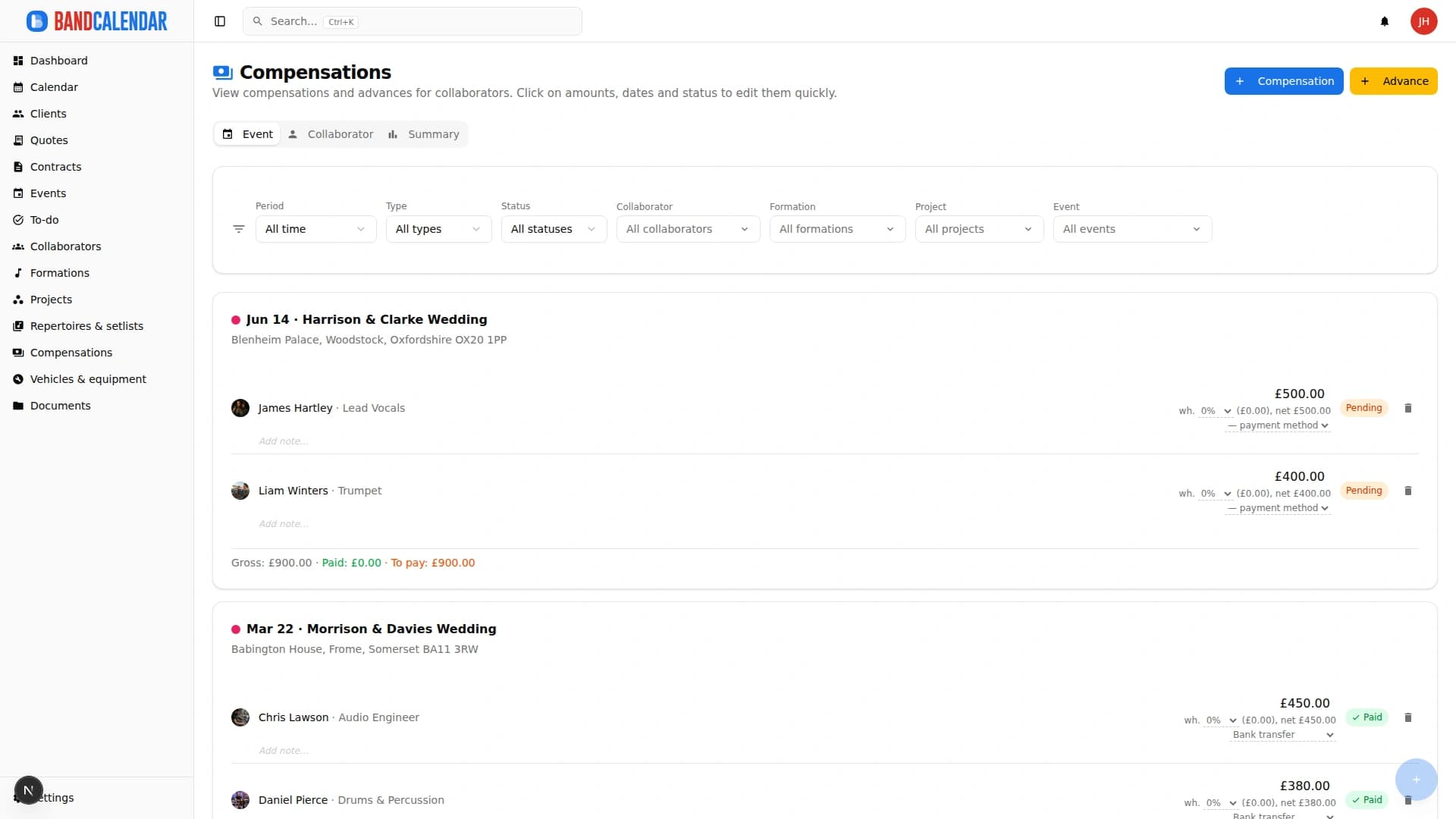
With Musician payments in BandCalendar, every gig automatically calculates individual gross and net payouts, tracks distributed advances, and links accounting receipts directly to the event date.
Frequently Asked Questions (FAQ)
Can a wedding band operate as an unregistered hobby group?
No. Providing live music entertainment for private weddings in exchange for a fee is deemed commercial trading by tax authorities worldwide (HMRC in the UK, IRS in the US). Operating informally without declaring income exposes members to back-taxes, interest, and severe financial penalties.
What is the difference between a partnership and a limited company for a band?
In a general partnership, all band members share profits and are jointly and personally liable for debts, cancellations, and damages. In a limited company (Ltd or LLC), the band exists as a separate legal entity: member personal assets are shielded, business expenses are deductible before corporation tax, but statutory filing and accounting costs are higher.
How does a music cooperative work for wedding musicians?
A music cooperative acts as an umbrella employer. The cooperative invoices the wedding couple, issues contracts, manages statutory employment insurance, and processes member earnings through payroll with tax and pension contributions withheld at source. It removes individual accounting overhead in exchange for an administration fee (typically 5% to 10%).
Can one band member invoice the client and pay the others?
Yes, this is common practice. The bandleader registers as a sole trader or limited business, contracts directly with the couple, and receives the gross fee. The leader then hires the other musicians as subcontracted self-employed freelancers (who submit invoices to the leader) or issues casual worker payments with appropriate tax deductions.
When should a live band switch from sole trader to a limited company?
A band should consider forming a limited company when annual turnover from private events consistently exceeds £40,000 to £50,000, or when high-value sound and lighting production assets require liability shielding. Below that threshold, operating as sole traders or a transparent partnership is usually more cost-effective.