The Complete Guide to Running a Wedding Band
From the first client enquiry to the wedding day: the full workflow for managing a wedding band without letting anything fall through the cracks.
March 20, 2026 · BandCalendar

What is a wedding band
A wedding band is a musical group specialised in weddings and private events. Unlike a concert band, the repertoire and organisation revolve around the couple's needs: the ceremony, cocktail hour, dinner, evening dancing.
A wedding band's success depends as much on musical quality as on organisational professionalism. Two bands with the same technical level are almost always distinguished by how they operate: whoever responds quickly, sends clear documents and keeps everything under control gets the work. Whoever is talented but disorganised loses clients before playing a single note.
The phases of a wedding gig
1. First contact and negotiation
The lead often comes from word of mouth, social media, Google, or wedding directories — platforms where couples search and compare vendors, and which for many bands have become the primary acquisition channel. Speed of response is the first signal of professionalism the client perceives: a couple planning their wedding contacts multiple bands in parallel. Whoever responds within a few hours has a real advantage over whoever responds two days later.
In the first exchanges you need to understand:
- The date, venue and type of event
- Which sets are required (ceremony, cocktail, dinner, evening dancing)
- The client's approximate budget
- Musical expectations (repertoire, atmosphere, any special songs)
At this stage you send a quote with the included services, prices and payment terms. A price in a WhatsApp message isn't enough: a formal document conveys professionalism and sets you apart from musicians who handle everything verbally.
2. Contract and deposit
Once an agreement is reached, the contract formalises everything. It's the document that protects both parties: it fixes the fee, the included services, cancellation penalties and logistical conditions.
The deposit — typically 30–50% of the total — is requested together with the signed contract, never before. Remember: blocking a date is a real financial commitment. It means potentially turning down other gigs for that evening. Without a signed contract and paid deposit, there is no written commitment — for either side.
If you want to go deeper on this, we have a dedicated article on how to write a contract for a wedding gig.
3. Event planning
In the following months the operational details are defined. This phase is often underestimated, but it's where most of the surprises on the wedding day get prevented.
Setlist and requested songs. Couples almost always have specific musical wishes: the entrance song, the first dance, something the mother-in-law insists on. The earlier you gather these details, the better you can prepare — and the fewer awkward last-minute requests there will be on the day.
Coordination with the venue. Never assume anything: where to set up, who manages access, permitted soundcheck times, acoustic restrictions in the room or garden, available power supply and how many amps. A virtual site check (even just a phone call with the venue coordinator) can prevent nasty surprises on load-in day.
Internal logistics. Who brings what, who drives, what time everyone meets. Details that seem trivial but cause confusion when left to WhatsApp messages the night before.
4. Sharing the repertoire
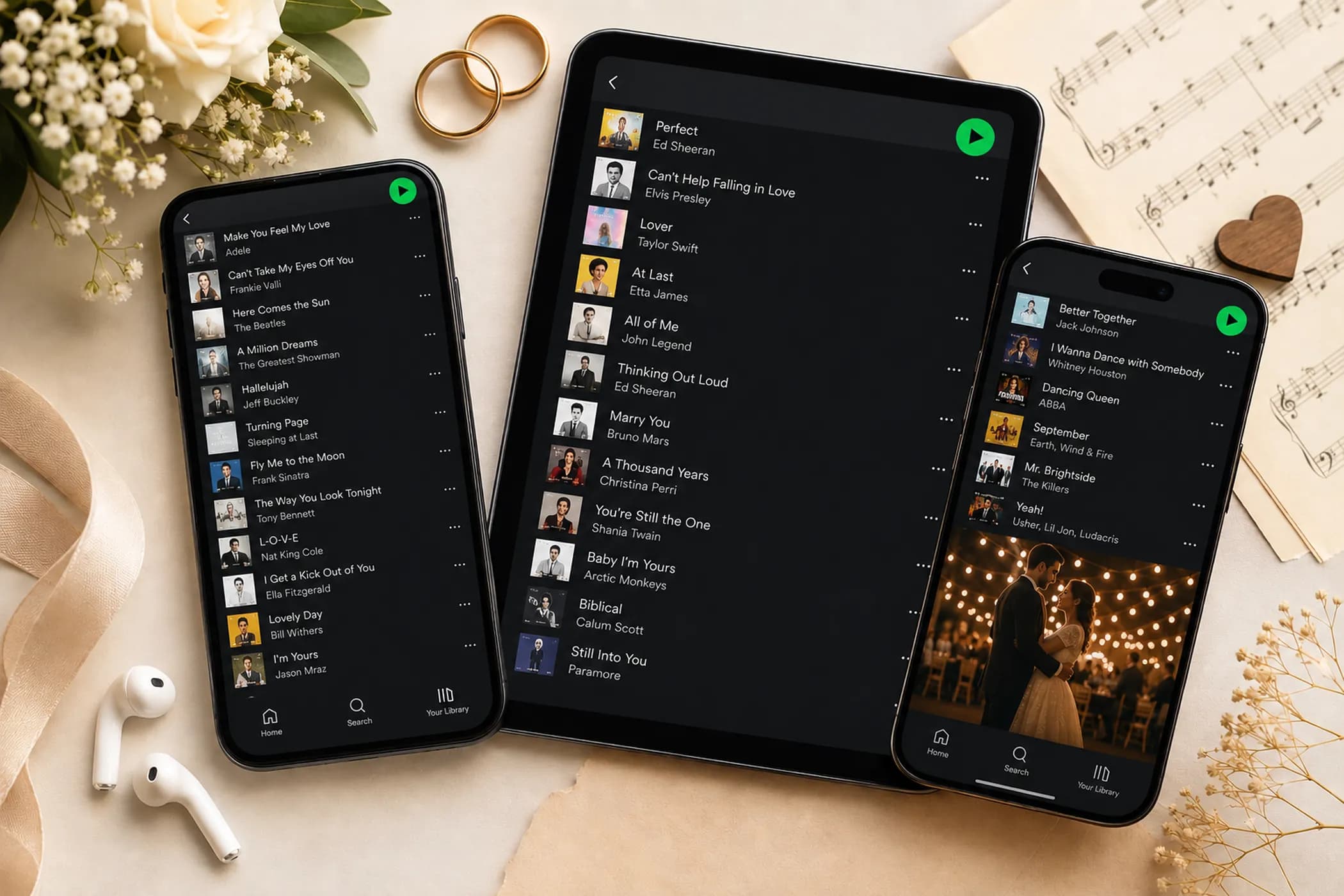
A practice couples greatly appreciate is sharing the full repertoire in advance, allowing them to mark preferences and flag songs they'd love or prefer to avoid.
The benefit isn't just for them: it dramatically reduces back-and-forth emails, eliminates misunderstandings ("I thought you played that one too"), and lets you prepare on the songs that actually matter to that couple. Couples who've been able to browse and choose online — without having to remember a twenty-minute phone call — are happier clients and easier to manage on the day.
BandCalendar has a dedicated feature for this workflow. In a few clicks you can generate a personalised link and send it to the couple: it opens a dedicated page, no login required, optimised for smartphones. The repertoire is organised into separate sections — ceremony, cocktail, dinner, evening dancing — each with a distinct colour and a customisable label you set before sending.
The couple scrolls through the list, highlights the songs they want (with a colour per phase), adds notes on individual songs or a general message, and submits with a tap. All of this happens independently, without you needing to be available at that moment.
When the response comes in, you find the highlighted songs directly in the management software — with a button that automatically generates the event setlist from the client's selections. No manual copying, no follow-up summary emails to send and wait for.
For the client, it's a polished and professional experience. For you, it eliminates one of the most time-consuming steps in the entire organisation process.
5. The day of the event
Arrival and soundcheck. Allow at least two hours before the start time for setup and run-through. Don't trust "official" schedules: catering running late, the room still being decorated, the ceremony coordinator moving your setup spot — all of this happens regularly. Buffer time is your insurance against other people's chaos.
Band briefing. Musical details get sorted at rehearsal. But before entering the venue, a briefing on the organisational side is essential: the sequence of key moments in the evening (couple's entrance, first dance, cake cutting, any surprises), the agreed times with the venue, who's the on-site contact among the venue staff, and who handles communication with the MC or wedding planner.
Managing the unexpected. The ceremony ran twenty minutes over. The catering served the starter late. The couple want to add a song not on the setlist. Having a clear protocol for handling these situations — who decides, how it's communicated internally — separates professional bands from those that panic. Our guide to the 8 most common wedding emergencies covers what to do when things go wrong.
Collecting the balance. Asking for money at midnight, when the couple are euphoric and surrounded by guests, is awkward for everyone. If you can negotiate in the contract that the balance is due a few days before the event, that's the ideal solution — but couples don't always agree to pay everything upfront. If payment on the evening is unavoidable, a good practice is to suggest the couple delegate this to a relative or witness: they hand the envelope to the bandleader at the start of the evening, when the atmosphere is still calm and before the party gets going.
6. After the event
- Record the balance received — update your records immediately
- Split the fees among musicians — with a criterion agreed in advance, not improvised on the night. Our guide to managing payments within a band explains how to structure splits fairly
- Request a review from the client — word of mouth is the primary acquisition channel for wedding bands. A thank-you message sent within 48 hours, with a direct link to the Google page, the directory profile or Trustpilot, multiplied across twenty weddings a year, builds a solid reputation over time. Our guide to collecting reviews on Google and wedding directories explains when and how to ask
- Update the portfolio — photos and video from the event should be archived and selected while the memory is fresh
The most common problems (and how to avoid them)
Slow response to the first enquiry
A couple planning a wedding contacts multiple vendors in parallel. Whoever responds after 48 hours often finds the spot already taken. The solution isn't to be glued to your phone: it's to have a standard quote ready to send in minutes, so that the response is complete and professional even if it arrives between one soundcheck and the next.
Scattered communications
Emails with the client, WhatsApp with the musicians, handwritten notes for logistics. When everything is distributed across different channels, all it takes is one detail getting lost to create a problem on the wedding day. Centralising information — contract, setlist, logistics, payments — in a single place is the only effective defence against this kind of mistake.
Last-minute requests
"But we said you'd also play during the cocktail hour" — this sentence, spoken half an hour before the cocktail hour, is the classic misunderstanding that arises when the service details aren't written unambiguously in the contract and quote. The more precise the document, the less room there is for creative interpretation.
The balance that never arrives
Getting the balance before the event isn't always possible — many couples prefer to pay on the night. But there's one rule musicians should be inflexible about: payment must be collected on the evening of the event itself, never after. Chasing a client who has just left for their honeymoon — and has a thousand other things on their mind — is draining and often fruitless. The balance date goes in the contract, and the evening of the event should be treated as a non-negotiable deadline.
The right tools make the difference
Managing all of this with scattered emails, spreadsheets and WhatsApp messages is possible, but exhausting and prone to error. A dedicated management tool like BandCalendar centralises every phase: from quote to signature, from setlist to fee distribution.
The result is less time on administration and more time making music.
If you want to stop wasting time with Word documents, PDFs and paper signatures, BandCalendar is built exactly for this.
Related BandCalendar workflows
Explore the connected features
Wedding bands
BandCalendar helps wedding bands and live musicians turn inquiries, quotes, contracts, repertoires, setlists, logistics and payments into one workflow that the whole team can use before, during and after the event.
Open pageEvent calendar
An operational calendar for musicians and bands that connects sales pipeline, clients, gigs, rehearsals, tasks, reminders, lineups, documents, Excel export and personal Google Calendar and Apple Calendar/iCloud sync.
Open pageQuotes and contracts
Create professional quotes and contracts for music services from separate content and layout templates, with rich text editing, preview-consistent PDFs, services and expense reimbursements, online quote acceptance, public links and click-to-accept simple electronic signature without a client account.
Open pageBand management software
What band management software needs: calendar, CRM, quotes, click-to-accept contracts, setlists, documents, collaborators, Finances and fees.
Open pageStop wasting time with Word, PDFs and spreadsheets.
- Contracts, payments, events, all in one place
- Designed for concerts, private events, weddings and tours
- Free up to 60 MB, no credit card required
Get one useful guide a month