Destination Weddings in Italy: What Foreign Bands Need to Know
A practical guide for bands travelling to Italy for a wedding: work rules, SIAE, customs, equipment, venues, timelines and Italian wedding culture.
May 26, 2026 · BandCalendar
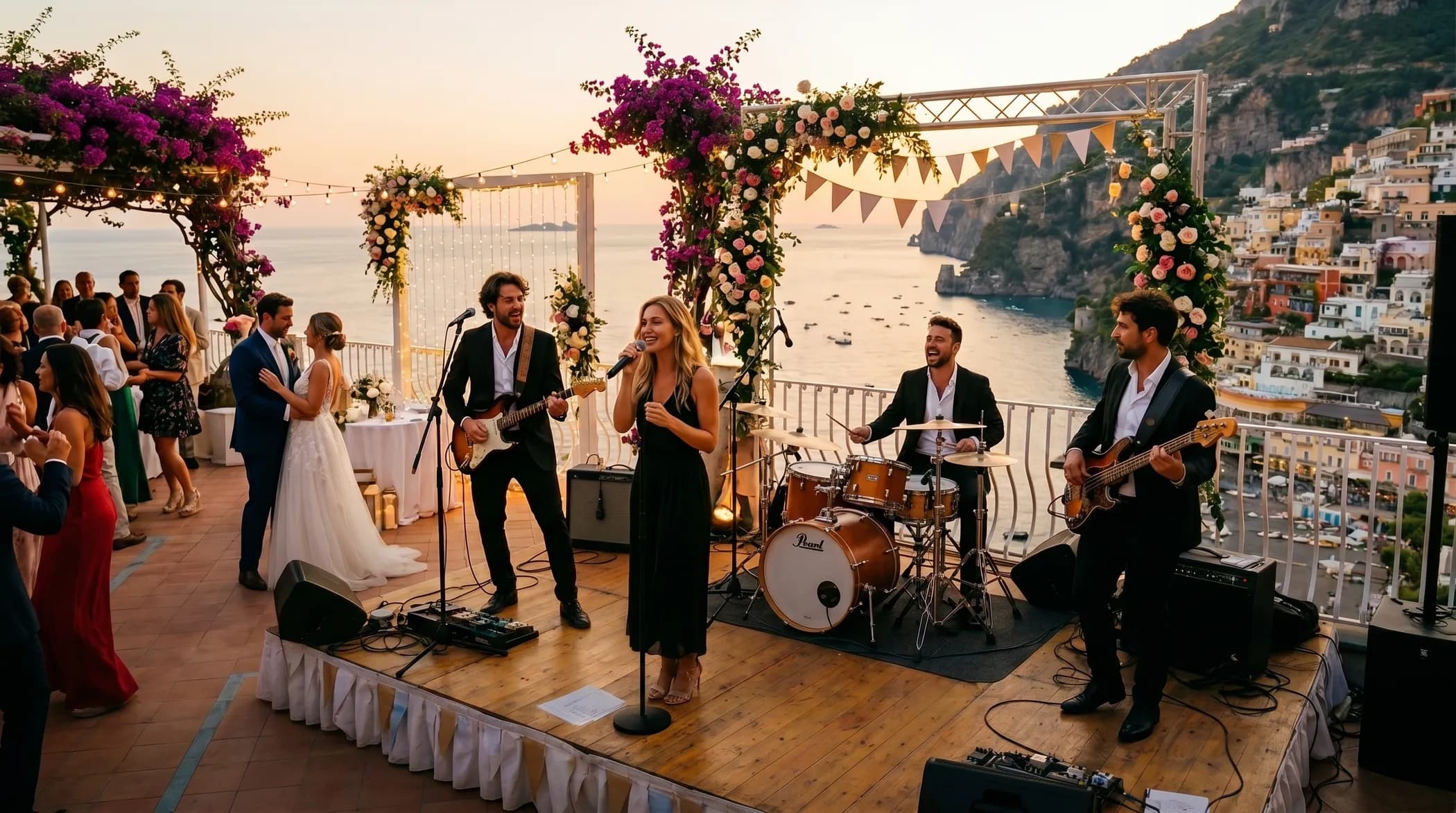
Italy is one of the strongest destination wedding markets in the world. That is not marketing copy: in 2025 the Destination Wedding in Italy Observatory estimated more than 16,700 weddings by foreign couples in Italy, over EUR 1.1 billion in revenue, and an average event budget of around EUR 67,000.
For bands outside Italy, that sounds attractive. A couple loves your band in London, Dublin, Berlin, New York, Toronto or Sydney and asks whether you can fly to Tuscany, Lake Como, Puglia, Sicily or the Amalfi Coast for their wedding.
Sometimes the answer should be yes.
But an Italian destination wedding is not just another wedding with better scenery. It is a cross-border job, in a country with its own music licensing rules, venue restrictions, power standards, customs procedures, curfews, wedding flow and supplier culture. If you treat it like a local gig plus flights, you can get yourself into trouble.
This is what you need to know before you say yes.
First: make sure you can legally perform
If you are an EU citizen, the baseline is simple: EU nationals can work as employed or self-employed workers in another EU country without a work permit. For most European bands, that removes the biggest immigration barrier, although tax, social security and insurance questions still need to be checked properly.
If you are from the UK, USA, Canada, Australia or another non-EU country, do not assume that visa-free tourist entry allows you to perform for money at a wedding in Italy.
Italy has specific procedures for non-EU workers in the entertainment sector, and Italian consular pages list a self-employment route for artists engaged by public or private entities. The exact route depends on nationality, length of stay, who is contracting you, and whether the work is treated as self-employed or organised through an employer.
The practical rule is blunt: check with the relevant Italian consulate or an immigration professional before accepting the booking. Do not rely on the couple, the planner or the venue to know this. Many destination wedding clients assume that if they can enter Italy as tourists, their photographer, celebrant or band can work there too. That assumption can be wrong.
If the paperwork is not realistic, quote for a local Italian partner instead: you provide direction, arrangements or a DJ-style appearance where lawful, and the live performance is handled by musicians already based in Italy. It is better to redesign the service than to gamble at the border.
Italy is 230V, 50Hz, with Italian plugs
Italy uses 230V / 50Hz power and, in real venues, you may encounter Type L Italian sockets, Schuko-style Type F sockets, or mixed adapters already installed by the venue.
For European bands this is usually manageable.
For North American bands, it is a serious technical point. Many laptop chargers and modern power supplies are dual voltage. Some pedalboards, keyboards, wireless receivers, mixers, vintage amps and lighting units are not. A plug adapter changes the shape of the plug; it does not turn 230V into 120V.
Before you travel, check every piece of equipment. If it is not rated for 230V / 50Hz, you need the correct transformer or, more realistically, you should rent that part locally.
Also ask the venue or planner for proper power information:
- where the band will be positioned
- how many dedicated circuits are available
- whether power is outdoors
- whether sockets are on timers or switched off until staff activate them
- whether generators are involved
- whether the venue uses a sound limiter
Do not arrive with a full international rig and expect a historic villa to behave like a modern theatre.
Do not fly your whole PA unless you have to
Most foreign bands should not bring a complete PA system to Italy.
Flights, excess baggage, customs, fragile equipment, power compatibility, local transport and load-in access can turn a profitable booking into a logistical mess. In Italy, many destination wedding venues are historic properties: villas, castles, farms, masserie, wineries, terraces, old towns. Beautiful for photos, annoying for cases. Our guide to preparing a professional technical rider explains how to specify equipment requirements clearly.
The smarter model is usually:
- bring essential personal instruments
- bring microphones, in-ears, laptops and small specialist items
- rent PA, monitors, lighting and sometimes backline locally
- ask for a named Italian audio supplier
- agree the tech spec before the contract is final
This is not a downgrade. It is how you protect the performance.
Italian wedding planners who work with international couples are used to sourcing local production. The problem is not whether production exists; the problem is whether the quote clearly says who books it, who pays it, what spec is required, and who is responsible if it is wrong.
Customs: instruments are easier than full production, but still plan it
If you are travelling from inside the EU, customs is not the issue.
If you are entering the EU from outside, temporary import rules matter. Portable musical instruments and accessories carried by travellers can benefit from customs simplifications when temporarily imported as professional equipment, but that does not mean you should travel without records.
Carry an inventory with serial numbers, values and ownership information. For higher-value equipment or larger professional setups, check whether an ATA Carnet or another temporary admission process is appropriate. If your instruments contain protected materials such as ivory, tortoiseshell, Brazilian rosewood or other CITES-listed species, check documentation requirements before travelling.
This is especially important for older guitars, bows, vintage instruments and decorative props. The wedding client will not understand why customs has delayed your bass or violin. You need to understand it before you fly.
SIAE is not optional, but it is not your bordero nightmare anymore
Italy has a performing rights system for private parties. If copyrighted music managed by SIAE is played at a wedding, the couple must obtain a SIAE private parties licence through the official portal. The licence is generally the responsibility of the organiser, which in a wedding means the couple, not the band.
For private parties, including weddings, SIAE no longer requires the bordero: you do not submit the list of songs performed for that private wedding.
That is good news, but you still need to clarify the licence in writing. Do not just write "licensing excluded" and hope everyone understands.
Use plain language:
"The Italian private event music licence (SIAE) is not included in our fee. It must be arranged by the couple through the official SIAE Private Parties portal before the wedding date. The planner or venue may assist, but the licence is the couple's responsibility."
If you also play recorded music, DJ-style sets or playlists between live sets, say so. SIAE tariffs distinguish live music from recorded music and mixed use, and the couple needs the correct licence.
Italian venues often have strict sound limits
The dream is an outdoor party under olive trees until 2 a.m.
The reality may be music outdoors until 11 p.m., amplified music moved indoors after dinner, a hard midnight stop, or a sound limiter that cuts power if you push the system too far.
Italian noise rules are not one simple national curfew. They depend on municipal regulations, venue permits, local residents, environmental constraints and the venue's own contract with the couple. Historic towns, lake areas, countryside villas and coastal venues can all have different limits.
Your job is not to argue with the venue manager on the night. Your job is to know the limit before you quote.
Ask:
- what time amplified outdoor music must stop
- whether the party can continue indoors
- whether drums are allowed outdoors
- whether there is a dB limit at the stage or property boundary
- whether a limiter is installed
- whether fireworks, cold sparks or amplified speeches are allowed
- who has authority to stop the music
Then design the performance around the rules: acoustic ceremony, semi-acoustic aperitivo, controlled dinner music, full party indoors. That is much better than promising a festival-style outdoor set that the venue will shut down.
The Italian wedding flow is different
A typical destination wedding day in Italy often looks like this:
- guest arrival
- symbolic, civil or religious ceremony
- aperitivo or cocktail reception
- seated dinner with several courses
- speeches, sometimes spread across the meal
- cake cutting, often in a separate scenic location
- first dance and party
- late-night open bar or DJ set, if allowed
The aperitivo can be a major part of the event, not just a short drinks hour. Dinner can be long. The dance floor may not start until much later than in the UK, Ireland, US or Australia. In some weddings, the first dance happens after the cake, not immediately after dinner.
Do not build your set plan around assumptions from your home market.
Ask for the Italian run sheet and adapt to it. You may need a smaller acoustic lineup for ceremony and aperitivo, a very restrained dinner setup, then the full band later. You may need to move position. You may need two systems. You may need to wait longer than expected between musical moments.
Quote for presence and logistics, not just playing time.
Symbolic ceremonies are common and very personalised
In 2025, symbolic ceremonies represented the majority of destination weddings by foreign couples in Italy. This matters for musicians.
A symbolic ceremony is not bound by the same structure as a church or town-hall ceremony. It may include multiple entrances, bilingual readings, personal vows, rituals, family speeches, a friend acting as celebrant, or a dramatic exit timed to a very specific song cue.
You need more than a song list.
Ask for:
- processional order
- exact cues
- whether music continues under readings
- whether a microphone is needed for the celebrant
- whether the celebrant speaks English, Italian or both
- name pronunciations
- who gives the visual cue if the band cannot see the aisle
A wedding ceremony is not a concert. Your job is to make the timing feel invisible.
Italian flavour: use it carefully
Many international couples want "something Italian". That might mean "Volare", a Neapolitan classic, an operatic moment, a mandolin-style aperitivo, a tarantella, or a regional folk reference.
Do not turn that into a theme-park version of Italy.
Italy is regional. A tarantella can work beautifully in the right southern setting and feel odd at a formal Lake Como dinner. A short Italian moment during aperitivo may be perfect for an American couple in Tuscany. A full Italian folk set may be exactly right for a family with roots in Sicily or Puglia.
Ask what they mean by Italian:
- a recognisable song
- a regional reference
- an acoustic atmosphere
- a party moment
- a tribute to family heritage
- simply music that feels elegant in the setting
Most destination wedding parties still want international repertoire once the dance floor opens. The Italian touch should support the event, not dominate it by default.
Work with the planner, but get decisions in writing
Italian destination weddings often involve a planner, and the planner may be your main day-to-day contact.
That is normal. It is also where misunderstandings start. Our guide to coordinating between the band, venue and wedding planner explains who's really in charge and how to avoid conflicts.
The planner can coordinate timings, supplier access, venue rules, transport and local production. But if your contract is with the couple, financial decisions need to come from the couple or be clearly authorised by them.
Get written confirmation for:
- final fee and currency
- deposit and balance schedule
- travel and accommodation responsibilities
- local production supplier
- exact services included
- overtime rate
- cancellation and postponement policy
- force majeure and travel disruption
- who approves extra sets or timing changes
WhatsApp is common in Italy on the day. Use it for coordination, not for rewriting the deal.
Quote in EUR and include the boring costs
Destination wedding clients often compare your fee to what they would pay at home. That can make Italy look deceptively simple: flights plus hotel plus performance.
Your quote needs to include the real costs:
- flights with instruments
- checked baggage and oversized baggage
- local airport transfers
- van or driver if needed
- accommodation near the venue
- meals and per diem
- travel day fees
- rehearsal or preparation time
- local PA and backline
- insurance
- visa or document costs, if applicable
- buffer for delays
Quote in EUR unless there is a strong reason not to. The venue, planner and local suppliers will operate in EUR. If you quote in GBP, USD, CAD or AUD, define who carries exchange-rate risk.
For long-haul bands, also be honest about fatigue. A wedding performance after an overnight flight and a three-hour transfer is not professional. Build in arrival the day before, ideally with enough time to recover and check production.
Load-in can be harder than the performance
Italian destination wedding venues are often old, protected, rural or scenic. That is the point. It also means:
- cobblestones
- gravel paths
- stairs
- no backstage
- limited parking
- small service entrances
- distance between ceremony, aperitivo, dinner and party
- restricted vehicle access in historic centres
- strict setup windows because the venue is still open to tourists or guests
Ask for photos or videos of the load-in route, not just the performance space.
If the venue says "the band area is in the garden", ask how cases reach the garden. If the planner says "there is power nearby", ask how far nearby is. If the party is in a cellar, ask about stairs, humidity and ventilation.
The difference between a smooth Italian wedding and a stressful one is often decided before anyone plays a note.
The bottom line
Playing a destination wedding in Italy can be a great job. The settings are beautiful, the clients are often invested, and the events can be musically rewarding.
But Italy rewards preparation. Check your right to work. Keep customs and instruments clean. Rent locally when it makes sense. Understand SIAE. Respect sound limits. Learn the Italian wedding flow. Put travel, production and decision-making into the contract.
The goal is not to make the wedding feel complicated. The goal is to absorb the complexity early so the performance feels effortless on the day.
Want to keep international wedding bookings under control?
With BandCalendar you can manage events, contracts, setlists, lineups, documents and payments in one place, from the first enquiry to the wedding day.
Try it free — no card required
Free plan included, upgrade whenever you like
Related BandCalendar workflows
Explore the connected features
Wedding bands
BandCalendar helps wedding bands and live musicians turn inquiries, quotes, contracts, repertoires, setlists, logistics and payments into one workflow that the whole team can use before, during and after the event.
Open pageQuotes and contracts
Create professional quotes and contracts for music services from separate content and layout templates, with rich text editing, preview-consistent PDFs, services and expense reimbursements, online quote acceptance, public links and click-to-accept simple electronic signature without a client account.
Open pageEvent calendar
An operational calendar for musicians and bands that connects sales pipeline, clients, gigs, rehearsals, tasks, reminders, lineups, documents, Excel export and personal Google Calendar and Apple Calendar/iCloud sync.
Open pageBand management software
What band management software needs: calendar, CRM, quotes, click-to-accept contracts, setlists, documents, collaborators, Finances and fees.
Open pageStop wasting time with Word, PDFs and spreadsheets.
- Contracts with simple electronic signature and tracked communications
- All confirmations in writing, no verbal-only agreements
- Protected reputation: everything in black and white
Get one useful guide a month
Related articles

Live Band vs DJ for Your Wedding: What Nobody Tells You (With Real Prices)
May 16, 2026
Freelance Musician Tax: How It Works in the UK, US, Canada and Australia
May 16, 2026