Band, Venue Manager and Wedding Planner: Who's Really in Charge?
No protocols, no coordination frameworks: how the relationships between musicians, venue staff and wedding planners actually work on the day.
March 22, 2026 · BandCalendar

The myth of supplier coordination
Search online for how to manage relationships between a band, the catering team and the wedding planner and you'll find plenty of articles talking about "coordination protocols", "proactive supplier communication", "shared briefings". Sounds great. The problem is that's not how it works.
The reality is much simpler — and for that reason, much more manageable.
Every supplier at a wedding has just one client: the couple. The musician works for the couple. The venue manager works for the couple. The wedding planner works for the couple. Everyone serves their own client, and if one does something for another it's only because both have agreed on it with the couple — not because they've made arrangements between themselves.
The musician's contract is with the couple. Not with the venue, not with the catering team, not with the wedding planner. Anything needed from the venue — space, power, early access — is requested by the couple from the venue. Not by the musician. Between the musician and the venue, in the vast majority of cases, there is no prior contact at all, and no need for any.
The contract with the couple is the only compass
Everything that happens over the course of the evening is measured against one thing only: the contract you signed with your clients.
The venue manager wants the dancing to happen between the starter and the main course? If the contract provides for a dancing slot in that window, fine. If it doesn't, the answer is no — politely, but no. If it provides for a single 20-minute slot and he wants 50 minutes split into three separate slots, you decide. Maybe you're in a good mood, maybe you're not. But there's no obligation to go along with it, and no one has the right to make you feel bad about it.
The wedding planner asks for something that's not in the contract? Same answer. You roll with it if it's reasonable and costs you nothing. Otherwise, no.
That is real coordination: not protocols, but common sense applied to what you actually signed up for.
What the venue manager actually wants (always the same things)
Venue managers are predictable. Wherever you go, they say the same four things.
First: they want the band not to take up too much space, especially if there's a dancing segment during or after dinner. It's a legitimate concern, but any musician who has put the minimum stage dimensions and the distance from the tables into the contract has nothing to worry about: if the couple signed that clause, it means — in theory — that they checked it. In practice that's not always true: couples often sign without reading, or read without checking, or check and downplay it. If you arrive and the space is tight, you adapt. There's no other practical option. You can certainly point out to your clients that the clause wasn't met — but taking legal action over a couple of square metres is ridiculous, and it's not worth it.
Second: they want to decide when to start the dancing, if it's included. They usually slot it in the longest break between courses — typically between the starter and the main — because that's when their staff has the most room to manoeuvre. It's reasonable, and you almost always go along with it.
Third: they want the band to respect any curfews imposed by the venue — volume lowered after a certain hour, music finished by midnight. You respect that too; it's in the contract with the couple.
Fourth, the one that really matters in practice: the venue manager gives the band a signal when the couple enters the room, because from the stage you often can't see the entrance. A nod, a gesture, a signal — and the band starts playing. That is the real communication between the venue manager and the musicians on the day. Not protocols. A nod.
The soundcheck: arrive early, know your priorities
Professional bands arrive at the venue at least an hour and a half, ideally two hours, before the first guests arrive. It's not a written rule anywhere: it's simply the time needed to unload the gear, set up the rig and run a soundcheck before the room fills up. It's good practice to include this in the contract with the couple — not with the venue, who's not your client — specifying the right to arrive early, unload close to the stage and complete the soundcheck at least an hour before guests arrive.
This is where the first concrete interaction with the venue manager comes in. To save money, venues often put certain sections of the electrical system on a timer: some sockets are switched off at the breaker during hours when they're not needed, and when the band arrives for the soundcheck they often find themselves without power. It happens often. Is it a problem? Almost never: you ask the venue manager or maintenance person to turn the socket back on, and they do it without fuss. They deal with it hundreds of times a season; they know exactly how it works. You don't need prior contact, a site visit or a specific clause with the venue — you just ask on the spot.
The soundcheck is not a rehearsal. It's not the moment to learn songs or finalise the setlist — that happens at weekly rehearsals. It's for checking levels, verifying that every instrument is working and understanding what each musician hears from the stage. Microphone feedback, drums drowning out the vocals, bass coming in too loud at the nearby tables: these problems get solved in the soundcheck, not during the couple's first dance.
If time is short — and it often is because the room isn't free when you arrive — start with the instruments that need the most adjusting: drums and vocals first. The rest can be dialled in.
The pre-evening briefing: what you actually say to the venue manager
Before the guests arrive, the musician finds the venue manager. Not for a formal briefing: for a five-minute standing chat that resolves everything.
The first thing to establish is the position — or positions, if the evening has multiple phases. If there's a small ensemble for drinks in the garden and then the full band indoors for the after-dinner dancing, you need to know both locations. And along with the positions, where to plug in for background music: where to set up the speaker for ambient sound, whether there's a built-in player or you need a Bluetooth receiver, where the cables run.
Positioning is the trickiest point. The musician wants to be placed so that the band is visible and audible: the couple are paying for the band, they should be able to see and hear them during the reception, not find them wedged into a corner behind the plants. That's why it's good practice — once the contract is signed — to ask the couple if you can have some input on the room layout before everything is decided. A simple message: "Send me the floor plan so I can tell you what works best." Sometimes it works. Sometimes it doesn't, because the venue says the positioning is non-negotiable and the couple are easily persuaded: table layout takes priority over everything, for the venue and for the catering team, and no table gets moved to give the band more space. That's understandable. It's also why, in the end, the band almost always adapts — even when the space is less than what was agreed in the contract.
The rest of the conversation with the venue manager covers the flow of the evening. Guests arrive in the garden for drinks, then move inside for dinner. The couple enter from there, and at that moment you need a signal to start playing, because from the stage you often can't see the entrance. Is there a dancing segment during dinner? Yes, between the starter and the main. Then for the cake-cutting you'll go back outside. That's it. The venue manager doesn't get involved in the musical side — repertoire, setlist, arrangements are nothing to do with them — apart from guidance on volumes, closing times and whether dancing is included. The rest is your business.
The wedding planner: many requests, one rule
The working relationship with the wedding planner is, in practice, disarmingly simple. Much simpler than the "supplier coordination" literature would have you believe.
The requests that come from the planner are less predictable than those from the venue manager — they don't follow a fixed pattern like "stage space" or "closing time." Logistical, aesthetic and organisational requests come in, sometimes frankly odd ones, often showing some confusion about what a musician's role actually is. The answer, in every case, is always the same: the contract with the couple and common sense. If the request is reasonable and falls within what you've agreed with your clients, you roll with it. Otherwise, no.
It's worth saying plainly: so-called "coordination" by the wedding planner is equally pointless whether you're dealing with professionals or amateurs, though for opposite reasons.
With professionals it's pointless because professionals already know what to do, when to do it and what's appropriate at every point in the evening. They know which of the couple's requests they agreed to and which ones they turned down, and they did so in a written contract. They don't need someone to explain their job to them. The planner might, however, pass along useful information — a request from the bride that she forgot to make directly to the band, or that she delegated to the planner. In that case you listen, assess, and respond accordingly: yes if it's within the contract, no if it goes beyond it.
With amateurs it's pointless for the opposite reason: if the musicians don't know their craft, a wedding planner certainly can't guide them. She knows her job, not theirs.
The slightly uncomfortable truth is that a wedding planner should always read the contracts their clients sign with suppliers. If they did, they'd know exactly what they can ask of that musician, that photographer, that florist — and what falls outside their agreement. Most planners don't. They ask for what seems reasonable in their own interests, which is keeping their client happy. That's understandable. But it's not the musician's problem: the musician is only bound by the contract they signed with the couple, not by the planner's expectations.
The rule that never changes
Anxious wedding planners, venue managers with their own ideas, venues with their rules: weddings are full of people who want to tell you what to do. The way to decide what to go along with and what not to is always the same: the contract you signed with your clients.
If it's in the contract, you do it. If it's reasonable and costs you nothing, you do it anyway. If it goes beyond what you agreed with the couple, you're free to say no — with a smile, but firmly. You owe no explanation to anyone except your clients.
Coordination is not a system. It's common sense applied, evening after evening.
Want to keep everything under control from first contact to the day of the event?
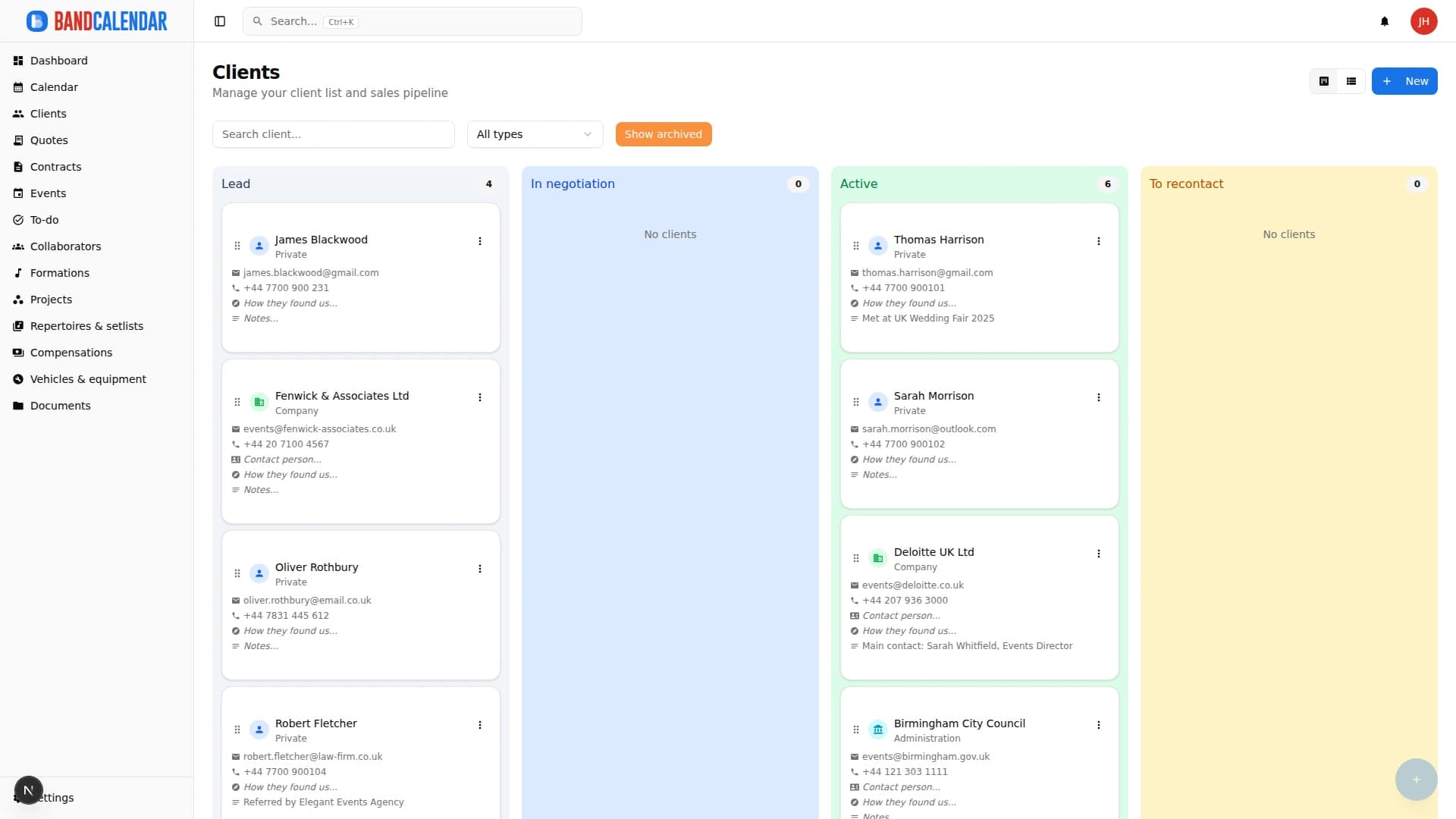
With BandCalendar you manage contracts, setlists, client communications and lineups — all in one place, with nothing falling through the cracks.
Try it free — no card required
Free plan included, upgrade whenever you like
Related BandCalendar workflows
Explore the connected features
Wedding bands
BandCalendar helps wedding bands and live musicians turn inquiries, quotes, contracts, repertoires, setlists, logistics and payments into one workflow that the whole team can use before, during and after the event.
Open pageEvent calendar
An operational calendar for musicians and bands that connects sales pipeline, clients, gigs, rehearsals, tasks, reminders, lineups, documents, Excel export and personal Google Calendar and Apple Calendar/iCloud sync.
Open pageCollaborators and lineups
Manage the band's real lineup: core musicians, substitutes, extra collaborators, roles, instruments, lineups, projects, linked events, payments, documents and different team permissions.
Open pageBandCalendar vs Google Calendar
Google Calendar remembers dates; BandCalendar manages the booking: clients, contracts, setlists, documents, Finances and collaborators, with personal Google and Apple sync.
Open pageStop wasting time with Word, PDFs and spreadsheets.
- Contracts with simple electronic signature and tracked communications
- All confirmations in writing, no verbal-only agreements
- Protected reputation: everything in black and white
Get one useful guide a month