How to Say No to a Client (Without Burning Bridges)
Impossible requests, unrealistic budgets, unavailable dates: when and how to turn down a client while keeping your professionalism and reputation intact.
March 21, 2026 · BandCalendar
The moment everyone dreads
The call comes in at 10pm. It's a couple who found your website. They want to know if you're available for their June wedding. Every Saturday is already booked except one — which happens to fall on your parents' anniversary, the only weekend of the year you promised not to work.
Or: the client asks if you can play for eight consecutive hours instead of the four agreed, "since you're already there." Or: they want you to learn fifty new songs for the event but aren't willing to pay extra. Or: they ask for a 40% discount because "we're friends of friends."
Saying yes to everything isn't professional. It's exploitation. But saying no the wrong way can cost you clients, earn you bad reviews, and damage your reputation. The difference between a musician who gets called back and one who gets forgotten comes down to how they say no.
Why saying no is hard
For many freelance musicians, every enquiry is an opportunity. Work isn't guaranteed, dates fill slowly, and every "no" feels like turning down money. There's the fear the client'll go to a competitor. The fear of seeming uncooperative. The temptation to accept everything and worry about it later.
The problem is that accepting impossible conditions solves nothing. It creates unrealistic expectations, generates stress during the event, and often leads to conflict when something inevitably goes wrong. The client who gets everything is also the client who'll demand even more next time — and who'll call you at 11pm the night before the event because "there's a small change."
Saying no isn't a closed door. You're simply telling the client what your service does and doesn't include — and those limits are precisely what make your work professional and sustainable.
When to say no
The date isn't available
The simplest case: you're already booked. There's no room to negotiate, no way to rearrange things. The answer's a clear no, but it can be a gentle no: "That date is already taken, but I may have availability for [alternative date]."
No need for elaborate excuses. Availability is a finite resource. Saying "I'm already booked" is enough.
The request is outside the budget
The client has a firm budget — say €800 — and your service starts at €1,500. You could come down to €1,200, but no further. What do you do?
The temptation is to say "let's see" and then reduce the service: fewer musicians, less time, less equipment. Sometimes it works. Sometimes the client still expects the full service at the reduced price, and disappointment is guaranteed.
The honest answer is: "For that budget I can offer you [reduced service]. If you want the full service, the price is [X]. Which would you prefer?"
The request is out of scope
"Could you also play during the cocktail hour?" "Could you learn this song for my mother?" "Could you come an hour early for soundcheck?" "Could you bring the lighting rig too?"
Each of these requests makes sense in isolation. The problem is when they add up without the client understanding that each one has a cost. Your original quote covers a specific service. Everything else is an extra.
The answer: "Absolutely, that service is available. It costs [X] more. Would you like me to add it to the quote?"
The conditions aren't acceptable
The client wants to pay after the event. They want a verbal agreement. They're asking for excessive discounts. They expect you to hold the date without a deposit. These situations call for a firm no — accepting them compromises your business and sets dangerous precedents.
The answer: "To work together I need [condition]. It's a requirement for all my clients, without exceptions."
It's not the right client
Sometimes the problem isn't the request — it's the person. The client who sent you fifty emails in one week. The one who argued over every line of the quote. The one who complains about every previous vendor. The one who shouts on the phone when something isn't to their liking.
These clients drain far more energy than they're worth. And they're often the ones who leave negative reviews, even when you've done everything right.
The answer: "I've thought carefully about your request and I've realised I'm not the right fit for this event. I wish you the best in finding the perfect solution for your needs."
How to say no without burning bridges
The constructive no formula
A professional no has three elements: acknowledgement, refusal, alternative.
Acknowledgement. "I completely understand that you want [X]." This shows you've listened, you've understood the request, and you're not just brushing them off.
Refusal. "Unfortunately I can't [X]." Simple, direct, no lengthy excuses. Not "I can't because my cousin is getting married that day and the car needs fixing and..." — just "I can't."
Alternative. "But I can [Y]." Offer a different solution, an alternative date, a reduced service, a colleague to contact.
The full formula: "I completely understand that you want [X]. Unfortunately I can't [X]. But I can [Y]."
Example: "I completely understand that you want the full six-piece band for €800. Unfortunately I can't go below €1,200 for that lineup. But I can offer you the trio at €700, which has a similar sound for that type of event. Which would you prefer?"
No to the timing, not the idea
Many requests are reasonable — but arrive at the wrong moment. Learning a new song with two weeks' notice is possible. Asking for it the night before the event is not.
The difference is timing. The answer: "Learning that song for you is possible, but we need at least ten days to rehearse it properly. If you let me know by [date], I'll add it with no problem. If it's for tomorrow, I can't guarantee the quality you'd want."
The no that becomes a sale
Sometimes a no is the opportunity to clarify the value of your service. When the client asks for an excessive discount or a free extra, the response becomes a teaching moment: "The service we offer includes [X, Y, Z]. That component is priced separately because it requires [time, equipment, extra staff]. I can walk you through how the price is structured so you can decide for yourselves."
A client who understands what they're buying is a client who won't feel "ripped off" afterwards — and is more likely to pay the right price.
Offering external alternatives
If you can't meet the request but know someone who can, making that referral is itself a service. "I'm not available that date, but I can recommend [Colleague X] who does excellent work. I'll send you their details."
The client remembers the musician who helped them find a solution — even if it wasn't you playing. And they often come back for the next event, because they know you're honest.
What to avoid
Long, detailed excuses
"I'd love to come, but my mother-in-law has her birthday that week and my wife would never forgive me, and then there's also my cousin's wedding..." The more you justify yourself, the less reliable you seem. The client doesn't need to know your private life. "I'm not available" is enough.
Maybe that becomes no
"Let's see, I'll let you know" when you already know the answer is no. This creates false expectations and wastes both your time. If the answer is no, say so straight away. The client can look for another solution.
No followed by guilt
Saying no and then adding: "Sorry I can't," "I really feel bad," "I hope you understand." Apologising like this signals insecurity. A professional has the right to decline. There's no need to apologise for having boundaries.
Saying yes and regretting it
The temptation is strong. The client pushes, the date is free, the price is low but it's still work. You accept, then spend the following weeks regretting the decision. During the event you're tired, frustrated, and the client notices. A sincere no is better than a yes that turns into a problem.
The role of documents
The best way to say no is to not have to say it at all — because the limits are already written somewhere.
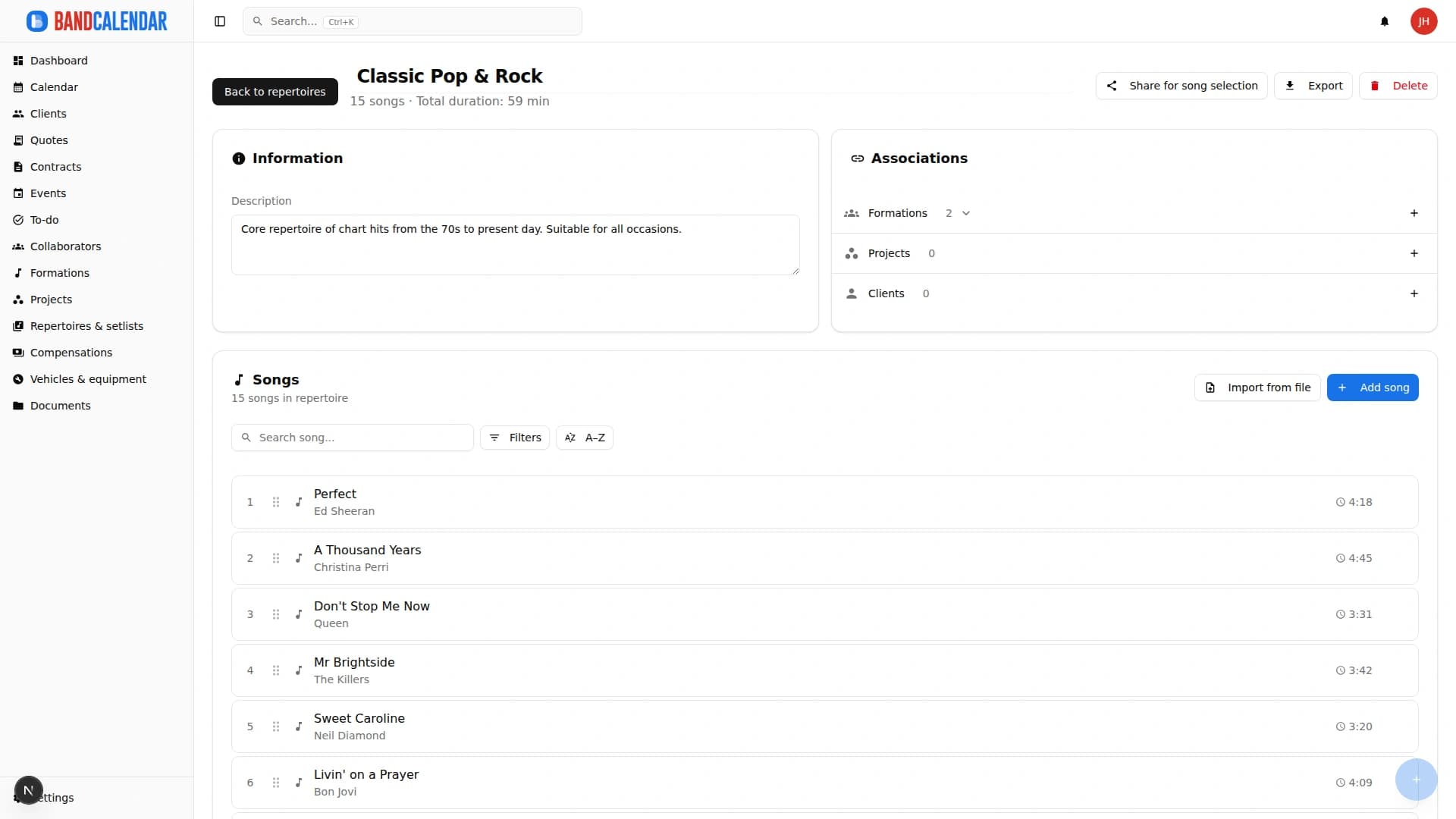
A clear quote
A specific quote isn't just a price. It's a list of what's included: number of sets, duration, number of musicians, equipment, timings, incidental costs, cancellation conditions.
When the client asks for something extra, you're not saying no to them. You're showing that the request isn't in the quote. "That's outside the service we agreed on" is much easier than "I don't want to do that."
A contract with clauses
The contract is mutual protection. If it contains clauses on cancellations, last-minute changes, timings and payments, every dispute points back to the document — not a battle of opinions.
"As per the contract, changes with less than 14 days' notice incur a 20% supplement." It's not you being rigid: it's the contract that defines the rules. And the client signed the contract too.
A record of communications
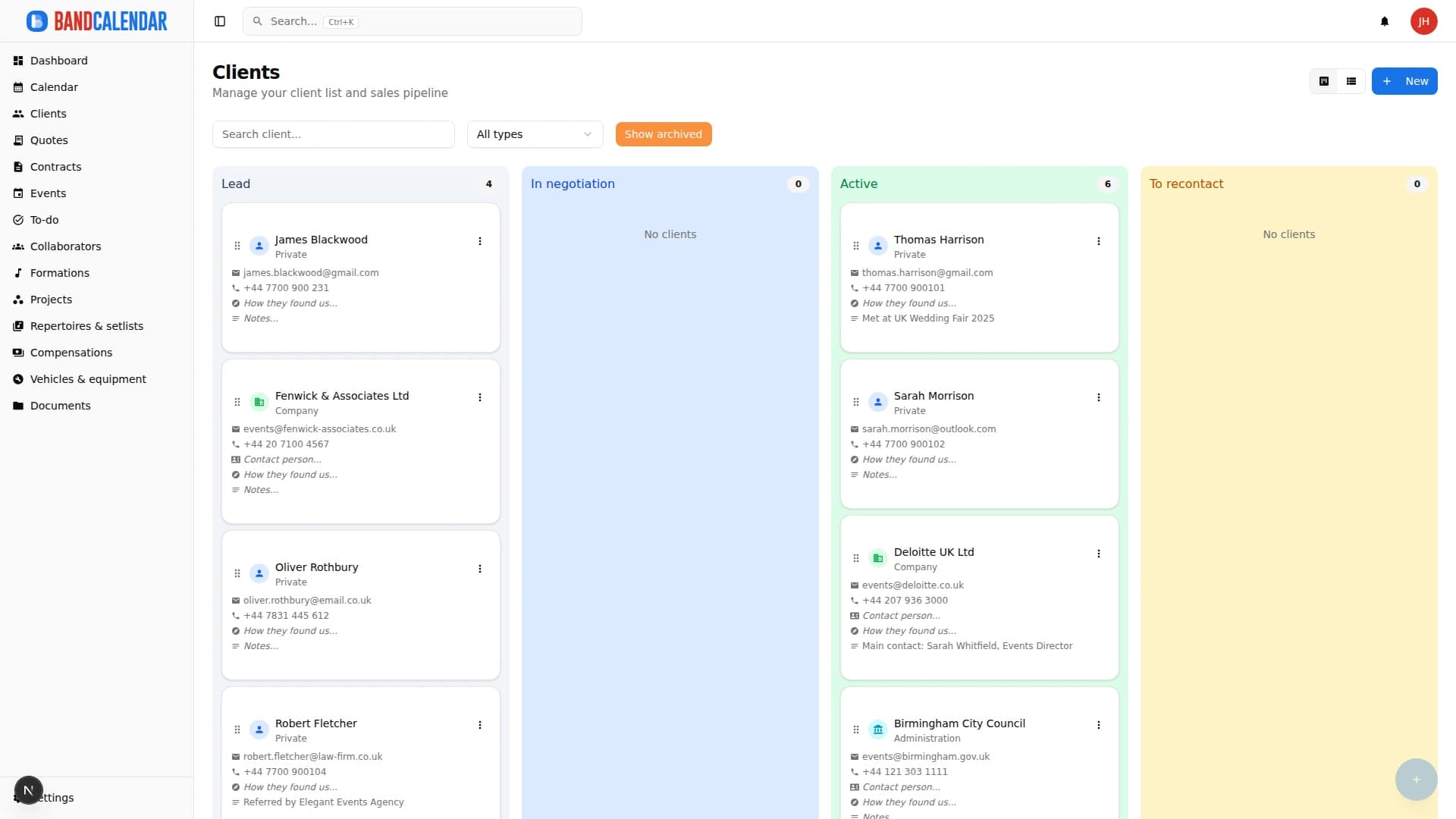
Having everything tracked in one place helps when people remember things differently. "But you said..." is much easier to handle when you can reply: "I have the message from the 15th where we confirmed [details]. If you want to change it, we can discuss it."
Where to say no in the workflow
Before the quote
If the request is clearly out of scope — budget far below your minimum, date already taken, unacceptable conditions — the best moment to say no is before investing any time. A quick response saves time for both sides.
During negotiation
When the client asks for changes to the quote, evaluate each request. Some are acceptable, others aren't: in both cases, respond explicitly. "Yes, we can do [X]." "No, [Y] isn't possible, because [reason]."
After the contract
Post-contract changes are the trickiest. Any changes must be confirmed in writing — not just verbally. If the request is impossible or unacceptable, you can always fall back on the signed contract.
The client will say no to you too
Equally important: you have the right to say no, and clients have the right to say no to you. Not every rejection is personal. Sometimes the client finds another band, a better price, a different solution. Making a drama out of it is counterproductive.
The professional who says no clearly, who accepts clients' rejections calmly, who doesn't try to win every negotiation, is the one who builds a reputation based on reliability. Clients call them back because they know that what they say is true — including when they say no.
How BandCalendar helps
Documents are the first line of defence when you need to say no. A clear quote and a contract with the right clauses prevent many arguments before they start.
Quotes. The quotes section lets you define exactly what's included: number of sets, duration, musicians, equipment, costs. When the client asks for an extra, the reference is the written document — not your personal opinion.
Contracts. The clauses on cancellations, last-minute changes, payments and timings are already in the document. When the client tries to renegotiate afterwards, the reference is the signed contract.
History. All communications, sent quotes, and requested changes are tracked. If a disagreement arises about "who said what," the answer is in the documents.
Templates. Quote and contract templates let you always have the standard clauses ready — including those that protect you, not just the client.
The bottom line
Saying no isn't losing a client. It's setting the terms on which you're willing to work. The musician who accepts everything, who has no limits, who takes on every impossible request, isn't more professional — they're just more exhausted.
The client who respects your limits is the one you want. The one who doesn't is the one who will drive you mad during the event, pay late, and leave a negative review over nothing.
Learning to say no with clarity and professionalism is one of the most important skills for anyone working in the events industry. It doesn't come from reading an article — it comes from experience, practice, and having the right documents as a solid foundation for every response.
In the meantime, the formula is simple: acknowledgement, refusal, alternative. The rest is practice.
Related BandCalendar workflows
Explore the connected features
Quotes and contracts
Create professional quotes and contracts for music services from separate content and layout templates, with rich text editing, preview-consistent PDFs, services and expense reimbursements, online quote acceptance, public links and click-to-accept simple electronic signature without a client account.
Open pageSolo musicians
BandCalendar helps solo musicians and freelancers manage gigs, clients, quotes, contracts, repertoires, documents, payments, reminders and history without scattering information across phone, email and spreadsheets.
Open pagePrivate events
BandCalendar helps musicians, bands and small ensembles manage private parties, corporate events, receptions and custom bookings with clients, quotes, contracts, timings, venues, documents and payments always connected.
Open pageStop wasting time with Word, PDFs and spreadsheets.
- Contracts with simple electronic signature and tracked communications
- All confirmations in writing, no verbal-only agreements
- Protected reputation: everything in black and white
Get one useful guide a month