How Much to Charge for a Wedding: Pricing, Strategies, and Getting Paid
How much to charge, how to structure your packages, and what to do when a client doesn't pay: a complete guide to pricing and payments for musicians.
March 21, 2026 · BandCalendar

The question every musician asks before their first booking
"How much should I charge?"
It's the first question that runs through your head when a couple contacts you about their wedding. And probably the hardest one to answer.
Charge too much and you risk losing the gig. Charge too little and you're working at a loss, devaluing your time and your professionalism, setting a precedent that's hard to reverse later.
There's no universal answer. The right price depends on dozens of factors: your experience, where you perform, your lineup size, the season, the couple's specific requests, your fixed costs.
This guide helps you do the math — not to undervalue yourself, but to understand exactly what your work is worth and how to ask for it with confidence.
The factors that affect a wedding band's price
Before talking numbers, it's important to understand what drives the final price. Two bands can charge very different amounts for the same event, and both can be right.
Here are the main factors:
Number of musicians A duo costs less than a five-piece. That seems obvious, but the difference isn't simply proportional. A quintet doesn't cost 2.5 times a duo: it costs more because of logistics (more gear, more stage space), more rehearsals, more coordination.
Performance duration Most weddings involve 2–3 sets of 45–60 minutes. If the couple wants 4 hours of continuous music, the price needs to reflect it — not just for the extra time, but for the additional energy and the preparation of a larger repertoire.
Distance and travel Playing 20 miles from your home base is very different from playing 200 miles away. Factor in:
- Fuel or train/plane tickets
- Travel time (which is time taken away from rehearsals or other work)
- Possible overnight stay (if the event runs late and driving back the same night isn't safe or practical)
Season May, June, September, and October are the most in-demand months. July and August still have weddings but many bands take vacations. November through March demand drops. Some musicians charge higher rates in peak season and offer discounts in the off-season to encourage bookings.
Day of the week A Saturday wedding is standard pricing. A Friday or Sunday wedding may come with a small discount (10–20%). A midweek wedding (Tuesday, Wednesday) may warrant a more significant discount (30–40%) because it's less common and couples often have tighter budgets.
Special requests
- Custom arrangements (personalized songs requested by the couple)
- Extra equipment (more powerful PA, lighting, dedicated sound engineer)
- Multiple-location performance (ceremony + cocktail hour + dinner at different venues)
- DJ set after the live performance
Every special request is added value that should be quoted separately.
Real price ranges in the market (2026)
The figures below are based on market research, musician forums, and actual quotes. They are indicative — your rates may be higher or lower depending on your experience and your local market. Note that prices vary significantly by region.
Acoustic duo — €800–€1,500
- 2 hours of music
- Basic equipment
Trio — €1,200–€2,000
- 2–3 hours of music
- Basic PA system
Four- or five-piece band — €1,800–€3,500
- 3 hours of music
- PA and lighting
- Dedicated sound engineer
Full band (6+ members) — €2,500–€5,000+
- 3–4 hours of music
- Complete PA system
- Sound engineer, lighting, DJ set
Important notes:
- Prices are typically quoted excluding VAT for standard tax regimes, or as all-inclusive for flat-rate tax regimes (always specify clearly on your quote)
- Most bands include a DJ set between live sets or after the performance in their price
- Some bands offer "ceremony + cocktail hour + dinner + party" packages at a better rate than booking services separately
- Higher prices tend to be found in major metropolitan areas (London, New York, Paris, etc.) and popular wedding destinations. Rates vary widely by region and country.
Real examples from forums and booking platforms:
From a wedding forum:
We have an acoustic duo for the civil ceremony and a five-piece band for the whole event (drums, bass, sax, keys, guitar) plus live band for the after-party. We're paying around €3,500.
From a booking site:
The cost of wedding music ranges from €500 to over €2,500.
From a musician community:
For a band, factor in the musical genre, number of members, transport costs, and catering.
How to calculate your price: the formula
Don't rely on guesswork or what others are charging. Calculate your price starting from your costs.
Here's a simple formula:
Base price = (Fixed costs + Variable costs + Contingency margin) + (Time × Hourly rate)
1. Fixed costs (annual, divided by number of weddings per year)
- Equipment (instruments, PA, lighting): depreciated over 5 years
- Professional liability insurance: €150–500/year
- Licensing fees (where applicable): varies by jurisdiction
- Accountant/bookkeeper: €500–1,500/year
- Website and marketing: €300–1,000/year
- Equipment maintenance: €200–500/year
Example: If you have €3,000 in fixed annual costs and play 30 weddings, that's €100 per wedding in fixed costs alone.
2. Variable costs (per wedding)
- Fuel/transport: calculate €0.50/km or actual train/plane fare
- Overnight stay: €80–150 per person if needed
- Meals: some couples provide dinner; otherwise budget €20–30 per person
- Extra equipment rental: if you need to hire something specific for that wedding
3. Contingency margin
Add 10–15% to cover:
- Delays that cause you to miss other work
- Equipment failures
- Illness (if you don't have a ready substitute)
4. Your time
How many hours do you actually put into a wedding?
- Initial communications and quote: 1–2 hours
- Negotiation: 0.5–1 hour
- Rehearsals (if the wedding requires specific songs): 2–4 hours
- Setup and soundcheck: 1–2 hours
- Performance: 3–4 hours
- Teardown and travel home: 1–2 hours
Total: 8–15 hours per wedding
If you want to earn €20/hour (net), that's €160–300 in labor alone.
Practical calculation example
Scenario: Four-piece band, wedding 60 miles away, 3 sets of 50 minutes, Saturday in peak season.
Fixed costs: €110 (equipment, insurance, accountant, marketing)
Variable costs: €200 (fuel €100, dinner €100)
Contingency margin (15%): €47
Time (12 hours × 4 musicians × €20/hour): €960
Total price: €1,317
Round up to €1,400–1,500 to give yourself room to negotiate.
Pricing strategies: packages vs. custom quotes
You have two possible approaches:
Approach 1: Predefined packages
Create 2–3 packages with fixed prices and included services. Advantages:
- The client immediately understands what they're getting
- You reduce time spent quoting
- You come across as more professional (like a restaurant menu)
Example:
Basic Package — €1,200
- Duo (vocals + guitar/piano)
- 2 sets of 50 minutes
- Basic PA system
- Standard repertoire (up to 100 songs)
- Available within 30 miles
Premium Package — €2,200
- Four-piece (vocals, guitar, bass, drums)
- 3 sets of 50 minutes
- PA and lighting
- Dedicated sound engineer
- Extended repertoire (up to 300 songs)
- 1 custom arrangement included
- Available within 60 miles
- DJ set between live sets
Approach 2: Custom quote
Start from a base rate and add extras based on requests. Advantages:
- Maximum flexibility
- Client pays only for what they want
- Ideal for weddings with unusual requirements
Example:
Base rate four-piece (3 sets): €1,800
- Additional ceremony: +€400
- Custom arrangement: +€150 each
- DJ set: +€300
- Travel beyond 60 miles: +€0.50/km
- Overnight stay (if needed): at actual cost
What to include in the standard package
Regardless of approach, these elements should always be included:
- Appropriate PA for the venue
- Basic lighting (if the venue doesn't provide it)
- Soundcheck before the event (30–60 minutes)
- Pre-agreed repertoire
- Punctual arrival (contract specifying arrival time)
- Appropriate attire (specify: black tie, dark suit, smart casual)
Paid extras
These should always be quoted separately:
- Custom arrangements
- Multi-location performance (e.g., ceremony and reception at different venues)
- DJ set
- Travel beyond a certain distance
- Overnight accommodation
- Extra equipment (e.g., more powerful PA than standard)
How to present your quote
How you present your price matters as much as the price itself.
No (too blunt):
The price for your wedding is €2,500.
Yes (detailed and professional):
For your wedding on June 15, 2026, we propose the following package:
Live four-piece (vocals, guitar, bass, drums)
- 3 sets of 50 minutes (cocktail hour, dinner, dancing)
- Professional PA with dedicated sound engineer
- Ambient lighting for the dance floor
- 250+ song repertoire, fully customizable
- Soundcheck at 6:00 PM
- Available from 7:00 PM to 1:00 AM
Total investment: €2,500 (plus applicable taxes)
What's included: [detailed list] Optional extras: [list with prices] Payment terms: 30% at booking, balance 7 days before the event
The client needs to feel the value, not just the cost.
Deposit and balance: best practices
This is the most important part when it comes to protecting your work.
How much deposit to ask for
Market standard: 30–50% of the total
- 30%: minimum acceptable to hold the date
- 40%: standard for most weddings
- 50% or more: recommended for peak-season weddings or higher-value bookings
Why ask for a substantial deposit:
- Locks the date — a client who has paid a deposit is less likely to change their mind
- Covers upfront costs — if you need to rent equipment or do extra rehearsals
- Protects you from cancellations — if the client cancels, you keep the deposit as a penalty (must be written in the contract)
- Filters serious clients — clients who refuse to pay a deposit are often problematic when it comes to the balance too
When to request the balance
Option 1: 7–14 days before the wedding
- Advantage: you're guaranteed to be paid before you perform
- Disadvantage: some couples may struggle to pay this far in advance
Option 2: On the day of the wedding (before the event starts)
- Advantage: the client pays when they see you've arrived punctually and professionally
- Disadvantage: you risk having to ask for money while you're doing the soundcheck (unprofessional)
Option 3: After the event (within 7 days)
- Advantage: the client is happy and pays willingly
- Disadvantage: high risk of delays or non-payment
Recommendation: Request the balance 7 days before the event. It's the market standard and protects you from surprises.
Accepted payment methods
Always specify in the contract which methods you accept:
- Bank transfer (traceable, preferred)
- Cash (within legal limits in your jurisdiction)
- Check (rarely used but acceptable)
- Credit card (if you have a card reader or an online system like Stripe/SumUp)
- Avoid PayPal for large amounts: fees are high and chargebacks are common
Cancellation clauses
The contract must specify what happens if the client cancels:
Example:
In the event of cancellation by the client:
- More than 90 days before the event: full refund of the deposit
- Between 90 and 60 days: 50% of the deposit is retained
- Between 60 and 30 days: 100% of the deposit is retained
- Within 30 days: 100% of the total fee is due
This protects you from losing the date if the client cancels at the last minute. Our guide to deposits and cancellation clauses explains how to protect your income when things go wrong.
What to do if the client asks not to pay a deposit
If the couple says "can we pay everything after the wedding?", your options are:
-
Politely decline:
I understand your situation, but our policy requires a 40% deposit to hold the date. It's standard practice that allows us to guarantee the service and turn down other requests for that date.
-
Offer an alternative:
We can reduce the deposit to 20% if you prefer, but in that case the total rate increases by 10% to account for the cancellation risk.
-
Assess the situation: If the couple has solid references (recommended by a trusted client, has already booked other vendors with positive reviews), you can make an exception. But put it in writing:
On an exceptional basis, we accept a 20% deposit with the balance due on the day of the event. In the event of cancellation more than 60 days out, the deposit will not be refunded.
What to do if the client doesn't pay after the wedding
Let's hope it never happens. But if it does, here's how to handle it.
Phase 1: Informal reminder (days 1–7 after the wedding)
Sometimes it's an oversight. Send a friendly message:
Hi Sarah and Tom, we hope your wedding was everything you dreamed of — we had a wonderful evening! Just a gentle reminder that the balance of €1,500 was due on March 10. Please transfer it to [bank details]. Thank you!
Phase 2: Formal reminder (days 8–15)
If there's no response, send a more formal email:
Dear Sarah and Tom,
This is to remind you that the balance of €1,500 for the musical service at your wedding on June 15, 2026 is still outstanding.
Please arrange payment within 7 days of receiving this notice, as agreed in the contract dated January 10, 2026.
We remain available for any questions.
Kind regards, The Sarabanda Band
Attach a copy of the contract and the invoice.
Phase 3: Formal demand (days 16–30)
If still no payment, send a formal demand letter via certified email or registered mail:
Formal Notice to Pay
Dear Sarah and Tom,
Despite our reminders of March 25 and April 5, the balance of €1,500 for the musical service at your wedding on June 15, 2026 remains unpaid.
We formally demand that you arrange payment no later than 15 days from receipt of this notice. If this deadline passes without payment, we will have no choice but to pursue legal action for debt recovery, at your expense and with accrued interest.
Yours sincerely, The Sarabanda Band
Phase 4: Legal action (beyond 30 days)
You have several options, depending on your jurisdiction:
Option A: Payment order (simplified court procedure)
- The fastest route for documented claims (contract + invoice)
- Cost: €200–500 (legal fees + court fees)
- Timeline: 1–3 months if the client doesn't contest
- Advantage: once issued, it can be enforced (you can pursue seizure of assets)
Option B: Mediation
- Cost: €100–300
- Timeline: 1–2 months
- Advantage: less expensive and faster than a full lawsuit
Option C: Small claims court
- For claims below a certain threshold (varies by country, typically €2,000–10,000)
- Often possible without a lawyer
- Cost: €50–100 in court fees
- Timeline: 3–6 months
Prevention: how to avoid getting here
- Clear contract — specify deadlines, penalties, interest on late payments
- Substantial deposit — at least 30–40%
- Balance before the event — ideally 7 days before
- Invoice issued promptly — send it right after (or before) the wedding
- Good relationship — clients who respect you are more likely to pay on time
When to say no to a price that's too low
Sometimes the couple offers less than you asked. How do you decide whether to accept?
Calculate your break-even point
If the price they're offering doesn't even cover your direct costs (travel, equipment, time), say no. You would be working at a loss.
Example: They offer €800 for a four-piece band 90 miles away.
- Fuel: €150
- Dinner: €80
- Fixed costs: €100
- Total costs: €330
- Remaining margin: €470 (split between 4 musicians × 10 hours of work = €11.75/hour each)
If €11.75/hour is below your minimum rate, decline.
The hidden cost of saying yes
Accepting an underpaid job has hidden costs:
- Time taken from other work — if you could have played a €2,000 gig that Saturday, you've lost €1,200
- Equipment wear — every event puts wear on instruments and PA
- Fatigue — working underpaid is demoralizing and leads to lower quality
- Precedent — if you accept €800, asking for €1,500 next time becomes harder
How to negotiate without losing the client
Instead of "no, that's too little," try:
I understand budget is a priority. Our standard rate for a four-piece is €2,200, but we can adapt the service to your needs:
- Reducing to a trio: €1,600
- Reducing from 3 to 2 sets: €1,800
- Removing the DJ set: €1,900
This way we can fit your budget without compromising on quality.
Or:
We could do €2,000 if:
- The ceremony and reception are at the same venue (we reduce travel)
- You pay the full amount at booking (we improve cash flow)
- The wedding is in the off-season (January–March)
Professional liability insurance: do you really need it?
Many musicians overlook it. But an incident can cost you a lot.
When it applies
It covers you if:
- One of your cables causes a short circuit and damages the venue's equipment
- A piece of equipment falls and injures a guest
- You play a copyrighted song without a license and the client gets fined
- A mistake on your part causes the event to be cancelled (e.g., you arrive late and the couple sues)
What it covers (and what it doesn't)
Covered:
- Material damage to third parties
- Physical injury to third parties
- Professional errors (e.g., last-minute cancellation due to your fault)
- Legal costs
Not covered:
- Intentional damage
- Criminal penalties
- Loss of earnings (if you can't perform due to illness)
- Broken equipment (requires a separate policy)
Typical costs
- Solo musician: €150–300/year
- Band (2–5 members): €300–500/year
- Typical coverage limits: €1–5 million per incident
When it's required
- If you perform at venues that require it (some hotels and event spaces mandate it)
- If you participate in festivals or public events (often required in the event brief)
- If you're employed by a band or agency
When it's optional (but recommended)
- Private weddings at non-commercial venues
- Concerts at venues that carry their own insurance
- Occasional performances
Quick checklist for setting your price
Before sending a quote, check these points:
- I've calculated my fixed costs (equipment, insurance, accountant)
- I've calculated my variable costs (travel, dinner, overnight)
- I've added a contingency margin (10–15%)
- I've quantified my time (rehearsals, setup, performance, teardown)
- I've checked market rates in my area
- I've prepared 2–3 package options (basic, premium, deluxe)
- I've specified what's included and what's extra
- I've defined the deposit amount (30–50%)
- I've specified the balance deadline (7 days before the event)
- I've included cancellation clauses in the contract
- I've checked whether professional liability insurance is required
How BandCalendar helps you
Setting the price is just the first step. Then you need to:
-
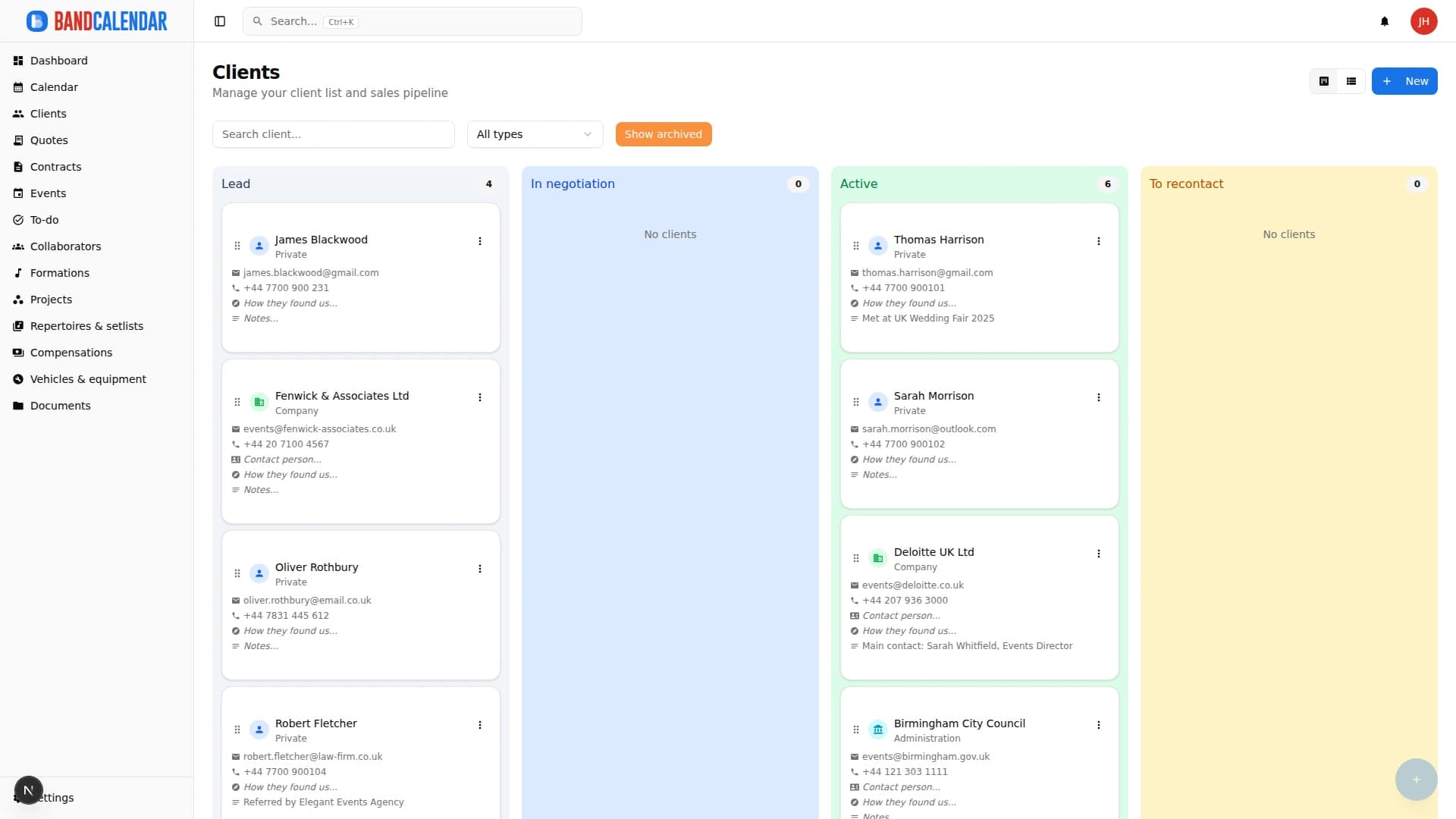
Prepare professional quotes — BandCalendar lets you create quote templates with your own layout, predefined line items, and automatic variables (client name, date, amount). A complete quote takes 5 minutes instead of 30.
-
Manage contracts with clear clauses — From an accepted quote, you generate the contract with one click. The contract automatically includes the payment terms, cancellation penalties, and logistics clauses.
-
Track deposits and balances — In the Payments tab of each contract, you record the deposit received and the balance. The system automatically calculates the remaining amount and updates the status (Unpaid, Partially paid, Paid).
-
Send automatic reminders — You can set up reminders for upcoming balances and notifications when a client hasn't yet signed the contract.
-
Archive everything in one place — Contracts, quotes, payments, client communications: all linked to the event, no more lost emails or parallel spreadsheets.
It's not magic. It's organization. And organization makes you look (and actually be) more professional.
The bottom line
Asking for the right price isn't greed. It's respect for your work, your time, and your professionalism.
If you charge too little:
- You work at a loss
- You devalue yourself in the market
- You attract clients who don't value what you do
If you charge the right price:
- You cover your costs
- You earn what you deserve
- You attract clients who appreciate quality
There is no universally "right" price. There is your right price, calculated from your costs, your experience, and your market.
Do the math. Prepare a clear quote. Ask with confidence.
The right couple will be happy to pay.
Want to get your quotes and contracts organized?
With BandCalendar you create professional quotes in 5 minutes, generate contracts with clear clauses, and track every payment. All in one place.
Related BandCalendar workflows
Explore the connected features
Fees and Finances
Track event money on two clear layers: client collections and customer refunds (commercial documents and the Finances tab), and collaborator fees with advances, line items, withholding and expense reimbursements. Summaries by period, event or musician.
Open pageQuotes and contracts
Create professional quotes and contracts for music services from separate content and layout templates, with rich text editing, preview-consistent PDFs, services and expense reimbursements, online quote acceptance, public links and click-to-accept simple electronic signature without a client account.
Open pageWedding bands
BandCalendar helps wedding bands and live musicians turn inquiries, quotes, contracts, repertoires, setlists, logistics and payments into one workflow that the whole team can use before, during and after the event.
Open pageStop wasting time with Word, PDFs and spreadsheets.
- Contracts with simple electronic signature and tracked communications
- All confirmations in writing, no verbal-only agreements
- Protected reputation: everything in black and white
Get one useful guide a month