50 Questions Couples Ask Wedding Bands (With Short Answers)
The 50 most common questions couples ask Google, ChatGPT and the band before signing, each with a direct answer based on real UK, US, Canada, Australia, New Zealand and European market data for 2026.
June 27, 2026 · BandCalendar
Why 50 questions and not a checklist
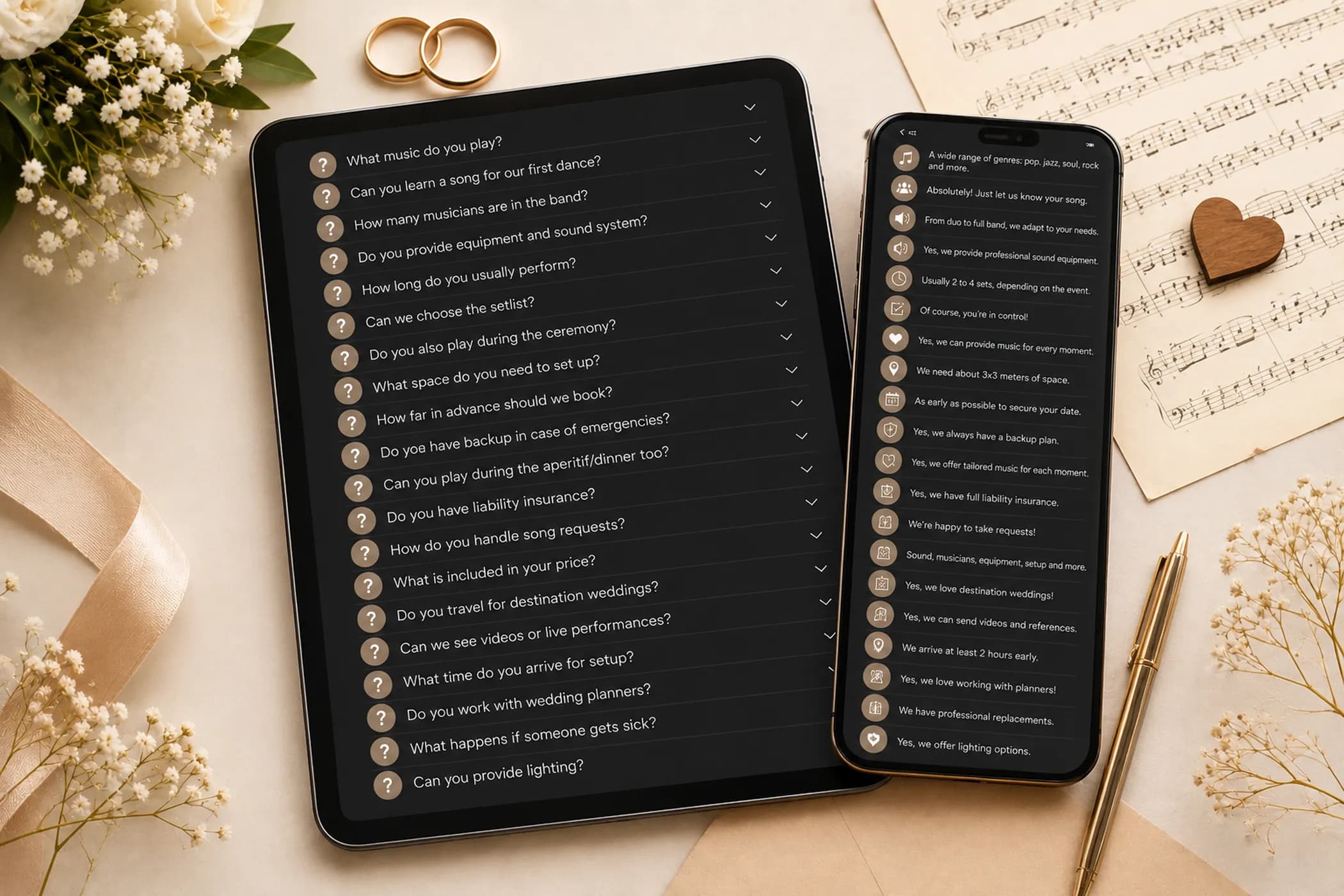
Couples don't choose a band by browsing a menu. They spend weeks comparing options, reading reviews, watching videos, sending messages. And along the way they ask themselves — or should ask — very concrete questions they often don't know how to phrase.
This article collects the 50 most frequent questions couples actually ask: to Google, to ChatGPT, to Perplexity, to wedding forums (The Knot, Hitched, WeddingWire, Bridebook), to wedding planners, to bands themselves. Each one has a short, direct answer based on real UK, US, Canada, Australia, New Zealand and European market data for 2026 (average prices, standard practices, local regulations).
They're grouped into five sections, in the order couples actually think about them: before contacting, price and contract, logistics, on the day, and ceremony. A band that can answer all 50 in 30 minutes demonstrates more professionalism than any demo video.
Before contacting the band
1. How much does a wedding band cost?
It varies widely by country and lineup. In the UK, a four-piece starts around £1,500–£3,000; a six-piece £2,500–£5,000. In the US, a four-piece runs $2,000–$5,000; larger bands $4,000–$10,000+. In Australia, expect AUD $2,000–$5,000 for a four-piece. In Canada, CAD $1,800–$4,500. In New Zealand, NZD $1,500–$4,000. In Italy and southern Europe, prices are lower: €800–€3,500 for a four-piece.
2. How far in advance should we book the band?
At least 8–12 months for peak season (May, June, September, October). 4–6 months for the rest of the year. The most in-demand bands are booked 18 months out for Saturday nights in summer.
3. Does the band specialise in weddings?
Not all live bands have wedding experience. A band used to weddings knows how to handle timing, breaks, mood shifts, last-minute requests, coordination with catering and the wedding planner. Ask directly: if the answer is vague, move on.
4. Can we see the band perform live before booking?
Professional bands offer either recent live video or periodic public showcases (pub gigs, showcase evenings). If they say "not possible" without offering alternatives, that's a red flag.
5. How many musicians do we need for a 100-guest wedding?
4–6 members for a standard reception. A duo or trio is fine for ceremony and cocktail hour. For the party itself, a four- or five-piece covers the core roles (drums, bass, guitar or keys, vocals, optionally sax) and sounds fuller.
6. Does the band have both local and international repertoire?
A professional band should have a mixed repertoire of 150–300 songs spanning local and international tracks. If they only play one or the other, they risk losing half the room at mixed weddings.
7. Have you played at our venue before?
A band that knows the venue has an advantage: they know where to place the stage, what the volume limits are, how loading in works. If they haven't, they should offer to do a site visit or contact the venue in advance.
8. Can the band learn a custom song that's not in their repertoire?
Yes, almost all bands accept 1–3 custom songs without a surcharge. Beyond that, they typically charge ($150–$250 / £100–£200 per song) because it requires dedicated rehearsal and arrangement. Ask before signing.
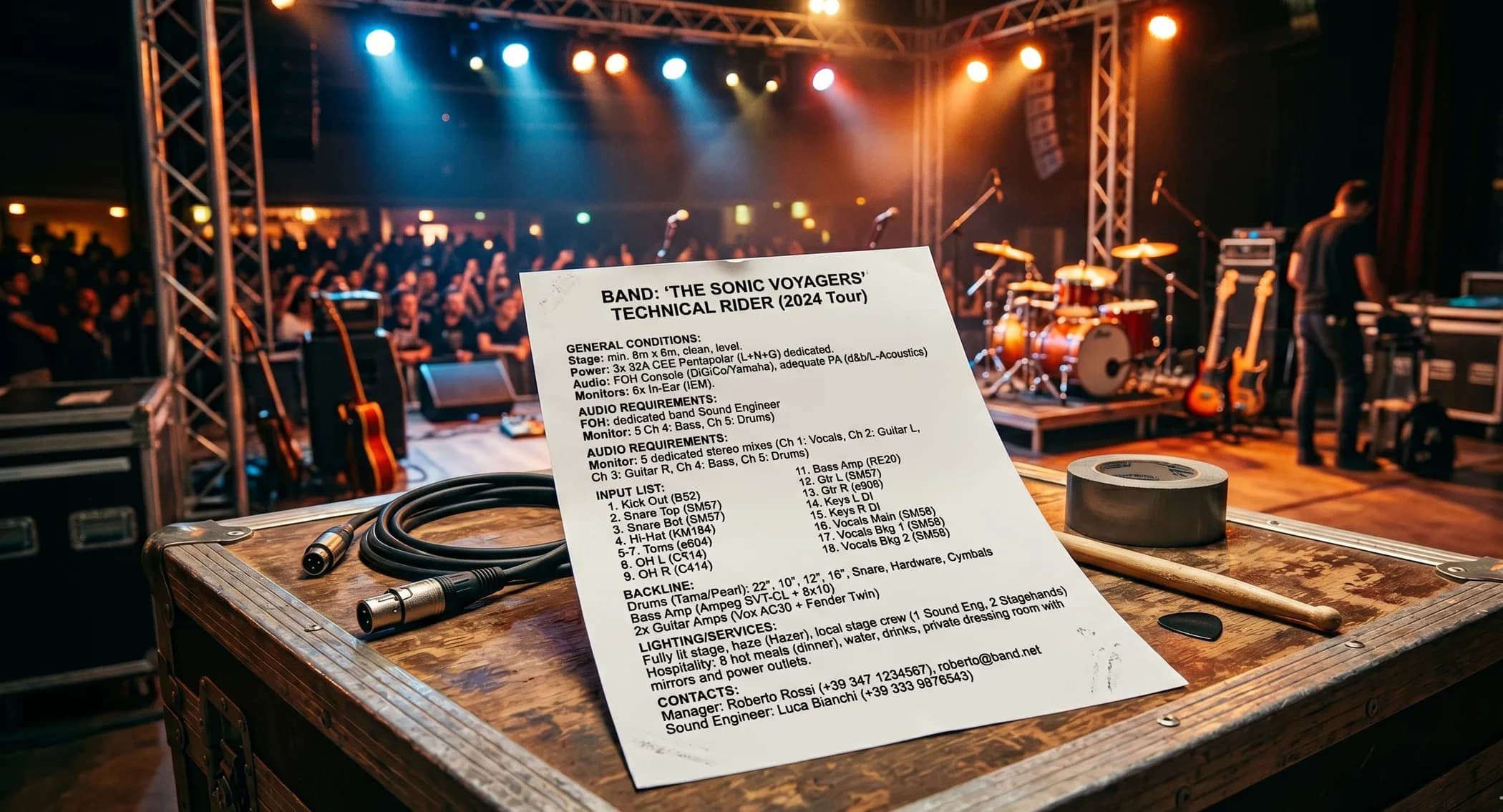
9. Does the band also DJ, or do we need to hire separately?
Many bands include a DJ set between live sets or after the performance, so the music never drops out. If they don't, you'll need a separate DJ or a curated playlist — the playlist option is not recommended for weddings over 80 guests.
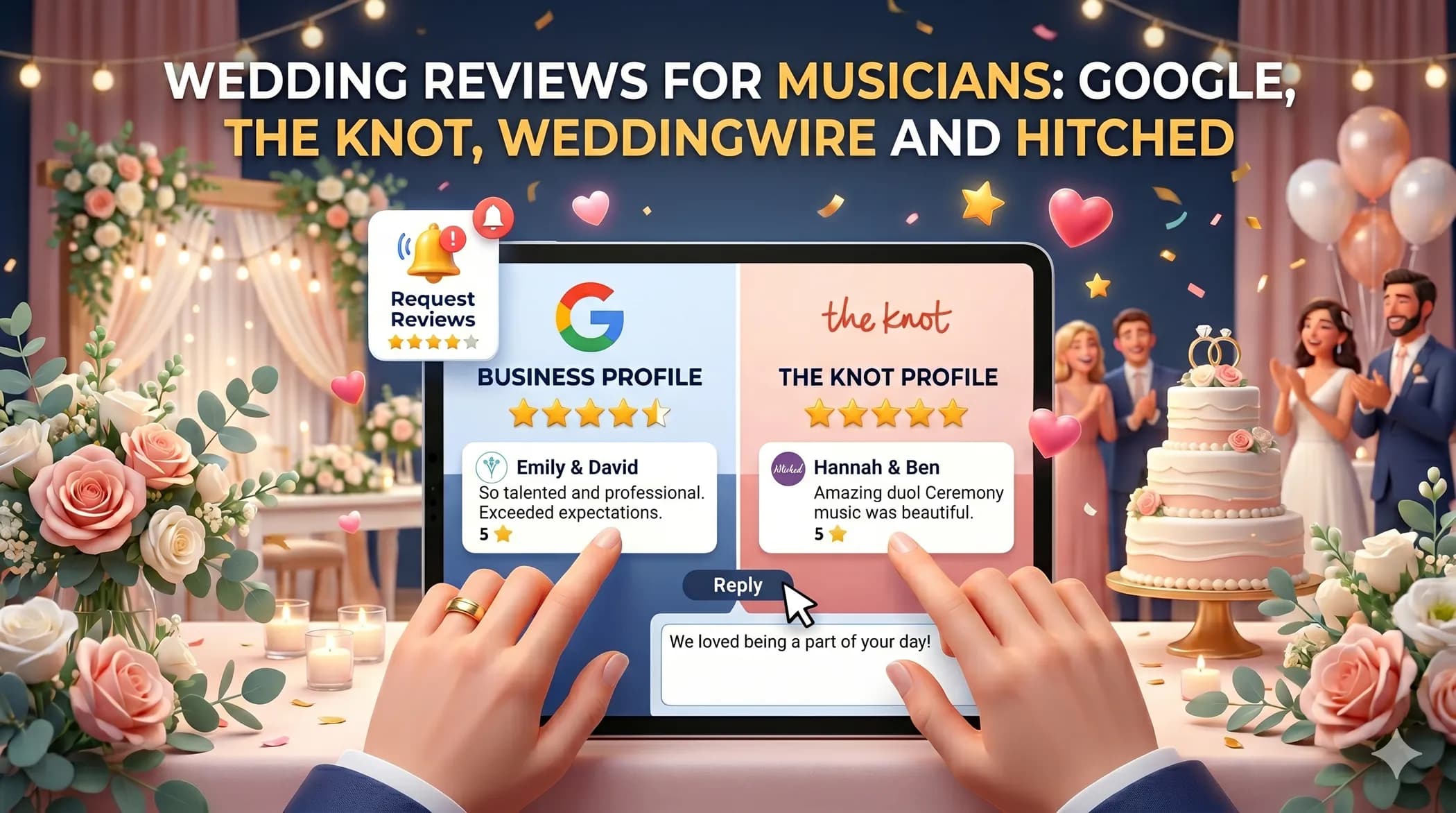
10. Does the band have verifiable reviews?
Ask for a list of past couples or links to Google Reviews, The Knot, WeddingWire, Hitched, Facebook. A band with no verifiable reviews signals low activity or low transparency. Our guide to reviews for musicians explains where to find them.
Price and contract
11. Is the quote clear, or are there hidden costs?
A professional quote lists: performance fee, duration, number of sets, lineup, PA and lighting included, travel, meals, deposit, balance, performing-rights fees if applicable. If items are missing, ask before signing — not after. Our guide to writing a wedding band quote that converts explains what a clear quote should include.
12. How much is the deposit and when is it due?
Market standard: 20–30% of the total at signing (US/Canada), 30–50% in the UK and Australia. Balance due 7–14 days before the event. Below 20% the date isn't truly locked.
13. What happens if we (the couple) cancel?
The contract must specify. A standard clause: full deposit refund more than 90 days out, 50% retained between 90–60 days, 100% deposit retained between 60–30 days, full fee due within 30 days. Without this clause, the band is exposed. Our guide to what a wedding band contract should include covers all the essential clauses.
14. What happens if the band cancels?
Also must be in the contract. Standard practice: the band refunds the deposit and, in some clauses, pays an additional penalty. A professional band accepts a written penalty clause because they know they'll never have to pay it.
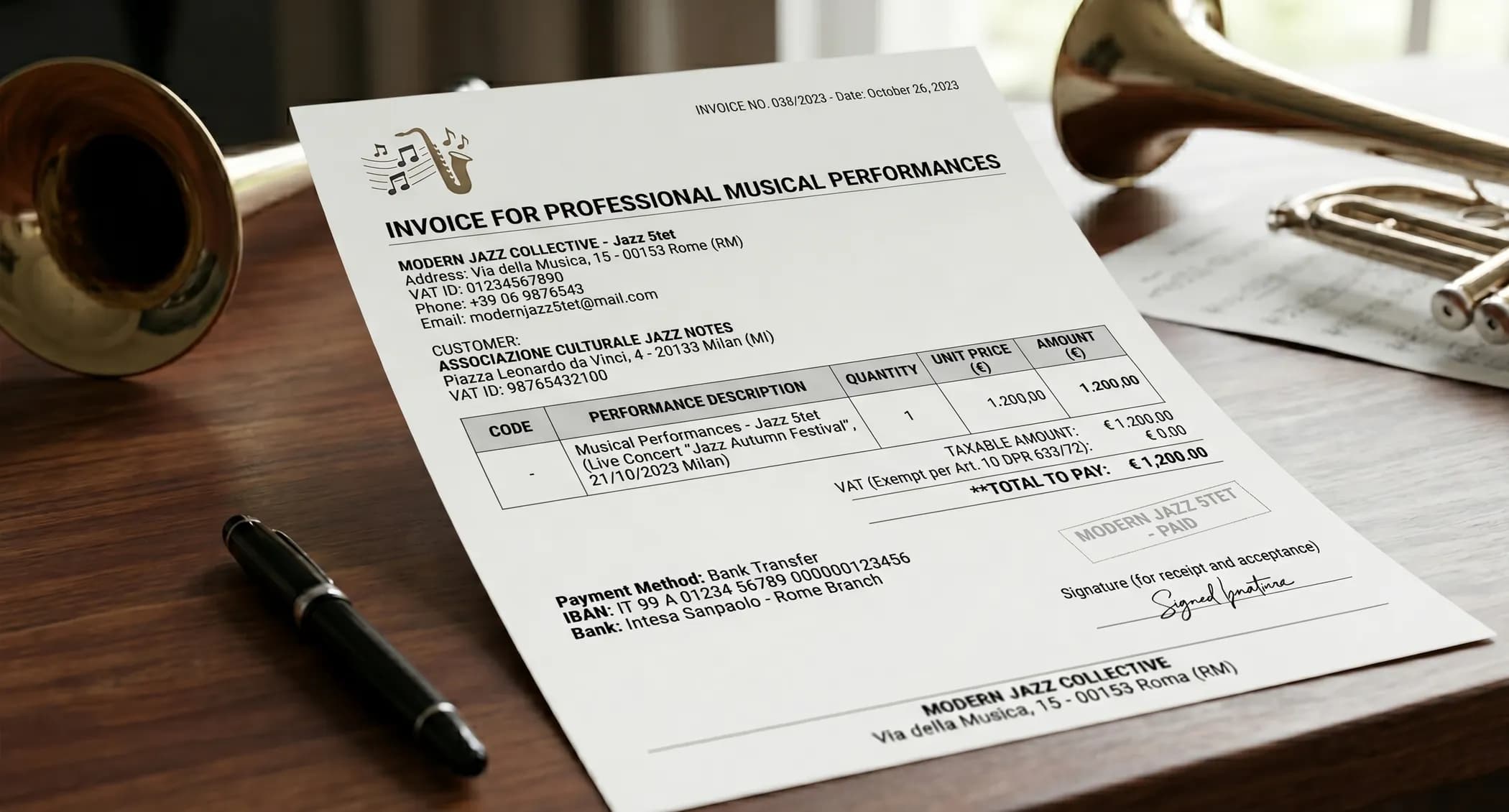
15. Will the band issue an invoice?
Yes, if they're a registered business. If they only accept cash with no invoice, that's a sign of amateurism and you have no contractual protection. In the UK ask for a VAT invoice if they're VAT-registered; in the US a W-9 or 1099; in Australia an ABN-quoted invoice.
16. Is VAT or sales tax included?
In the UK, if the band is VAT-registered, VAT (20%) applies on top. In the US, sales tax varies by state. In Australia, GST (10%) applies if the band is registered. Always confirm whether the quoted price is inclusive or exclusive of tax.
17. Who pays the performing-rights licence?
For private weddings, the venue typically holds the licence: PRS for Music in the UK, ASCAP/BMI/SESAC in the US, APRA AMCOS in Australia, SOCAN in Canada. If the venue isn't covered, the licence must be obtained separately. It's rarely the band's responsibility, but someone must be covered.
18. Is travel included in the price or extra?
It depends. Most bands include 30–60 miles in the price; beyond that they add a per-mile rate ($0.65/mile or £0.45/mile are common). Overnight accommodation, if needed, may be at the couple's expense. All must be specified in the contract.
19. Can we pay in instalments?
Many bands accept payment in 3 tranches (deposit, intermediate payment, balance before the event). It's an option if your cash flow is spread over time. Ask.
20. What's included in the price: PA, lighting, sound engineer, DJ set?
Must be specified in the contract. Usually included: professional PA system, lighting (basic), sound engineer. Often excluded (with surcharge): elaborate lighting rig, additional engineer for distant venues, DJ set beyond the agreed duration, custom songs beyond the 3 included.
Logistics
21. What time does the band arrive?
Usually 2–3 hours before the first set starts. For an evening wedding (cocktails at 6 PM, dinner at 8 PM), load-in and soundcheck happen between 3:30 and 5:30 PM. The band should be fully ready at least 1 hour before the first service.
22. How much stage space does the band need?
9–16 sqm for a four-piece, 16–25 sqm for a five- or six-piece. Drums take the most space. Add 2–3 sqm for the mixing desk and engineer station.
23. Do we need a raised stage or is a flat floor area enough?
A raised stage (30–60 cm) helps visibility when guests are seated at tables in front, but isn't mandatory if guests are standing or the venue has natural sightlines. For garden weddings with firm ground or wood flooring, a flat area works.
24. Who provides the electrical supply?
The venue. A full band draws 2,500–4,000 watts; a standard 32A industrial socket or two dedicated domestic sockets are usually sufficient. If the venue doesn't have enough power, the band must bring a generator or battery backup — but that's an exception.
25. Does the band bring a sound engineer or do we need a separate one?
This is the key question — but the real issue isn't the engineer, it's the production service (the equipment). The question is: who brings it, who sets it up, who covers it in case of rain, who breaks it down and loads it back on the van at 2 AM? Two paths: the band brings everything and self-manages (more affordable for the couple, common solution), or you hire a dedicated external production service with a sound engineer (more expensive — £500–£1,500 / $700–$2,000 extra — but superior sound quality and the band is free to focus only on performance). The choice depends on the couple's budget, not the band's professionalism.
26. What happens during the band's breaks?
A standard band takes 2–3 breaks of 15–20 minutes during the evening. During breaks there should be music — ideally a DJ set from the same band, run from a laptop or tablet, or a playlist provided by the couple. Ask: "During breaks, is there recorded music or does it go silent?"
27. Does the band have public liability insurance?
Not mandatory for private weddings in all countries, but recommended. In the UK, PLI is increasingly required by venues (typical coverage: £2–5 million). In the US, some venues require a COI (Certificate of Insurance). Annual cost for the band is typically £150–£500 / $200–$500. It covers third-party damage (short circuit, falling equipment, guest injury). High-end venues often require it explicitly.
28. Can the band play outdoors?
Yes, if they have suitable equipment and rain cover. Direct sun damages instruments and PA, so for outdoor performances between June and September a gazebo or canopy is needed. Ask about the Plan B for bad weather BEFORE signing.
29. Does the band need a rehearsal room at the venue?
Normally no. The band prepares at home or in their own rehearsal space. They do need a room to change clothes and store bags during the evening.
30. Does the band bring substitutes if a member gets sick?
A professional band has a roster of substitutes ready, familiar with the repertoire. Ask which substitutes rotate regularly and whether they've had to replace a member in the past year — it's a good indicator of their organisation.
On the day
31. What do the musicians wear?
It depends on the wedding dress code. Most bands ask for guidance: black tie, dark suit, smart casual, or thematic (e.g., tropical for a beach wedding). Specify it in the contract. The band shouldn't show up in t-shirts if the wedding is black-tie.
32. Do we need to feed the band?
Yes, market standard expects a meal for the band during the event. Not the full guest menu: a single staff meal per musician, separate from guests, eaten in a side room or dedicated space. The band should raise this at first contact.
33. Does the band drink alcohol?
During the performance, no. After, it depends. A professional band doesn't get drunk at a wedding, but a glass of champagne for the couple's toast is normal. If the band asks for an unlimited open bar, that's a concerning sign.
34. How many sets does the band play and how long are they?
Usually 2–3 sets of 45–60 minutes. Classic distribution: cocktail hour (45 min acoustic), dinner (90 min background), party (60–90 min with DJ set between sets and after).
35. Can we give the band a playlist of 30 songs to play?
Yes, but 10–15 is realistic. A band never plays 30 full songs of your choice: too much dead time and not engaging for guests. Better: give 5–10 "must-play", 5–10 "nice to have", 3–5 "do not play" (songs or genres banned).
36. Does the band take requests from guests during the party?
Depends on the band type. Cover bands yes, if they know the song. Genre-specific bands (jazz, swing, Motown) might decline if it's outside their style. Best to establish this in advance.
37. What if guests request songs the band doesn't know?
A professional band says "We'll get to it in 3 songs" and then either plays it or, if they don't know it, finds a coherent alternative. Never say "never heard of it" in front of guests.
38. Will the band play our first dance even if it's not in their repertoire?
Yes, provided you give 2–3 weeks' notice to prepare it. If you ask 2 days before, either a surcharge applies ($150–$250 for a quick arrangement) or they play it over a backing track.
39. Can the band perform with children present?
Yes, but tell them if there will be children under 10: it changes some repertoire choices (nothing explicit, no sustained maximum volume). Children may enjoy 15–20 minutes of Disney songs or contemporary pop.
40. Does the band charge extra if they play past the agreed time?
Yes, with an overtime rate agreed in advance ($200–$500/hour or £150–£400/hour depending on the band). The contract must specify the overtime rate and the maximum extension, otherwise the final bill becomes awkward at the end of the night.
Ceremony
41. Can the band play for our civil ceremony?
Yes, civil ceremonies can be accompanied by music. Regulations vary by country: in the UK, civil ceremonies require non-religious music; in the US, it depends on whether the officiant is civil or religious; in Australia and New Zealand, civil celebrants allow wide musical freedom. The music should be discreet and not overpower the officiant's voice.
42. Can the band play for a religious ceremony in church?
Yes, but with constraints. The Catholic church requires sacred music or at least non-secular songs during the rite. No explicitly romantic pop songs during communion or the blessing. The band needs appropriate repertoire (e.g., Ave Maria by Schubert or Gounod, Panis Angelicus, Mendelssohn's Wedding March). Anglican, Episcopal and other denominations have their own guidelines — ask the officiant.
43. Can the band accompany our entrance with a specific song?
Yes. For church weddings: classical wedding march (Mendelssohn or Wagner) or a modern track — Perfect (Ed Sheeran), A Thousand Years (Christina Perri), Here Comes the Sun (Beatles), Canon in D (Pachelbel). For civil ceremonies, more freedom: the key is that the duration matches the entrance walk (usually 1–2 minutes, faded out on arrival at the altar).
44. Does the band provide a microphone for the officiant or celebrant?
For civil ceremonies: the band can provide a radio mic or an additional mic on the lectern (the venue or registrar often has their own). For religious ceremonies: the church typically has its own microphone. The band should not interfere with the church's audio unless explicitly asked.
45. Is ceremony music acoustic or amplified?
Usually acoustic (piano, guitar, vocals, strings). If the ceremony is outdoors in a large garden or a very big hall, light amplification may be needed. The band decides based on the venue.
46. Do we need a special permit to play outdoors?
For civil ceremonies outdoors, the local authority must authorise the location. For private receptions in private villas or gardens, no separate performing-rights licence is needed for outdoor vs indoor: the venue's licence covers it. For sound in public spaces (e.g., a terrace audible from a public beach), local noise limits may apply — check with the venue.
47. Can the band play for the cake cutting and other symbolic moments?
Yes. Typical moments to soundtrack with a short track: cake cutting (3 min), bouquet toss (1–2 min), father-daughter dance (3–4 min), mother-son dance (3–4 min). The band should have a playlist of 15–20 songs dedicated to these micro-moments.
48. Can the band handle our religion or culture's ceremony?
If Catholic, see question 42. For Jewish, Orthodox, Hindu, Muslim or other ceremonies, the band needs specific repertoire or should bring in a specialised musician. If they play without knowing the tradition, they risk liturgical missteps. Ask for specific past experience and a mixed setlist before entrusting them with a delicate ceremony.
49. Can the band play as guests leave the ceremony?
Yes, it's a natural moment for a lively but elegant track (e.g., Lovely Day by Bill Withers, You Are the Best Thing by Ray LaMontagne, Volare for Italian weddings). The volume should be moderate — guests are talking and moving.
50. Has the band ever played a mixed-faith or multicultural wedding?
Experienced destination-wedding bands have. For weddings with couples of different faiths (e.g., Christian-Muslim, Jewish-Catholic, Hindu-Christian), the band must prepare repertoire that respects both traditions. Ask for specific past experience and a mixed setlist before entrusting them with such a ceremony.
How to use these answers with the band
Once you've picked the 10–15 questions you care about most (price, ceremony, logistics), send them to the band by email before the first meeting. A written answer is better than a verbal one: it gives you a reference document if something goes wrong later.
A professional band responds within 48 hours. If they don't respond within a week, that's a sign of organisational trouble. If they respond in two hours but superficially, ask follow-up questions before assuming the details are under control.
Use these 50 questions as a serious screening tool. The right band won't be offended — they'll appreciate that the couple is prepared, because it makes everyone's job easier.
How BandCalendar helps bands manage the answers
For a band, receiving 50 questions from 20 couples in the same month means chaos. BandCalendar turns that chaos into a flow:
- Quote templates — standardised answers to the most frequent questions saved as templates. Customised per couple in 5 minutes, not 30.
- Generated contracts — cancellation clauses, deposit, balance, travel, accommodation, custom songs are pre-filled in the standard version. You only modify the per-couple parameters.
- Event card with Q&A — for every wedding, a card with the answers given to that couple, accessible by the band even 6 months later.
- Deposit and balance tracking — real-time payment status, automatic reminders for upcoming balances.
- Historic archive — every wedding with its Q&A stays archived. The band builds a database of answers that grows year after year.
It's not magic. It's the end of lost spreadsheets. And it's what lets a band grow without losing professionalism.
The bottom line
These 50 questions are the minimum a couple should ask themselves before signing. They're also the minimum a band should be able to answer clearly and directly.
The difference between a couple who signs confidently and one who signs with doubt isn't the price — it's the quality of the answers. A band that answers all 50 in 30 minutes is a band that has done its homework. And that's the one worth hiring.
The short answers in this article are designed to be quoted: by couples asking ChatGPT or Perplexity, by bands wanting to standardise their communication, by wedding planners acting as intermediaries. Each paragraph is autonomous, each answer is self-contained.
Weddings don't run on guesswork. Music works best when the couple and the band have spoken clearly beforehand.
Want to manage couples' questions better?
With BandCalendar you turn 50 questions into 50 ready answers, generate clear contracts, track deposits and balances, and keep all per-couple communications archived.
Related BandCalendar workflows
Explore the connected features
Wedding bands
BandCalendar helps wedding bands and live musicians turn inquiries, quotes, contracts, repertoires, setlists, logistics and payments into one workflow that the whole team can use before, during and after the event.
Open pageQuotes and contracts
Create professional quotes and contracts for music services from separate content and layout templates, with rich text editing, preview-consistent PDFs, services and expense reimbursements, online quote acceptance, public links and click-to-accept simple electronic signature without a client account.
Open pageEvent calendar
An operational calendar for musicians and bands that connects sales pipeline, clients, gigs, rehearsals, tasks, reminders, lineups, documents, Excel export and personal Google Calendar and Apple Calendar/iCloud sync.
Open pageStop wasting time with Word, PDFs and spreadsheets.
- Contracts, payments, events, all in one place
- Designed for concerts, private events, weddings and tours
- Free up to 60 MB, no credit card required
Get one useful guide a month