Musician Invoicing: When to Issue an Invoice and Who Gets One
When are you legally required to invoice? What goes on it? And what happens with private clients like wedding couples? A country-by-country guide for UK, USA, Canada, Australia and Ireland.
May 17, 2026 · BandCalendar
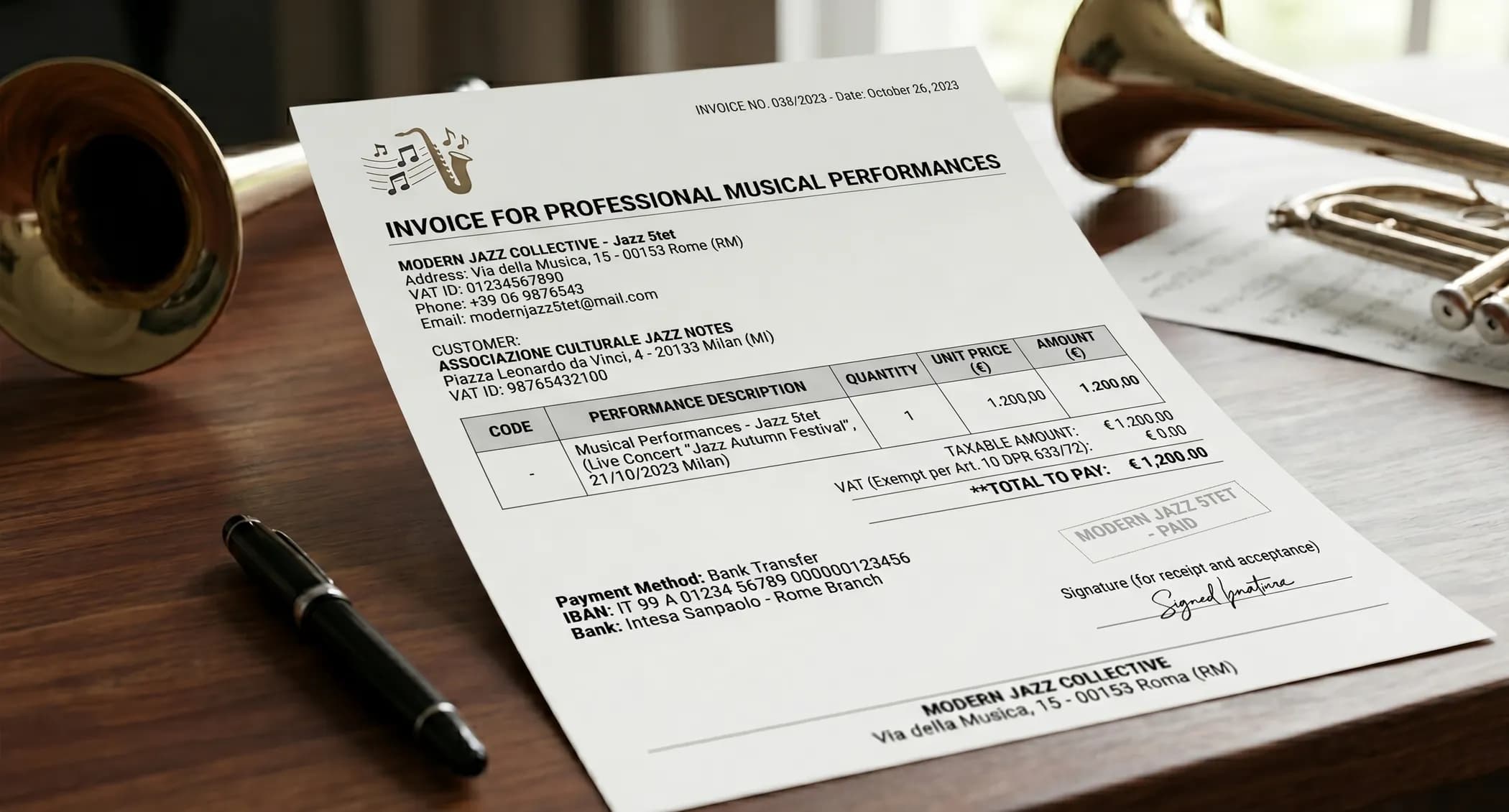
The question that follows every paid gig
A venue emails: they need "an invoice for accounting purposes" before they can process payment. A wedding couple asks if you'll be sending anything after the big day. A booking agent asks whether you're set up to invoice before confirming your next booking.
In most English-speaking countries, the legal obligation to issue invoices is driven by VAT or GST registration — not by a general rule that you must document every transaction. But the practical reality is different: even when there's no legal requirement, a paper trail protects you. This guide explains the rules country by country, covering who needs the invoice, what it must contain, and what happens when a private client — a wedding couple, a private host — is the one paying the bill.
United Kingdom
When must you issue an invoice?
A self-employed musician who is not VAT-registered has no legal obligation under HMRC rules to issue a formal invoice. But professional practice — and your own tax records — make it essential. Every payment you receive is income you must declare; an invoice is the cleanest documentation you have.
If you are VAT-registered (taxable turnover exceeding £90,000 in any rolling 12 months), you are required to issue a VAT invoice to any VAT-registered business customer who asks for one. For private clients (a wedding couple, a private host) who are not running a business, a VAT invoice is not legally required — but providing a receipt or invoice is good practice, and clients can formally request one.
VAT on music performance fees
For VAT-registered musicians, live music performance fees are standard-rated at 20%. This applies to the vast majority of bookings: weddings, corporate events, concerts, club residencies, private parties.
Two important exceptions:
- Private music tuition (one-to-one teaching): VAT-exempt, regardless of your turnover. Teaching income doesn't count towards your VAT taxable turnover.
- Eligible cultural services supplied by qualifying bodies (registered charities, certain not-for-profit arts organisations): may be exempt under the Cultural Services exemption. This rarely applies to individual gigging musicians, but if you perform for a qualifying cultural body, the VAT treatment of the fee may differ.
What must a UK invoice include?
If not VAT-registered (non-VAT invoice):
- Your name and any trading name
- Your address
- A unique sequential invoice number
- Invoice date
- Description of service (e.g. "Live music performance — Hartley-Singh wedding, 14 June 2026")
- Amount due
- Payment terms and bank details
If VAT-registered (full VAT invoice): All of the above, plus:
- Your VAT registration number
- VAT rate applied (e.g. 20%)
- VAT amount shown separately
- The net (VAT-exclusive) price
For supplies under £250, a simplified VAT invoice is permitted: it can omit the customer's details and the net/VAT breakdown, showing only the gross total and the VAT rate.
Private clients (wedding couples) in the UK
A UK wedding couple is not VAT-registered and has no reporting obligations towards you. They pay your full agreed fee — no withholding, no form to complete. You issue them a simple receipt or invoice for their records. There is no legal obligation on either side beyond paying the agreed amount.
Record-keeping
Keep all invoices — both issued and received — for 6 years from the 31 January Self Assessment filing deadline for the relevant tax year.
Making Tax Digital — from April 2026
From 6 April 2026, musicians with qualifying gross income above £50,000 in the 2024/25 tax year must use MTD-compatible accounting software and make quarterly digital submissions to HMRC. The threshold drops to £30,000 in April 2027 and £20,000 in April 2028. For affected musicians, invoices must be recorded in MTD-compatible software (Xero, QuickBooks, FreeAgent and others are all compatible).
United States
There is no standard invoice requirement — but you still need records
The US has no federal law specifying that freelancers must issue invoices. There is no national sales tax, VAT or GST. What matters is that you declare your income, and that you have records to support it if the IRS ever asks.
In practice, business clients will ask you to complete a W-9 form before the first payment. This provides your name, address and Taxpayer Identification Number (TIN). It's the payer's mechanism for issuing you a 1099-NEC at year-end.
1099-NEC threshold — 2026
From the 2026 tax year, the 1099-NEC reporting threshold has been raised to $2,000 (up from the longstanding $600). This means a business client who pays you less than $2,000 in the year is no longer required to send you a 1099-NEC.
You must still declare all income. The threshold determines the payer's reporting obligation — not yours. A missing 1099-NEC is the payer's issue, not a free pass for your return.
Royalties (mechanical, performance, sync) are still reported on Form 1099-MISC, Box 2, with a lower threshold of $10. The 1099-NEC change does not affect this.
What to include on a US musician invoice
No federal standard governs invoice format, but a professional invoice for a US client should include:
- Your legal name and address
- Invoice number (unique, sequential)
- Invoice date
- Client's name and address
- Description of service (event name, date, location)
- Fee amount
- Payment terms and method
For a recurring business client, they'll have your W-9 on file. For a one-off private client — a wedding couple — there's no form needed from either side. They pay the full agreed fee, you declare the income on Schedule C of your federal return.
Private clients in the US
A US wedding couple or private host has no 1099 obligations and no withholding requirements. They pay the full gross fee. The fact that they paid in cash does not exempt the income from tax — cash gig income is fully taxable.
Recommended practice: always issue your own invoice even when the law doesn't require it. It confirms the agreed fee before any dispute, creates a clear income record that matches your bank deposits, and documents your gross earnings for quarterly estimated tax calculations.
Quarterly estimated taxes
If you expect to owe $1,000 or more in federal tax for the year, pay quarterly estimated taxes. 2026 due dates: April 15, June 16, September 15, January 15 (2027). A common rule of thumb: set aside 25–30% of every payment received.
Canada
GST/HST and the $30,000 threshold
Canadian musicians are not required to register for GST/HST unless their gross annual revenue from all self-employment exceeds $30,000 in any rolling 12-month period. Below this threshold, your invoices carry no GST/HST component.
Once you cross the threshold, you have 30 days to register for a GST/HST number. From that point, you charge and collect the applicable rate:
| Province/Territory | Rate |
|---|---|
| Alberta, Yukon, NWT, Nunavut | 5% GST only |
| British Columbia, Manitoba, Saskatchewan | 5% GST + PST (separate) |
| Ontario | 13% HST |
| New Brunswick, Nova Scotia, PEI, NL | 15% HST |
| Quebec | 5% GST + 9.975% QST (separate) |
Invoice tiers — CRA requirements
| Invoice amount | Required on the invoice |
|---|---|
| Under $30 | Supplier name, date of supply, total paid |
| $30 – $149.99 | Above + supplier's GST/HST registration number, applicable tax rate |
| $150 and over | Above + buyer's name or trading name, itemised description, GST/HST amount shown separately |
Below the $30,000 registration threshold, your invoices don't include GST/HST — so the middle and upper tiers effectively only require the basic fields. Still: include a reference number, date and description on every invoice.
T4A slips
A business client who pays you $500 or more in a calendar year (excluding GST/HST) must issue you a T4A slip by the last day of February of the following year. This is the payer's obligation. You must declare all income regardless of whether you receive a T4A.
Private clients (wedding couples) in Canada
Canadian wedding couples are private individuals and have no T4A obligations. They pay gross. You report the income on Form T2125 (Statement of Business or Professional Activities) as part of your T1 General return. Filing deadline for self-employed individuals: 15 June, but any tax owing is still due 30 April — late payment accrues interest from that date even if your filing deadline is June.
Quebec specifics
Self-employed musicians in Quebec deal with both CRA (federal) and Revenu Québec (provincial). If GST/HST registered, you also register for QST (Quebec Sales Tax: 9.975%). Quebec residents file two returns. Musicians who have self-employed status can notify payers in writing, removing certain employer obligations from the payer.
Australia
ABN — before the first gig, full stop
Register for an Australian Business Number (ABN) through the Australian Business Register before taking any paid engagement. Without one, payers are legally required to withhold tax at the top marginal rate of 47% before paying you — the "no-ABN withholding" rule. ABN registration is free and takes minutes online.
Your ABN appears on every invoice you issue.
When are you required to issue a tax invoice?
A tax invoice (the GST-compliant document) is required when:
- You are GST-registered (annual gross turnover exceeds $75,000)
- The taxable supply exceeds $82.50 including GST
- The customer requests one within 28 days of the supply (you must provide it within 28 days of the request)
If you are not GST-registered, issue a regular invoice — not a "tax invoice". Include your ABN, date, description and amount, but do not add or mention GST.
Tax invoice requirements
Under $1,000 (incl. GST):
- Statement that the document is a tax invoice
- Your name or business name
- Your ABN
- Date the invoice was issued
- Brief description of what was supplied, including quantity
- GST amount payable (or a statement that the price includes GST)
$1,000 and over: All of the above, plus:
- Buyer's identity (name or ABN)
GST rate on performance services
GST is 10% on standard taxable supplies. Live music performance fees are generally taxable at 10%. There is no special reduced rate or exemption for live music in Australia (unlike some other countries).
Note on PAYG withholding: Payments subject to ATO Schedule 3 (which can apply to entertainers in certain agency structures) are generally not subject to GST. If you're being engaged through a booking agency that withholds PAYG on your behalf, get advice on how to structure your invoices and whether GST applies to your particular arrangement.
Private clients (wedding couples) in Australia
An Australian wedding couple has no withholding obligations once you have an ABN on file. They pay the gross amount. You declare the income in your annual tax return and reconcile any PAYG withheld (which typically won't apply for direct private bookings). If you are GST-registered, you charge 10% on top of your fee.
Record-keeping
Keep all records for 5 years from the date of the relevant transaction.
Ireland
VAT registration threshold
For services supplied in Ireland, the VAT registration threshold is €37,500 per year (12-month rolling period). Below this level, you cannot charge VAT on your invoices and cannot reclaim VAT on business purchases. Above it, you must register and issue compliant VAT invoices.
VAT on live music — the Irish exemption
Revenue (the Irish tax authority) has a specific provision worth knowing: live musical and theatrical performances are exempt from VAT where no food or drink is supplied during the show.
In practice:
- A concert where no food or drink is served to the audience: the admission may be VAT-exempt at the promoter level. For the musician receiving a performance fee, the VAT treatment of that fee depends on the contract structure — get advice if this applies to you.
- A wedding or private function where food and drink are being served: typically standard-rated at 23% if you are VAT-registered.
Most Irish musicians below the €37,500 threshold will never need to charge VAT. But once you cross it, the distinction between exempt and standard-rated performances is material.
What must an Irish VAT invoice include?
| Field | Notes |
|---|---|
| Issue date | |
| Sequential invoice number | Must be unique |
| Your name, address and VAT registration number | |
| Customer name and address | Required if invoice ≥ €100 |
| Description of the supply | |
| Date of supply | If different from invoice date |
| VAT-exclusive price | |
| VAT rate applied | |
| VAT amount payable |
A simplified invoice (omitting customer details and the VAT breakdown, showing only gross and rate) is permitted only when the total does not exceed €100.
Private clients (wedding couples) in Ireland
Irish wedding couples have no withholding obligation and no reporting requirements. They pay the full gross fee. You declare the income via your annual Form 11 through Revenue Online Service (ROS). Preliminary tax is due 31 October; the final return is due 31 October of the following year.
Note: Ireland's Artist Exemption (Section 195, TCA 1997) exempts income from original musical compositions from income tax up to €50,000 per year — but it applies to income tax only, not to VAT or USC/PRSI. And it applies to original compositions, not to performance fees from playing covers or someone else's work.
Record-keeping
Keep all invoices for 6 years from the date of the supply.
Country comparison at a glance
| UK | USA | Canada | Australia | Ireland | |
|---|---|---|---|---|---|
| Invoice legally required? | Only if VAT-registered | No federal requirement | Required if GST/HST-registered | Required (tax invoice) above $82.50 | Only if VAT-registered |
| Tax on performance fees | 20% VAT (if registered) | No sales tax / VAT | 5–15% GST/HST (if registered) | 10% GST (if registered) | 23% VAT (if registered) |
| Registration threshold | £90,000 | N/A | CAD $30,000 | AUD $75,000 | €37,500 |
| Year-end form from business payer | None standard | 1099-NEC (if ≥ $2,000) | T4A (if ≥ $500) | Payment summary / ATO pre-fill | None standard |
| Private client withholding? | No | No | No | No (but 47% if no ABN) | No |
| Special scheme for artists | None | HITS Act (recording costs deduction) | None | None | Artist Exemption (income tax on original work, up to €50k) |
| Invoice retention | 6 years | 3–7 years | 6 years | 5 years | 6 years |
The invoice you should always send — regardless of legal requirements
In every country covered here, the law is less demanding than professional practice. Private clients (wedding couples, private hosts) have essentially no obligations towards you. Business clients may not be required to issue year-end forms below certain thresholds.
None of that means the paperwork can be skipped. An invoice issued to every client:
- Confirms the agreed fee before any dispute arises
- Creates an income record that matches your bank statements
- Is your primary evidence if a tax authority ever queries your declared income
- Documents your gross earnings for quarterly tax calculations and annual returns
- Signals that you run your career like a business — which affects how venues and agents treat you
The simplest format works: your name, the client's name, a unique reference number, the event date and description, the fee, your payment details. Use a template and spend 90 seconds per gig.
Common mistakes
"It was a private booking, so no invoice needed." In all five countries, private clients have no reporting or withholding obligations. That doesn't mean the income isn't taxable — it is, in full. The invoice protects you, not them.
"I didn't receive a 1099 / T4A / PAYG summary." The payer's reporting obligation exists above a threshold that may not apply to your booking, or doesn't apply to private clients at all. Your obligation to declare income has no minimum. Report everything.
"I'm below the VAT/GST threshold, so I don't need to worry about invoicing." Being below the threshold means you don't collect VAT or GST. It doesn't exempt you from issuing professional invoices and maintaining income records.
"I'll sort out the invoices at tax time." Three months of gigs reconstructed from memory is how income gets under-reported or misattributed. Issue invoices as you go — the information exists when you're standing at the gig, not three months later.
"Cash gigs don't need documenting." Cash income is taxable income in every country. Tax authorities use bank deposit analysis, industry benchmarks, and cross-referencing with venue reports. Undeclared cash is the highest-risk category.
Keep your records before the admin catches up
In every country here, tax authority data on musicians' income comes primarily from what business clients report. For private events — weddings, birthday parties, corporate dinners — that's often nothing, because private clients have no reporting obligations.
That makes your own records more important, not less. BandCalendar lets you log every event with the client, date, and agreed fee. It isn't accounting software — for the actual return, use an accountant. But it's where the raw data lives, organised by date and client, so that when your accountant asks for a list of gigs and gross income, you're not rebuilding it from memory.
Invoice, VAT and GST rules change annually. This guide reflects published rules for the 2025/26 or 2026 tax year in each country as of May 2026. For personalised advice on your situation, consult a qualified accountant or tax adviser in your country.
Related BandCalendar workflows
Explore the connected features
Fees and Finances
Track event money on two clear layers: client collections and customer refunds (commercial documents and the Finances tab), and collaborator fees with advances, line items, withholding and expense reimbursements. Summaries by period, event or musician.
Open pageQuotes and contracts
Create professional quotes and contracts for music services from separate content and layout templates, with rich text editing, preview-consistent PDFs, services and expense reimbursements, online quote acceptance, public links and click-to-accept simple electronic signature without a client account.
Open pageSolo musicians
BandCalendar helps solo musicians and freelancers manage gigs, clients, quotes, contracts, repertoires, documents, payments, reminders and history without scattering information across phone, email and spreadsheets.
Open pageStop wasting time with Word, PDFs and spreadsheets.
- Contracts, payments, events, all in one place
- Designed for concerts, private events, weddings and tours
- Free up to 60 MB, no credit card required
Get one useful guide a month