SEO and AEO for Musicians: How to Be Found on Google, ChatGPT and Perplexity in 2026
From traditional SEO to AI: how to structure your website, reviews and online presence to be found when couples are searching for a wedding band.
March 20, 2026 · BandCalendar
Search has changed. Are you ready?
Until three years ago, there was only one route: Google. The couple searched "wedding band Milan", you appeared in the results, they clicked on your website, they got in touch.
Today the journey is more fragmented. Some couples still start with Google. Others ask ChatGPT: "What are the best wedding bands in Lombardy?" Others use Perplexity or Gemini to compare options, read reviews and understand typical pricing.
AI-powered searches are growing rapidly. For musicians working in weddings — a market where research is thorough, in-depth and done months in advance — this shift isn't marginal. It's structural.
The question isn't whether AI will influence how couples find you. The question is: when it happens, will you be one of the bands they're pointed to, or will you be invisible?
What AEO is and why it matters for musicians
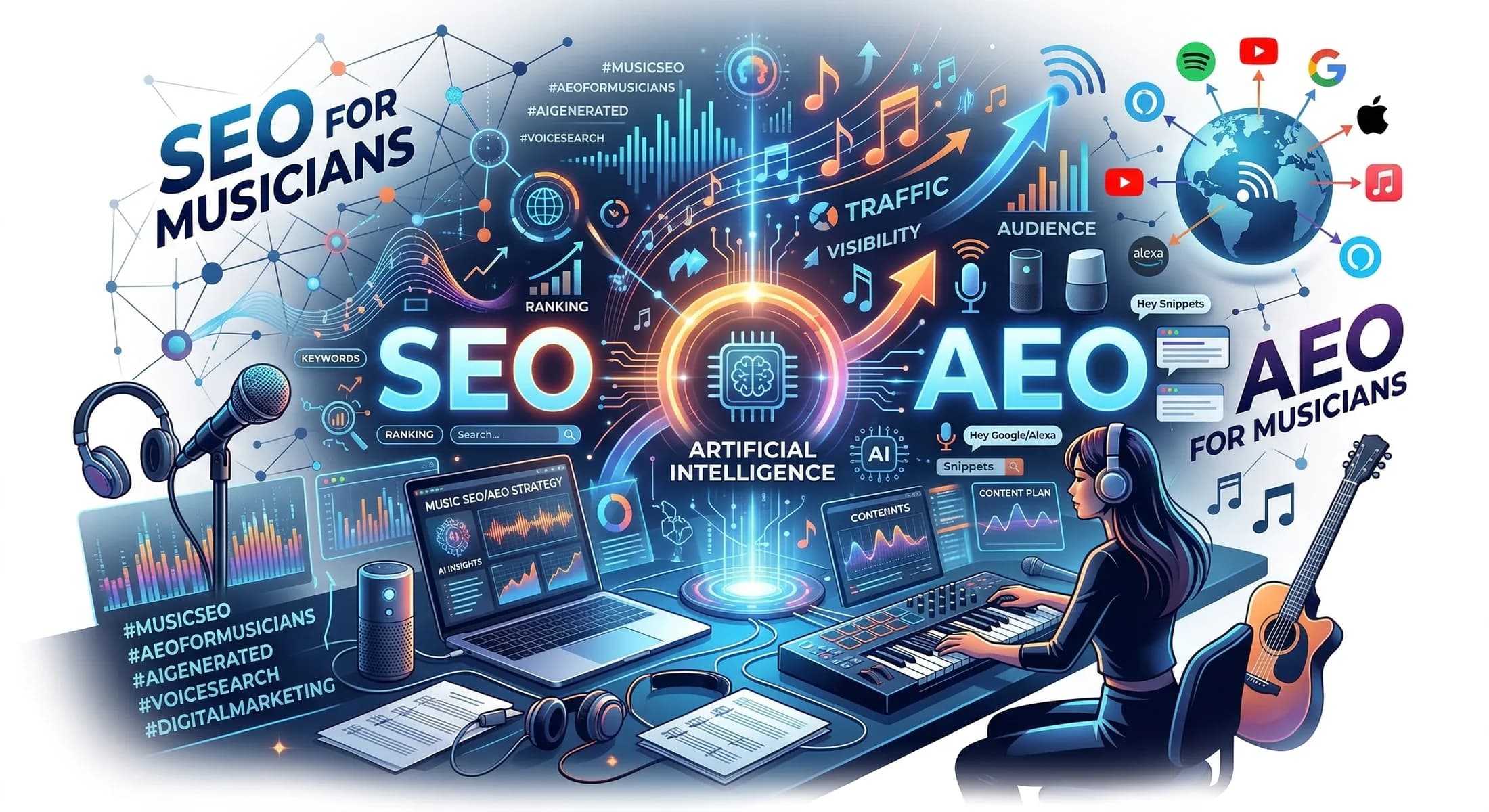
AEO stands for Answer Engine Optimization — optimisation for answer engines. While traditional SEO aims to position your page in search results, AEO aims to get your page cited as a source in AI-generated answers.
When someone asks ChatGPT "Which wedding bands are there in the Lake District?", the AI doesn't show a list of links. It gives a text response, with names, descriptions and sometimes links. If your name doesn't appear in that answer, for that couple you're practically invisible.
GEO — Generative Engine Optimization — is the broader concept: optimising your entire site so that AI systems understand it, consider it trustworthy and cite it when generating responses.
For a musician, the distinction is this:
- Traditional SEO: appearing on Google when someone searches "wedding band Manchester"
- AEO/GEO: being cited by ChatGPT when someone asks "Which bands would you recommend for a wedding in the North West?"
Both matter. But AEO is new, less well known, and for that reason represents a competitive advantage for those who act now.
The 3 differences between traditional SEO and AI search
1. SEO rewards keywords. AEO rewards direct answers.
On Google, you optimise titles, meta descriptions and keyword density. On ChatGPT and Perplexity, what matters is how clearly you answer the questions couples are actually asking.
Practical example. Instead of writing:
We provide musical services for private events and ceremonies.
Write:
We play at weddings across the North of England. The standard package includes 3 x 45-minute sets, PA system and lighting, starting from £1,200.
The second sentence is extractable. An AI can take it and use it in a response. The first is too vague.
2. SEO looks at backlinks. AEO looks at content authority.
Backlinks still matter, but AI systems also evaluate how much your content is cited, shared and referenced elsewhere. If you're mentioned on industry portals, wedding blogs, or if your reviews are numerous and detailed, AI systems consider you more credible. Our guide to collecting reviews on Google and wedding directories explains how to build a review strategy that AI systems recognise as authoritative.
3. SEO is for machines. AEO is for machines that read like humans.
AI systems don't scan your site looking for keywords. They read it to understand what you're about, how expert you are, and whether you can be a reliable source. This means that content structure — questions, answers, concrete examples — matters more than keyword density.
How to optimise your website to be cited by AI
Page structure: questions and answers
Every page on your website should answer specific questions that couples are asking. Use section headings as natural questions:
- H1: Wedding Band in [Your City/Region]
- H2: How much does a wedding band cost?
- H2: What musical genres do you play?
- H2: How long have you been playing together?
- H2: What happens if a musician is ill on the wedding day?
Under each H2, give a direct answer in the first 40–60 characters. Then expand with detail.
Example:
How much does a wedding band cost?
Prices start from £1,200 for a trio and go up to £3,500 for an eight-piece lineup. The price includes PA system, lighting and 3 x 45-minute sets.
This structure is easily extractable by AI. When someone asks "How much does a wedding band cost?", your answer has a strong chance of being cited.
Schema markup: the language AI understands
Schema markup is code you add to your website to explicitly tell AI systems what each piece of content represents. It's like labelling your content: "this is the price", "this is the review", "this is the author."
The most useful schema types for a musician are:
- MusicGroup — describes the band, members and genres
- LocalBusiness — contact information, service area, hours
- Service — description of services offered with pricing
- Event — upcoming concert or wedding dates
- Review — client reviews
- FAQPage — frequently asked questions with answers
If you use WordPress, plugins like RankMath or Schema Pro add these automatically. If you have a custom site, ask your developer to implement them.
"About us" page: experience and authority
AI systems evaluate E-E-A-T — Experience, Expertise, Authoritativeness, Trustworthiness. Your "About us" page is where you demonstrate these qualities. Don't write:
We're a passionate band that loves to play.
Write:
We've been playing together since 2015. We've performed at over 200 weddings across the country. Our musicians studied at conservatoire level and have honed their live performance through professional masterclasses.
Then add:
- Photos of the members with short bios
- Logos or mentions of publications that have featured you
- Concrete numbers (years of activity, weddings played, reviews received)
Services page: extractable details
AI systems love concrete data. On your services page, include:
- Prices — even just a range ("from £1,200 to £3,500")
- Duration — "3 x 45-minute sets"
- Geographic coverage — "London, South East, East Anglia"
- Equipment included — "PA system, lighting rig, dedicated sound engineer"
- Repertoire — "over 300 songs spanning pop, rock, soul and Motown classics"
Each data point is a hook that AI systems can use to answer specific questions.
Google Business Profile: the non-negotiable baseline
Even if you're targeting AEO, Google remains the first point of contact for many couples. Google Business Profile (formerly Google My Business) is free and gets you appearing in local searches and on Google Maps.
What to fill in:
- Business name — use the band name, don't stuff keywords into it
- Category — "Musician" (primary), "Wedding service" or "Entertainment agency" (secondary)
- Service area — cities and regions where you perform
- Hours — even if variable, indicate a general availability window
- Photos — at least 10 professional photos (live shots, backstage, with couples)
- Services — detailed list of what you offer
- Website — link to your homepage or a dedicated weddings landing page
Reviews: the single most important factor for local ranking. Ask every couple to leave a review after the wedding. Always respond — including to negative reviews — with a professional tone.
Posts and updates: Google rewards active profiles. Post once a month with a photo from a recent wedding, an upcoming date or a live video clip.
Wedding directories: why they still matter
Hitched, Bridebook, The Knot, WeddingWire and other aggregator directories are authoritative sources for AI systems. When an AI looks for information about wedding bands, these directories are among the first sources it consults.
Being listed has two advantages:
- Direct visibility — couples find you on the directory
- Authority signal — AI systems see that you're referenced by credible sources
How to optimise your profile:
- Fill in every field — don't leave sections blank
- Use professional photos — no selfies, no blurry shots
- Write a detailed description — include location, genres, lineup options
- Collect reviews — the more the better
- Update regularly — active profiles get shown more often
Note: not all directories allow external links to your website. Even without a link, simply being present counts as an authority signal.
Online reviews as a trust signal for AI and clients
Reviews don't just persuade couples. They persuade AI systems that you're reliable.
Where to collect reviews:
- Google Business Profile
- Wedding directories (Hitched, Bridebook, Matrimonio.com, etc.)
- Facebook (less important, but useful)
- Trustpilot (if your site has significant traffic)
How to ask for reviews:
Don't say: "Leave us a review."
Say: "If you enjoyed working with us, could you leave us a Google review? It helps other couples find us. Here's the direct link: [link]"
Detailed reviews are worth more. A review that says "Great band, highly recommended" is less useful than one that says:
We booked [Band Name] for our wedding in Tuscany. They played during the ceremony, the drinks reception and the dancing. The repertoire was varied and they read the room brilliantly. Professional, punctual and discreet. Highly recommended!
AI systems extract concrete details from reviews like this. Generic ones don't give them much to work with.
Video and multimedia: the signal AI systems prefer
AI systems increasingly weight video content. YouTube is the world's second-largest search engine, and videos appear more and more often in AI responses and Google results.
What to do:
- Upload performance videos to YouTube with descriptive titles ("Wedding band Manchester - First dance couple")
- Add subtitles to videos (AI systems read the text)
- Write detailed descriptions with natural keywords
- Embed videos on your website (increases dwell time)
A well-optimised video can be cited by ChatGPT when someone asks "wedding bands with demo videos".
NAP consistency: the detail that makes the difference
NAP stands for Name, Address, Phone. AI systems verify that this information is identical across:
- Your website
- Google Business Profile
- All wedding directories
- Social media pages
- Local directories
If your phone number differs on Hitched compared to your website, AI systems (and Google) lose trust. Check and standardise everything.
Practical checklist: what to do this week
Here's a list of concrete actions you can take in the next 7 days:
Days 1–2: Website
- Rewrite your homepage with a direct answer to "What do you do?" in the first 40 characters
- Add a FAQ section with 5–7 questions and concrete answers
- Include prices (even just a range) on the services page
- Add schema markup (use RankMath or ask your developer)
Days 3–4: Google Business Profile
- Fill in every field on the profile
- Upload 10 professional photos
- Ask 3 recent couples to leave a review
- Publish a post with a photo from a recent wedding
Days 5–6: Wedding directories and video
- Update your profile on Hitched, Bridebook or other directories where you're listed
- Add recent photos
- Ask couples from the last 6 months for reviews
- Upload a video to YouTube with optimised title and description
- Check NAP consistency across all online profiles
Day 7: Monitoring
- Search your name on Google — what comes up?
- Ask ChatGPT "Which wedding bands are there in [your region]?" — are you mentioned?
- Look for any negative reviews — respond professionally
How BandCalendar helps
AEO rewards those with structured, up-to-date and traceable content. BandCalendar isn't an SEO tool, but it helps you build the documentary foundation that AI systems value.
Quotes and contracts. Every quote and contract is archived and organised. If a couple asks "What are your cancellation terms?", you can answer precisely — and that answer can become content for your FAQ page.
Setlists and repertoires. The structured repertoire in BandCalendar can be exported and used to create dedicated pages on your website ("Our 300 wedding songs") — extractable content for AI systems.
Reviews and feedback. The post-event feedback form helps you collect detailed reviews, which you can then publish on your website or on Google.
Professional documents. Clear quotes, complete contracts, tracked communications: all of this contributes to building the authority that AI systems evaluate.
It's not AEO directly. It's the operational foundation that lets you create AEO-friendly content without wasting time.
The bottom line
AEO isn't a trick. It's a paradigm shift in the way people find information. For musicians working in weddings — a market where research is thorough, in-depth and done months in advance — being cited by AI isn't optional.
You don't need to become an SEO expert. You need to structure your content so that AI systems understand it. Questions and answers, concrete data, detailed reviews, presence on authoritative sources.
The couple who searches for you on ChatGPT in two years' time won't find whoever has the most beautiful website. They'll find whoever answered their questions best.
Be that musician.
Related BandCalendar workflows
Explore the connected features
Solo musicians
BandCalendar helps solo musicians and freelancers manage gigs, clients, quotes, contracts, repertoires, documents, payments, reminders and history without scattering information across phone, email and spreadsheets.
Open pageDocuments and media
Organize PDFs, riders, contracts, quotes, images, audio, video, versions and public links in a cloud archive connected to clients, events, collaborators, lineups and projects, with contextual upload dialogs, PWA offline and controlled collaborator visibility on the event.
Open pagePrivate events
BandCalendar helps musicians, bands and small ensembles manage private parties, corporate events, receptions and custom bookings with clients, quotes, contracts, timings, venues, documents and payments always connected.
Open pageBand management software
What band management software needs: calendar, CRM, quotes, click-to-accept contracts, setlists, documents, collaborators, Finances and fees.
Open pageStop wasting time with Word, PDFs and spreadsheets.
- Contracts, payments, events, all in one place
- Designed for concerts, private events, weddings and tours
- Free up to 60 MB, no credit card required
Get one useful guide a month