Band Transport and Equipment: Who Brings What, Who Pays, Who Drives
Overloaded van, forgotten cables, arguments about who drives: logistics can ruin a gig before it even starts. Here's how to get organised.
March 20, 2026 · BandCalendar
The loading chaos
It's Saturday afternoon. The gig is at 9pm. At 5pm the band meets up to load the van.
"Who's bringing the PA?" "I thought you were." "But I brought it last month!" "Where are the cables?" "Does anyone have the vocal mic?" "Is Marco's van big enough?"
Half an hour later, they're still standing in the car park arguing. Someone has to go home to get the amp they forgot. The van is overloaded and the instruments are at risk. Soundcheck gets skipped. The gig starts late. The client is annoyed.
This scene is more common than you'd think. On musician forums, threads about logistics and equipment are among the most frequent. Who brings what, who pays for fuel, who's responsible if something breaks. Without organisation, every gig turns into a scramble.
The typical logistics problems in bands
1. Nobody knows who has what
In many bands, equipment belongs to individual musicians. One person owns the PA, another has the cables, another has the lighting stands. The problem starts when there's no shared inventory.
What happens: On the day of the gig, someone realises something essential is missing. "I thought you were bringing it." "I left it at home because I assumed it was already there." Too late to fix.
How to avoid it: Keep an up-to-date inventory of all the band's equipment, noting who owns what and where it's normally kept.
2. The van is always too small
"Will we all fit?" "If we push it in, it'll go." "But the amps will get damaged like that."
Transporting equipment requires space and organisation. Fragile instruments, heavy amplifiers, cables that tangle into knots: if the van is overloaded or badly packed, something will break.
What happens: You arrive at the venue and discover a speaker took a knock and isn't working. Or worse: an instrument broke in transit and the gig is in jeopardy.
How to avoid it: Use a van that's appropriate for the load. Pack with a system: heavy and bulky items first, lighter ones on top. Secure everything to prevent shifting.
3. Who drives? Who unloads?
Driving a van full of equipment takes concentration. Loading and unloading takes strength and time. Without clear rules, one person ends up doing everything while the others watch.
What happens: The same willing musician always ends up driving, loading and unloading alone. The others turn up, play and leave. After a few gigs, the person who does everything gets tired and resentment sets in.
How to avoid it: Rotate the tasks. At each gig, a different person drives, a different person handles loading. Alternatively: financially compensate whoever takes on extra responsibility.
4. Who pays for fuel and hire?
The van belongs to one of the band's musicians. Who pays for fuel? What if the van breaks down? What if you need to hire a bigger vehicle for a gig further away?
What happens: The van owner pays everything out of their own pocket. After a few months, they realise they've spent hundreds of pounds with no reimbursement. The others aren't aware of the real costs.
How to avoid it: Set a clear rule from the start: fuel is shared between everyone, or it's deducted from the gross fee before dividing it up. If a hire vehicle is needed, that's a shared expense.
5. The forgotten checklist
Every gig requires specific equipment: microphones, cables, stands, amplifiers, lights. Without a checklist, it's easy to forget something.
What happens: You arrive at the venue and the main vocal mic is missing. Or the cables for the amps. Or the lighting rig. The gig goes ahead with last-minute workarounds.
How to avoid it: Have a standard checklist for each type of event. Tick off every item during loading and again during unloading.
What clients expect from your logistics
Clients — especially those at weddings and corporate events — don't see the logistics. They only see the result. If the band arrives late, if soundcheck is skipped, if something doesn't work during the performance, the client notices.
A wedding planner summed it up well:
When a band arrives organised, with everything they need and ready for soundcheck at the agreed time, you can tell they're professional. When they turn up late, with missing equipment or things forgotten, your first thought is: if they're this sloppy about logistics, what are they going to be like with the music?
Logistics isn't just an internal band matter. It shapes how professional you look to your client.
How BandCalendar solves logistics problems
BandCalendar isn't just a management tool for events and setlists. It includes dedicated sections for managing vehicles and equipment in an organised, trackable way.
Equipment section with full inventory
In BandCalendar you can register every piece of the band's equipment:
- Name and description (e.g. "Full PA system", "Mercedes Sprinter van")
- Owner — who physically owns the equipment
- Category — audio, lighting, instruments, cables, etc.
- Status — available, in use, under maintenance, damaged
- Notes — useful details (e.g. "Needs a 5-metre XLR cable", "Maximum load 8 people")
Each piece of equipment can be assigned to one or more events. When you assign equipment to an event, you know exactly who will bring it and whether it's available on that date.
Vehicles section with automatic assignment
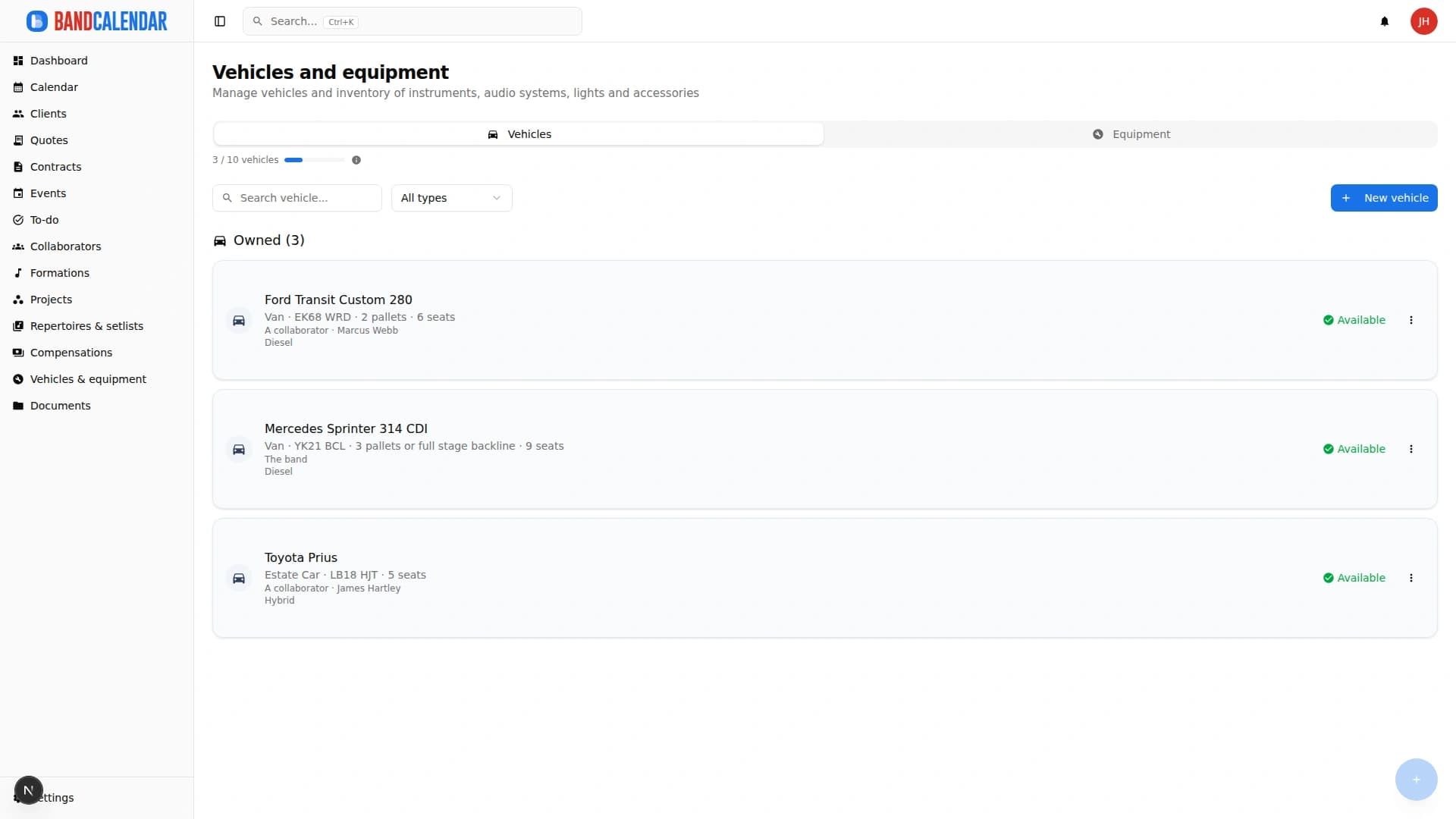
The Vehicles section lets you register:
- Registration and model of the vehicle
- Owner — who owns it
- Capacity — number of seats and load volume
- Availability — when the vehicle is free or already assigned
When you create an event, you can assign a specific vehicle. The system alerts you if that vehicle is already booked for another event on the same date — preventing last-minute conflicts.
Loading and unloading checklist
For each event, BandCalendar automatically generates a checklist based on the assigned equipment:
- Before departure: tick off each item as you load the vehicle
- On arrival: verify everything arrived undamaged
- After the event: tick off as you unload and put everything away
The checklist is accessible to all team members assigned to the event. If something is missing, everyone can see it immediately.
Automatic conflict alerts
BandCalendar automatically checks for scheduling conflicts:
- Vehicle already assigned: if you try to assign the same vehicle to two events on the same date, the system alerts you
- Equipment unavailable: if a piece of equipment is already assigned to another event or is under maintenance, you receive an alert
- Overload: if you assign more equipment than the assigned vehicle can carry, the system warns you
These alerts prevent mistakes before they happen — not after, when it's too late.
Equipment history
Every piece of equipment has a usage history:
- Which events it was used for
- Who transported it
- Any damage or maintenance reported
- Hire or repair costs
This history is useful for tracking wear and tear, planning maintenance and calculating the real costs of each event.
Real cases from the forums
Here are some typical scenarios:
Case 1 — The forgotten PA
"There are six of us. One person was supposed to bring the PA. When we arrived at the venue, we found out they'd left it at home. 'I only remembered when I was loading up,' they said. We had to hire a system at the last minute — extra cost of £200. Who pays?"
Solution: Have a checklist and a designated equipment manager for each event. Before leaving, verify that everything is loaded.
Case 2 — The overloaded van
"Our drummer has a small van. We loaded everything in anyway: drum kit, amps, PA. During the journey, a speaker fell over and broke. Nobody had secured it."
Solution: Use a vehicle that's appropriate for the load. Always secure heavy equipment. Don't cut corners to save time.
Case 3 — The fuel that never got reimbursed
"I've been using my own van for two years. I've spent over £1,500 on fuel. Nobody has ever reimbursed me a penny. The others say: 'But you're playing too, it's for the band.'"
Solution: Set a clear rule from the very beginning. Fuel is shared between everyone, or it's deducted from the gross fee before dividing it up.
The essential transport checklist
Before every event:
- Check the assigned equipment — verify on BandCalendar what's needed for that event
- Confirm who's bringing what — every item on the checklist must have an owner
- Check the vehicle — is it available? Is it big enough? Does it have enough fuel?
- Load methodically — heavy items first, lighter ones on top. Secure everything to prevent shifting
- Tick off the checklist — verify every item as you load
- On arrival, check for damage — make sure nothing broke in transit
- After the event, unload and store — tick off the checklist as you unload
- Report any damage immediately — if something broke, log it in BandCalendar straight away
The bottom line
Logistics isn't glamorous. It's not part of the show. But it's fundamental. An organised band arrives on time, prepared and professional. A disorganised band arrives late, with things missing and problems to solve.
The difference isn't musical ability. It's organisation.
With BandCalendar you can manage vehicles, equipment and checklists in one place. You assign each piece to an event, check availability, avoid conflicts and forgotten items. So you can focus on the music — not on hunting for cables.
If you want to stop arguing about who brings the PA and who drives the van, BandCalendar is built exactly for that.
Related BandCalendar workflows
Explore the connected features
Documents and media
Organize PDFs, riders, contracts, quotes, images, audio, video, versions and public links in a cloud archive connected to clients, events, collaborators, lineups and projects, with contextual upload dialogs, PWA offline and controlled collaborator visibility on the event.
Open pageConcert bands
BandCalendar helps concert bands, tribute bands, entertainment agencies, promoters and live-entertainment companies manage gigs, tours, venues, changing lineups, setlists, technical documents, logistics, fees and reimbursements in one workspace.
Open pageEvent calendar
An operational calendar for musicians and bands that connects sales pipeline, clients, gigs, rehearsals, tasks, reminders, lineups, documents, Excel export and personal Google Calendar and Apple Calendar/iCloud sync.
Open pageStop wasting time with Word, PDFs and spreadsheets.
- Contracts with simple electronic signature and tracked communications
- All confirmations in writing, no verbal-only agreements
- Protected reputation: everything in black and white
Get one useful guide a month